15
Adjustments and settings
Dierential feed
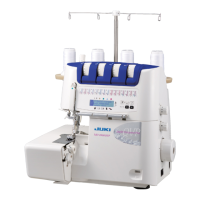
There are two feed dogs one front (C) and one rear (D). The two feed dogs
move independently and the distance each feed dog travels during one
complete movement can be adjusted. The dierential feed prevents uting
or waving in knitted or stretch fabrics and movements between the layers of
fabric. It also ensures pucker-free seams in smooth fabric such as nylon or
closely woven fabric.
Perfectly at seams in knits or stretch fabrics.
The distance travelled by the front feed dog should be greater than that of
the rear feed dog. The front feed dog, therefore, feeds an amount of fabric
which the rear feed dog can take up behind the needle without stretching
the fabric. (E)
Pucker - free seams in nylon or closely woven fabrics.
The distance travelled by the rear feed dog should be greater than that of
the front feed dog. The front feed dog, therefore, holds the fabric back so
that the rear feed dog can take it up behind the needle without any pucker-
ing. (F)
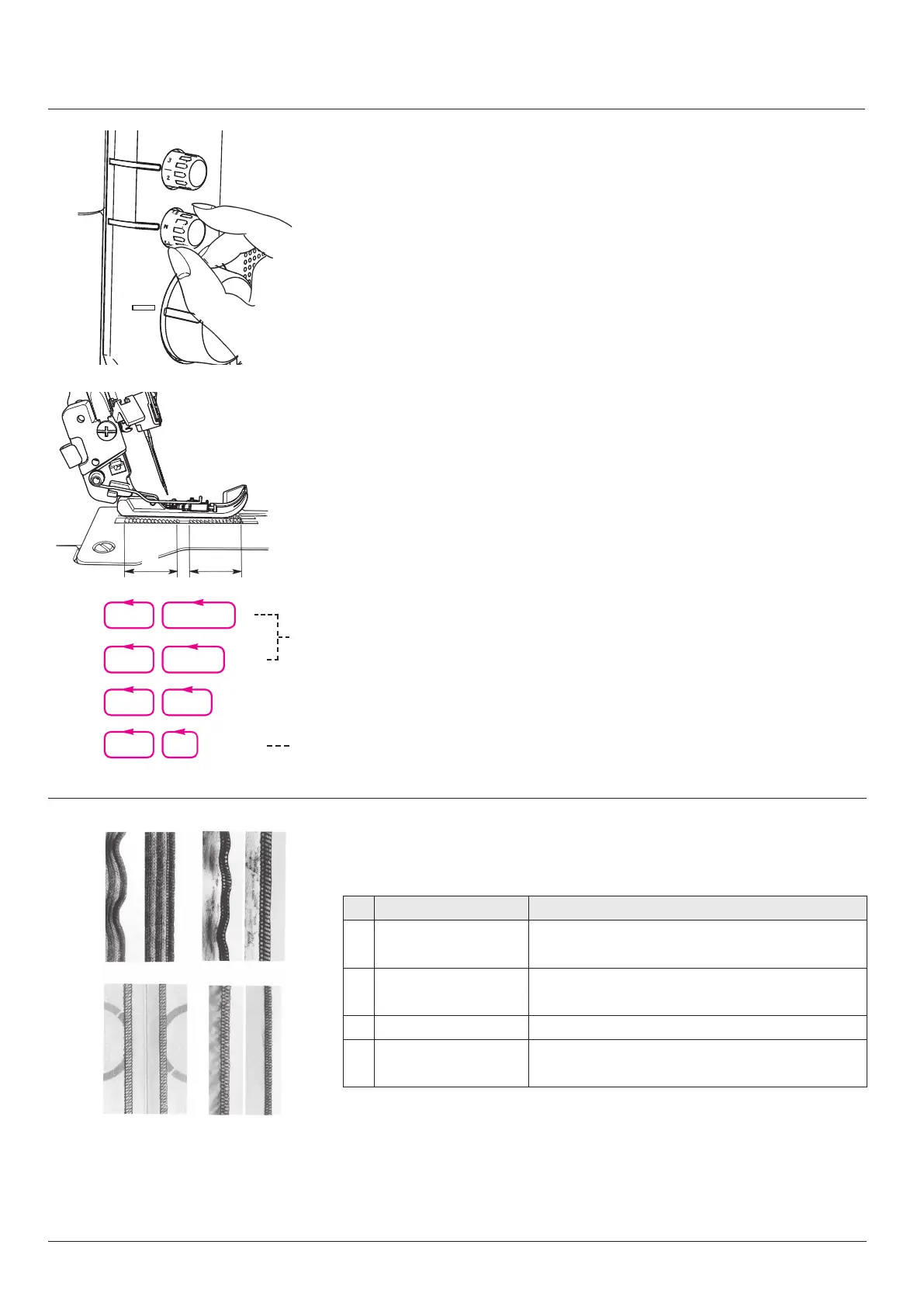
Adjusting the dierential feed
The dierential feed can be adjusted by simply turning the dierential feed
adjustment dial in the direction desired. Always make a trial run. The dierential
feed is innitely variable and can be adjusted while sewing.
Adjusting the dierential feed
Simply turn the dial in the direction desired for fully variable adjustment
while sewing. Test sew.
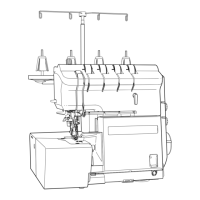
G H
JI
Eect Fabric
2 Wave-free seams (G) Thick wool knits, hand knitted articles, very
stretchy fabrics
1.5 Wave-free seams (H) Cotton, silk, synthetic jersey, sweatshirt fabrics
and ne knits
N Normal feed (I) Woven fabrics
0.7 No puckering (J) Fine nylon jersey, closely woven fabrics, lining
fabric satin, poplin
2
1.5
N(1)
0.7
E
F
D
C


 To Next Page