EasyManua.ls Logo

JVC CA-S200 - Standard Recording

JVC CA-S200
27 pages
Print Icon
To Next Page IconTo Next Page
To Previous Page IconTo Previous Page
Loading...
What
can
you
record?
Tapes
«Radio
-CDs
Microphone
Connected
source
Copyright
Reduce
hiss—Dolby
NR
Recording
level
Erasure
protection
Recording
sound
mode
Usable
tape
type
Standard
recording:
Any
source
to
tape
Source
to
tape:
Step
by
step
Page
13
Recording
Recording
onto
cassette
tape
from
any
of
the
sound
sources
is
easy
and
the
CA-S200
does
most
of
the
work.
Just
have
a
tape
in
deck
B,
have
the
source
ready,
make
one
or
two
settings,
and
you’re
ready
to
record.
For
each
source
the
procedure
is
a
little
different
and
now
we’
ll
explain
just
what
to
do
for
each
one.
If
you
forget,
just
go
back
to
the
section
which
has
the
specific
procedures
you
need.
But
first,
here
are
a
few
things
to
make
your
recordings
better.
Things
to
Know
before
You
Start
Recording:
Q
It
may
be
unlawful
to
record
or
playback
copyrighted
material
without
the
consent
of
the
copyright
owner.
.
Q)
Press
DOLBY
B
NR
—the
indicator
lights
up—
to
reduce
tape
hiss,
except
when
dubbing
tapes
since
Dolby
NR
is
inactive
in
dubbing
mode
regardless
of
the
setting
of
DOLBY
B
NR.
The
dubbed
tape
automatically
contains
the
same
processing
as
the
source
tape.
Q
The
recording
level,
which
is
the
volume
at
which
the
new
tape
is
being
made,
is
automatically
set
correctly,
so
itis
not
affected
by
the
VOLUME
control
on
the
CA-S200.
Thus,
you
can
adjust
the
sound
you
are
actually
listening
to
without
changing
the
recording.
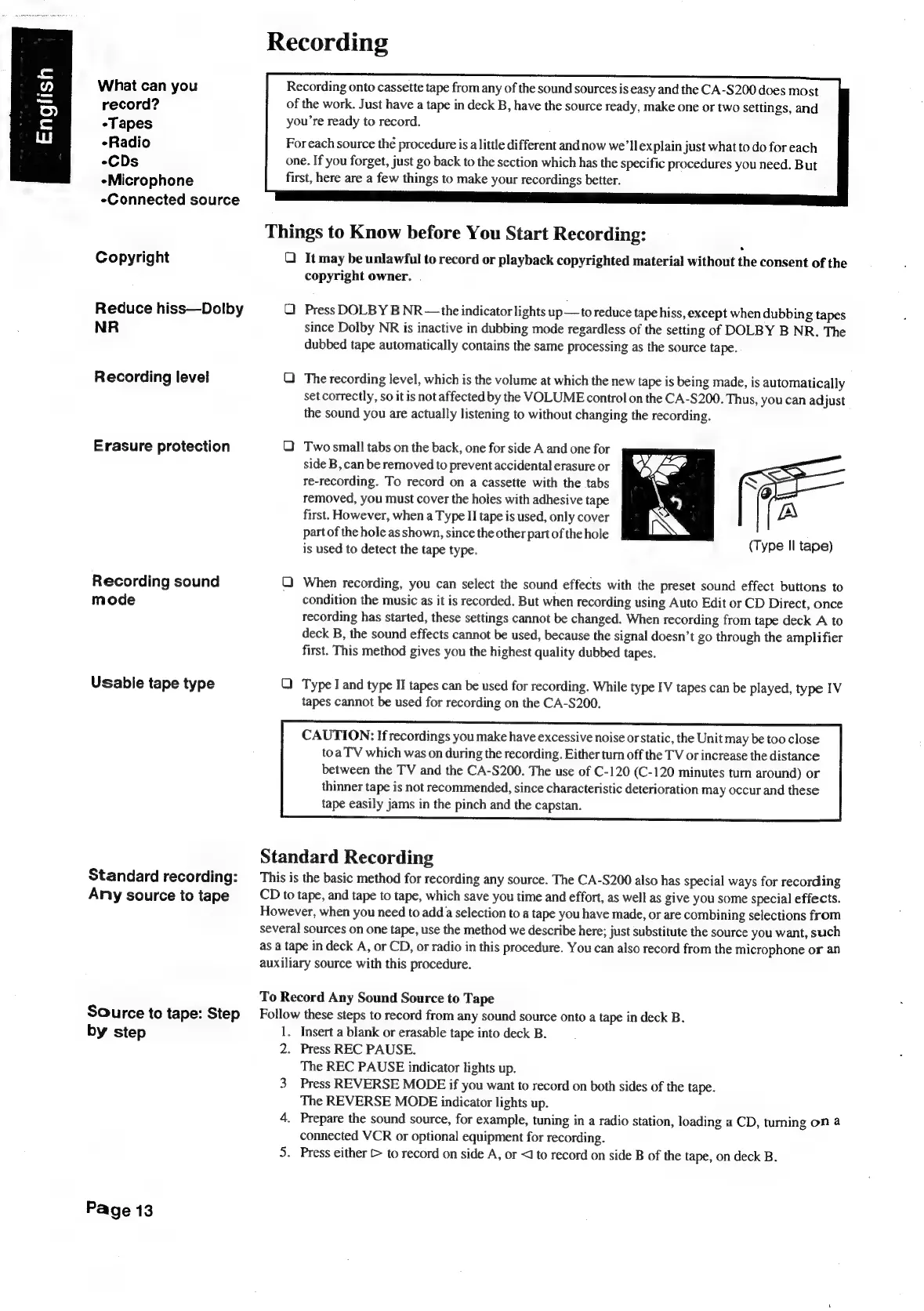
Q
Two
small
tabs
on
the
back,
one
for
side
A
and
one
for
mannan
side
B,
can
be
removed
to
prevent
accidental
erasure
or
Y
L~4
re-recording.
To
record
on
a
cassette
with
the
tabs
a
@)
removed,
you
must
cover
the
holes
with
adhesive
tape
4
A
first.
However,
when
a
Type
II
tape
is
used,
only
cover
IW
part
of
the
hole
as
shown,
since
the
other
part
of
the
hole
is
used
to
detect
the
tape
type.
(Type
Il
tape)
Q
When
recording,
you
can
select
the
sound
effects
with
the
preset
sound
effect
buttons
to
condition
the
music
as
it
is
recorded.
But
when
recording
using
Auto
Edit
or
CD
Direct,
once
recording
has
started,
these
settings
cannot
be
changed.
When
recording
from
tape
deck
A
to
deck
B,
the
sound
effects
cannot
be
used,
because
the
signal
doesn’t
go
through
the
amplifier
first.
This
method
gives
you
the
highest
quality
dubbed
tapes.
Q
Type
I
and
type
II
tapes
can
be
used
for
recording.
While
type
I'V
tapes
can
be
played,
type
IV
tapes
cannot
be
used
for
recording
on
the
CA-S200.
CAUTION:
If
recordings
you
make
have
excessive
noise
or
static,
the
Unit
may
be
too
close
toa
TV
which
was
on
during
the
recording.
Either
turn
off
the
TV
or
increase
the
distance
between
the
TV
and
the
CA-S200.
The
use
of
C-120
(C-120
minutes
turn
around)
or
thinner
tape
is
not
recommended,
since
characteristic
deterioration
may
occur
and
these
tape
easily
jams
in
the
pinch
and
the
capstan.
Standard
Recording
This
is
the
basic
method
for
recording
any
source.
The
CA-S200
also
has
special
ways
for
recording
CD
to
tape,
and
tape
to
tape,
which
save
you
time
and
effort,
as
well
as
give
you
some
special
effects.
However,
when
you
need
to
adda
selection
to
a
tape
you
have
made,
or
are
combining
selections
from
several
sources
on
one
tape,
use
the
method
we
describe
here;
just
substitute
the
source
you
want,
such
as
a
tape
in
deck
A,
or
CD,
or
radio
in
this
procedure.
You
can
also
record
from
the
microphone
or
an
auxiliary
source
with
this
procedure.
To
Record
Any
Sound
Source
to
Tape
Follow
these
steps
to
record
from
any
sound
source
onto
a
tape
in
deck
B.
1.
Insert
a
blank
or
erasable
tape
into
deck
B.
2.
Press
REC
PAUSE.
The
REC
PAUSE
indicator
lights
up.
3
Press
REVERSE
MODE
if
you
want
to
record
on
both
sides
of
the
tape.
The
REVERSE
MODE
indicator
lights
up.
4.
Prepare
the
sound
source,
for
example,
tuning
in
a
radio
station,
loading
a
CD,
tuming
on
a
connected
VCR
or
optional
equipment
for
recording.
5.
Press
either
>
to
record
on
side
A,
or
<J
to
record
on
side
B
of
the
tape,
on
deck
B.

Table of Contents

Related product manuals