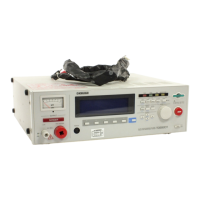
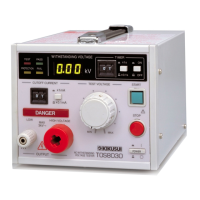
6-6 TOS5051A/5050A
6.1.5 Setting the Test Voltage
This procedure is to set the test voltage (output voltage of the tester) to be applied to
the DUT.
• To get the stable test voltage (output voltage), the tester should be connected to
the stable AC power supply. From the tester's internal circuit configuration of
view in the AC withstanding voltage test, the output voltage is affected by fluctua-
tions of the AC power supply.
Setup procedure
1. Turn OFF the lower pass/fail judgment function by pressing the UP/
LOW key while holding down the SHIFT key.
The “LOWER ON” message will disappear.
2.
Turn OFF the timer function by pressing the ON/OFF key.
The “TIMER ON” message will disappear.
3.
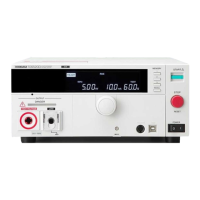
Check that the TEST VOLTAGE control is in the “0” position (fully coun-
terclockwise) and that the tester is in the READY status (status that the
“READY” message appears). Then, press the START switch.
4.
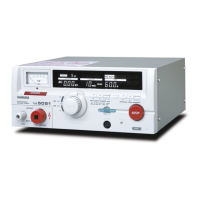
Monitoring the output voltage on the analog voltmeter or VOLTAGE
readout, raise the output voltage to the desired value by turning gradu-
ally the TEST VOLTAGE control clockwise.
5.
Press the STOP switch to cut off the output voltage.
6.
Turn ON the timer function by pressing the ON/OFF key.
The “TIMER ON” message will appear.
7.
If you need the lower pass/fail judgment function also, press the UP/
LOW key while holding down the SHIFT key.
The “LOWER ON” message will appear.
6.1.6 Connecting the DUT
Connection Procedure
1. Be sure that the analog voltmeter indicates “0” volt.
2.
Be sure that the DANGER lamp has turned OFF.
3.
Be sure that the “READY” message has appeared.
4.
Connect the low test lead to the LOW terminal.
5.
Connect the high test lead to the HIGH VOLTAGE terminal.
6.
To check that the high output voltage is not being delivered, short-circuit
the low test lead and high test lead.
7.
Connect the low test lead to the DUT.
8.
Connect the other end of the high test lead to the DUT.
NOTE


 To Next Page