TOS8030 Panel Operations 37
5.3.2 Connection to the DUT
Follow the procedure described in “3.3.1 Connecting the Test Leads”
(page 20).
5.3.3 Starting the Test and Making Judgments
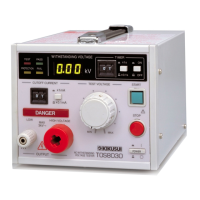
To start the test:
Move the TIMER switch to the ON position.
Press the START switch when the tester is in the READY state.
When a PASS judgment is made
When the time set by the timer has elapsed, the test voltage is shut off, causing a
PASS determination to be returned. The PASS judgment is indicated in three ways:
the PASS lamp lights, the buzzer sounds, and a PASS signal is generated.
The PASS state is indicated only briefly (approx. 200 ms), after which the tester
immediately enters the READY state.
If a FAIL judgment is returned
If a leakage current exceeding the reference value flows through the DUT during
testing, the test voltage is shut off, causing a FAIL determination to be returned. The
FAIL judgment is indicated in three ways: the FAIL lamp lights, the buzzer sounds,
and a FAIL signal is generated.
The FAIL state is held until the STOP switch is pressed.
To stop the test:
To stop testing (shut off the output) for any reason after testing begins, press the
STOP switch.
The following test types are also possible.
It is possible to conduct testing in which the test voltage is gradually increased from
0 V without using the timer. Note that, when setting test voltages of more than
5 mA, testing is subject to output time limitations. For more information, see “Foot-
note *1” in “9.1 Basic Specifications” (page 46).
Re-application of test voltage (re-testing)
As long as the tester is in a READY state, testing can be repeated under the current
test conditions simply by pressing the START switch.
■ Before disconnecting the test leads from the DUT
Confirm that high voltage is not being output, referring to “3.3.3 Checking Safety
after Shutting off the Output” (page 23).


 To Next Page