ADD FURNACE CO.,LTD.
44 ซอยบรมราชชนนี
โทร: 02-888-3472 โทร: ออกแบบ:08-08-170-170 แฟกซ์: 02-888-3258
https://www.add-furnace.com E-mail: sales@add-furnace.com
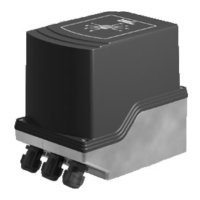
IC 40 function
4 .8 Inputs
4 .8 .1 Digital
In the basic setting, the two digital inputs operate as
universal inputs. If a voltage of 24 V DC or 100 – 230 V AC
is applied to the input, this is recognized as “On” signal
(positive logic).
Switching logic
The switching logic can be inverted for each individual
digital input. An applied voltage is then recognized as
“Off” signal
while no voltage results in an “On” signal (negative
logic). Inversion of the input switching logic in
conjunction with the operating modes provides new
options for defining the behaviour of the actuator.
4 .8 .2 Analogue
The actuator can approach corresponding intermediate
positions via a current signal to the additional input. This
function can be used only if an actuator IC 40 with 4 – 20
mA analogue input is connected (option). The switch-on
and switch-off threshold of the analogue input is defined
at approx. 3 mA.
The assignment of current value to position can be freely
de-fined via 5 pairs of values (interpolation points).One
position which the actuator approaches when the
corresponding current signal is applied can be assigned
to each of the interpolation points at 4, 8, 12, 16 and 20
mA. The position is interpolated on the basis of a linear
function in each case between the interpolation points.
In the case of operating modes 25 and 26, 2
characteristic curves, each with 5 interpolation points,
can be defined. In this case, the digital inputs define
which characteristic curve currently applies. This allows
the same current signal to be used to run through two
different capacity ranges, for example for lambda
adjustment or for hot-air compensation, see page 47 (2-
point operation with characteristic curve switchover
I) and see page 49 (2-point operation with characteristic
curve switchover II).
Filtering and hysteresis of the current signal
In order to suppress noise of the current signal, the
analogue input is sampled equidistantly every
millisecond and a mean value is generated over 0.1 s.
This filtering can be prolonged up to 1 s in the case of a
very poor input signal. However, this also prolongs the
response time to a change at the analogue input.
The current input (4 – 20 mA) operates internally with a
resolution of 10 bit (corresponding to 0.1% of the
actuator). This allows the analogue input to detect a
change of 0.02 mA (hysteresis).If the input signal
fluctuates too greatly (owing to noise for instance), this
high resolution results in constant corrections of the
actuator and butterfly valve (when mounted onto BVA,
BVAF, BVG, BVGF, BVH or BVHS). Consequently, the
hysteresis may be increased to up to 0.2 mA. The
resolution in this case is reduced down to 1% of the
actuator accordingly. The maximum resolution is always
set in each case as the basic setting. 57


 To Next Page