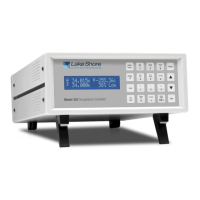
Lake Shore Model 332 Temperature Controller User’s Manual
8.10.4 Analog Output Calibration
Overview
The Model 332 has one analog output which requires calibration. Zero offset and gain errors are
calibrated out by programming offset and gain constants to the instrument.
Calibration Process
8.10.4.1 Analog Output Calibration
Purpose
To determine the analog output offset and gain errors and provide offset and gain calibration
constants back to the Model 332. Configure the analog output for a maximum output capability of
10 W, refer to Paragraph 8.7. Once calibrated, the analog output may be configured for a maximum
output of 1 W without requiring re-calibration.
Process
1. Reset the calibration constants to their default values using the CALRSTZ and CALRSTG
commands.
EXAMPLE:
Zero Offset Reset Command: CALRSTZ V,1
Gain Reset Command:
CALRSTG V,1
2. Connect the 100 kΩ resistor to the analog output. Connect the positive lead of the DMM to the
analog output positive terminal, the negative lead is connected to the analog output negative
terminal.
3. Set the analog output to manual mode, bipolar mode on, manual output of –100 %. Read the
output voltage with the DMM to a tolerance of ±0.0010 VDC and record this negative full scale
(–FS) value.
4. Determine the offset calibration constant by dividing the –FS value by 10, adding 1, and then
negating the result.
5. Use the
CALZ command to send the offset calibration constant.
EXAMPLE:
–FS DMM Reading: –10.0564
Offset Constant Calculation: -((-10.0564/10) + 1) = 0.00564
Calibration Command:
CALZ V,1,0.00564
NOTE: Be careful to use the formula described above and not use the same process that
calibrates the zero offset of the inputs.
6. Set the analog output to +100 %. Read the output voltage with the DMM to a tolerance of
±0.0010 VDC and record this positive full scale (+FS) value.
7. Determine the gain calibration constant by negating the –FS reading obtained in Step 3 and
adding the +FS reading to the result and then dividing that number into 20.
8. Use the
CALG command to send the gain calibration constant.
EXAMPLE:
+FS DMM Reading: 10.0432
–FS DMM Reading: –10.0564
Gain Constant Calculation: 20/(10.0432+10.0564) = 0.99504
Calibration Command:
CALG V,1,0.99504
9. Send the CALSAVE command to save the constants in the E
2
prom.
Service 8-17


 To Next Page