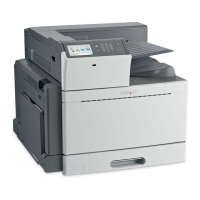
Lexmark C925/X925 Color Product Study Guide Rev 2.3
For Training Purposes Only 6/21/2011
12
Theory of Operation
Electrophotographic Process
This color laser printer uses the Electrophotographic process (EP Process) to image toner onto the media
via a tandem (in-line) system. This system contains four color cartridge assemblies (cyan, yellow,
magenta, and black). The Electrophotographic Process steps are as follows:
• Charge – each Photoconductor Drum surface is evenly charged with electricity from the
Charge Roll (located inside the photoconductor unit assembly) by the HVPS board,
• Expose – each Printhead (LED) exposes the photoconductor with light and creates a Latent
Image on the surface by partially discharging the area exposed. In this printer, each color
has its own LED printhead to expose the four color stations,
• Develop – toner from the Developer Roll (located in the developer unit assembly) adheres to
the latent image on the surface of the photoconductor. This happens because of a difference
in charge potential between the two surfaces,
• 1
st
Transfer – an electrical charge is sent to each of the four 1
st
Transfer Rolls inside the
Transfer Belt. Due to the difference in charge potential, toner is transferred from the
Photoconductor Drum to the surface of the Transfer Belt as it passes each color station,
• 2
nd
Transfer – media is picked from the tray and passes between the 2
nd
Transfer Roller and
Transfer Belt surface. A positive charge is sent to the 2
nd
Transfer roller and toner jumps to
the media due to the charge difference,
• Fuse – the media is carried to the fuser where the toner is bonded permanently to the page
by heat and pressure,
• Clean/Erase – a cleaning blade for each Photoconductor Drum and one for the Transfer Belt
clean residual toner from the surfaces of those components. Waste toner is deposited into
the Waste Toner Box. This printer does not have erase lamps.
If a component fails, it is important to recognize at which step the failure took place. By knowing this, you
can determine the source of the problem. Understanding the EP Process is the key to troubleshooting
print quality problems.
The following page illustrates the EP Components in a cross-sectional of a C925/X925 printer. A more
detailed cross-sectional is found later in this section.



 To Next Page