Need help?
Do you have a question about the LG V-NET ACS PREMTA000 and is the answer not in the manual?
Safety guidelines for product installation procedures.
Safety precautions to follow during product operation.
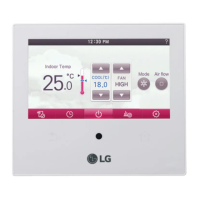
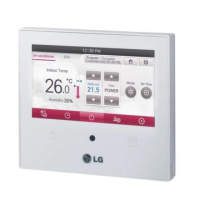
Details of the remote controller's physical parts and interface.
List of included accessories with the product.
How to turn the air conditioner and ventilator on or off.
Operating the unit to maintain cooling comfort.
Performing strong cooling in a short period.
Operating the unit to provide warm air.
Removing moisture from the air.
Region-specific dehumidification for monsoon areas.
Circulating air without heating or cooling.
Automatic operation to satisfy space requirements.
Automatic temperature management with heating and cooling.
Setting and adjusting the desired indoor temperature.
Adjusting the speed of the fan for airflow.
Adjusting the direction of air flow.
Turning the unit on or off.
Maintaining proper cooling comfort.
Performing strong cooling in a short period.
Providing warm air to the space.
Removing moisture from the air.
Region-specific dehumidification for monsoon areas.
Circulating indoor air only.
Automatic operation to satisfy space requirements.
Automatic temperature management with heating and cooling.
Setting and adjusting the desired indoor temperature.
Viewing the current indoor room temperature.
Adjusting the fan speed.
Adjusting the direction of air flow.
Adjusting the angle of the air flow vanes.
Improving indoor air quality with plasma purification.
Enhancing energy saving performance during cooling.
Reinforcing heating performance with electric heater.
Setting fan operation after thermal control.
Automatic filter cleaning function.
Enabling operation of an optional ventilation kit.
Enabling humidifier for space comfort.
Radiating frequency to deter mosquitoes.
Cooling function related to Himalayan climate.
Saving energy while maintaining comfort.
Switching between air conditioner and ventilation modes.
Selecting ventilation modes for the product.
Using heat exchanger for ventilation during cooling/heating.
Controlling the fan speed for ventilation.
Performing ventilation quickly.
Performing energy-saving function during ventilation.
Setting a simple reservation timer.
Setting a sleep mode or stop time.
Scheduling the unit to turn on automatically.
Scheduling the unit to turn off automatically.
Creating and editing weekly schedule patterns.
Deleting a specific scheduled event.
Deleting existing 7-day schedule patterns.
Copying and pasting events between days of the week.
Setting weekly schedule events.
Setting yearly schedules by month.
Deleting a yearly schedule.
Setting automatic stop on a specific date.
Adding a scheduled holiday event.
Deleting a scheduled holiday event.
Viewing energy usage (operation time, power consumption).
Setting daily amount target usage for energy.
Setting a limit on the product's operation time.
Saving energy by controlling operation time.
Setting popup notices for consumption or time restrictions.
Resetting energy and time usage information.
Preventing unauthorized operation by locking controller buttons.
Locking the temperature setting beyond a preset value.
Checking filter status and when to change it.
Operating the elevation grill for filter cleaning.
Automatic filter cleaning for the product.
Drying the inside of the unit after cooling operation.
Automatically switching between cooling and heating.
Changing wireless module to AP mode.
Selecting zone names for control.
Setting a default time for timed override.
Applying a set temperature when in home leave mode.
Maintaining a difference between heating and cooling temps.
Activating ventilation after a preset delay time.
Setting the current date displayed on the controller.
Setting the current time displayed on the controller.
Setting a password to prevent unauthorized changes.
Showing or hiding elements on the default screen.
Adjusting the brightness of the standby screen.
Adjusting screen stay-on time before turning off.
Initializing all timer settings of the remote controller.
Choosing whether to use touch screen sound effects.
Changing displayed information on the home screen.
Setting unit of measure for temperature.
Choosing the local language for the display.
Setting the GUI type on the remote controller.
Setting summer time duration on the system date and time.
Checking and inputting the service center telephone number.
Registering and changing the service center number.
Checking indoor/outdoor unit type and capacity.
Checking remote controller model and software version.
Steps for mounting the remote controller on the wall.
Connecting and controlling multiple indoor units.
Controlling units when AC and ventilation are connected.
Procedure to access the installer setting mode.
Reference for installer setting codes and values.
Performing a test operation after product installation.
Setting fan speed step values for ESP.
Selecting the temperature sensor for indoor temperature.
Adjusting fan amount based on ceiling height.
Configuring master/slave settings for the remote controller.
Setting indoor units to master or slave mode.
Switching display between Celsius and Fahrenheit.
Setting the emergency heater function.
Selecting the setting temperature range option.
Setting minimum running time for outdoor unit cycles.
Restoring indoor unit operation after power failure.
Setting for simple dry contact unit installation.
 General
| Brand | LG |
|---|---|
| Model | V-NET ACS PREMTA000 |
| Category | Remote Control |
| Language | English |

 To Next Page