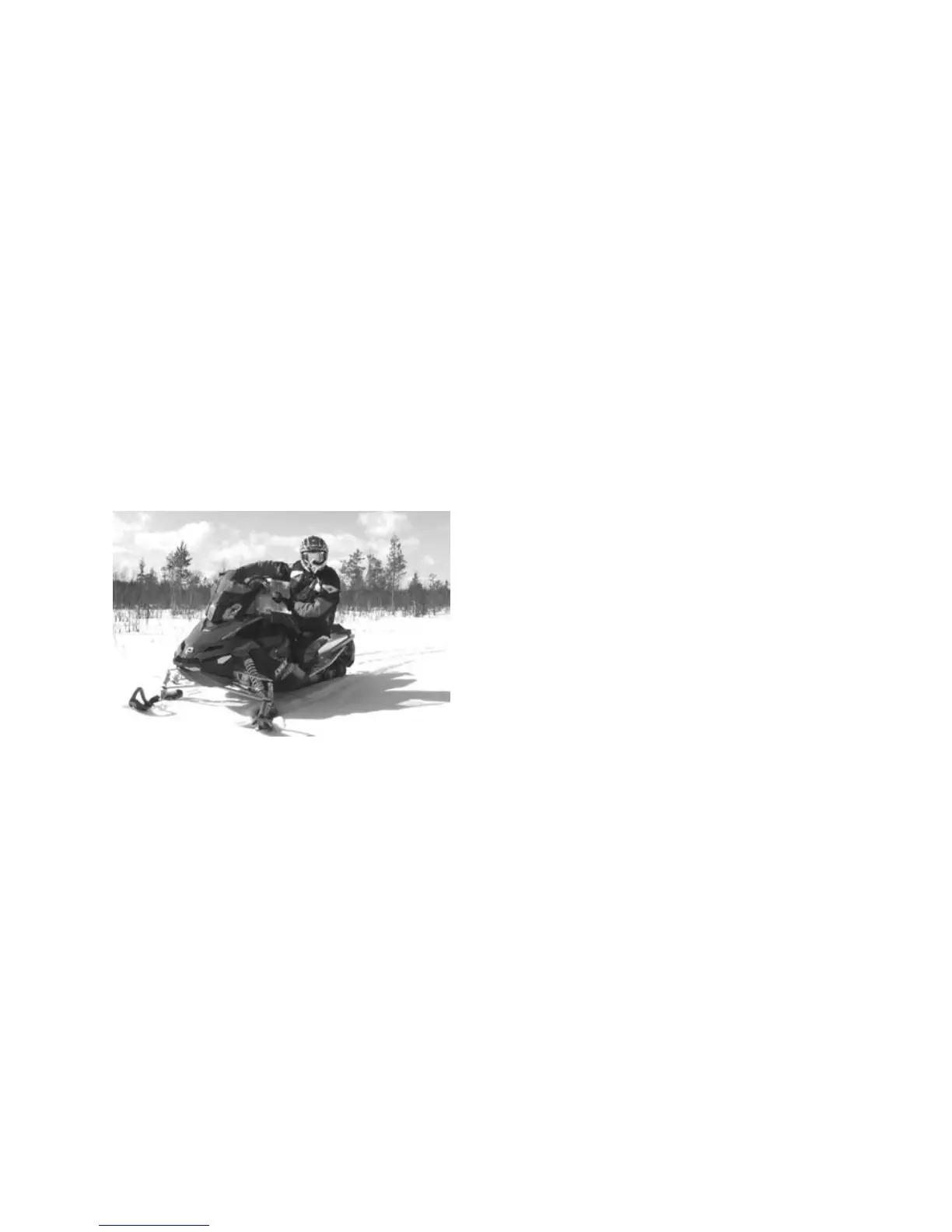
Turning
Depending on terrain conditions, there
are two preferred ways to turn or cor-
ner a snowmobile. For most snow
surfaces, “body english” is the key to
turning. Leaning towards the inside of
the turn and positioning body weight
on the inside foot will create a “bank-
ing” condition beneath the track. By
adopting t his position a nd positioning
yourself as far forward as poss ible,
weight will be tran sferred to the insid e
ski.
On oc cas ion, you will find that the on-
ly way to turn the vehicle about in
deep snow is to pull the sn owmob ile
around. Do not over-exert yourself.
Get assistance. Rememb er to always
lift using your legs as opposed to your
back.
Road Crossing
In some cases, you will be approach-
ing the road from a ditch or snowbank.
Choose a place where you know you
can climb without difficulty. Use the
standing position and proceed with on-
ly as much speed needed to crest the
bank. Stop completely at the top of
the b ank an d wait for all traf fic to clear.
Judge the drop to the roadway. Cross
the r oad at a 90° angle . If you en-
counter another snowbank on the op-
posite side, position y our feet near the
rear of the vehicle. Remember, your
snowmobile is not d esigned to oper-
ate on bare pavement and steering on
this type of surface is mor e difficult.
Railroad Crossing
Never rid e o n ra ilroad tracks . It is ille-
gal. Railroad tracks and railro ad rights-
of-way are private property. A snow -
mobile is n o match for a train. When
crossing a railroad track, stop, look and
listen.
Night R ides
The amount of natural a nd artificial
light at a given time can effect your
ability to see or to be seen. N ig httime
snowmobiling is d elig htful. It can be
a uniqu e experienc e if you ac knowl-
edge your reduce d vis ibility. Before
you start, make certain your lights
are clean and work properly. Drive
at speeds that will allow you to stop
in time when you see an unknown
or dangerous object ahead. Stay on
established trails and never operate in
unfamiliar territory. Avoid rive rs and
lakes. Guy wires, barbed wire fences,
cabled road entrances and other ob-
jects such as tree limbs are difficult
to see at night. Never drive alone.
Always carry a flashlight. Keep away
from residential areas and respect the
right of others to sleep.
20
______________________



 To Next Page