Code F07011709
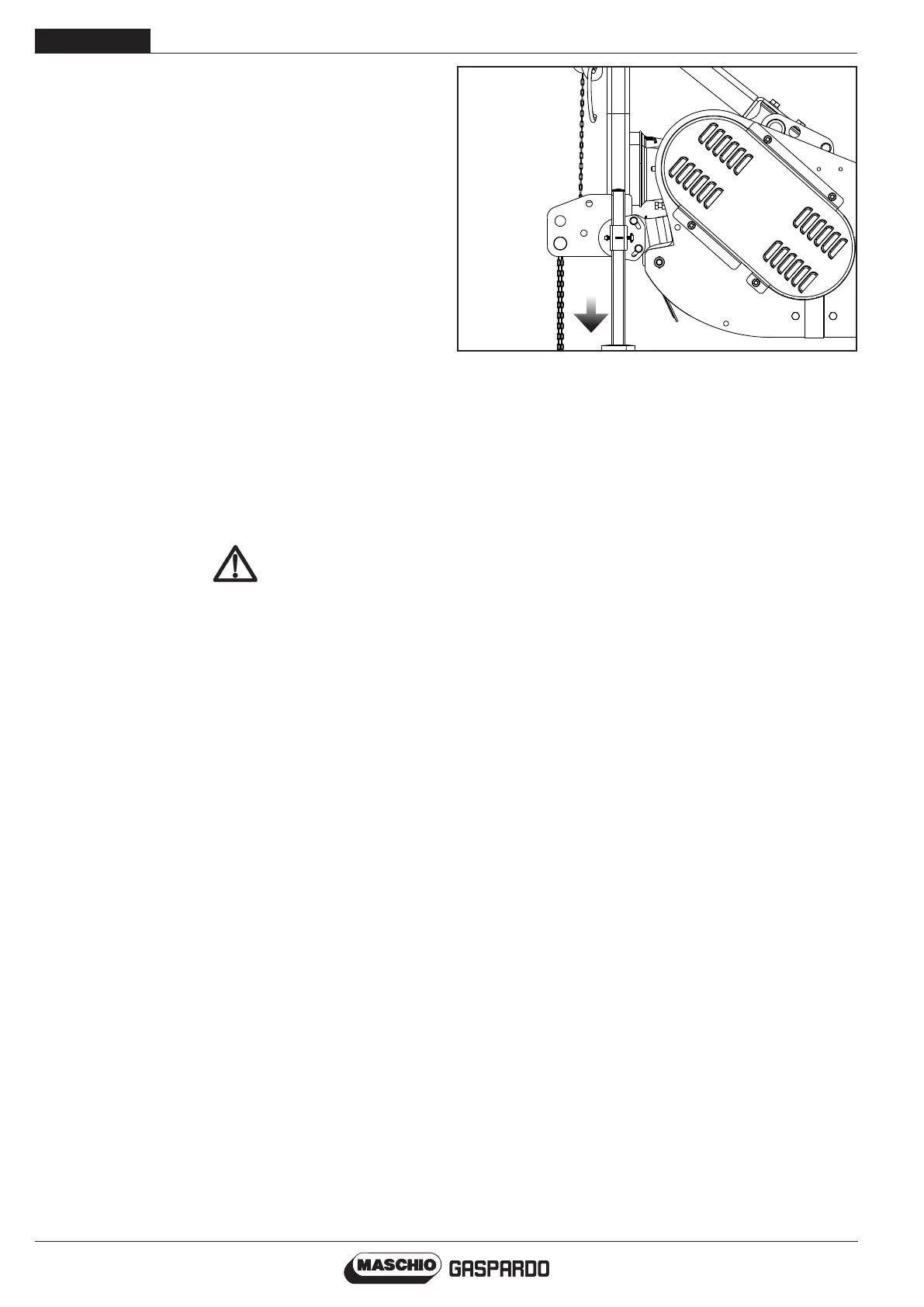
g.32
USE AND MAINTENANCE
ENGLISH
28
- Lower the machine to the ground.
- Make sure that machine is parked on a proper surface.
- Position the bearing stand as indicated in g.32 to
make the machine more stable.
5.0 MAINTENANCE
Here follows a list of various maintenance operations to
be carried out periodically. Lowered operating costs and
a longer lasting seeding machine depend, among others,
on the methodical and constant observation of mese rules.
The maintenance periods listed in this booklet are only
indicative and are for on normal conditions on use,
therefore be varied depending the kind of service, the
more or less dusty surroundings, seasonal factors, etc.
For more serious conditions of service, maintenance
will logically be done more often.
All operations must be carried out by expert personnel,
equipped with protective gloves, in a clean and dust-
free environment.
All maintenance operations must be carried out with the
machine hooked up to the tractor, the parking brake en-
gaged, the engine o, the ignition key removed and the
equipment sitting on suitable supports on the ground.
ATTENTION
USING OILS AND GREASES
- Before injecting grease, the nipples must be cleaned
to avoid mud, dustand foreign bodies from mixing with
the grease, otherwise they will reduce or even annul
the eect of the lubrication.
- Always keep oils and grease out of reach of children.
- Always read warnings and precautions indicated on
the containers carefully.
- Avoid skin-contact.
- After use wash the equipment thoroughly.
- Treat the used oils and polluting liquids in conformity
with the laws in force.
RECOMMENDED LUBRICANTS
- For lubrication in general, we advise: OIL SAE 80W/90.
- For all greasing points we advise: AGIP GR MU EP 2 GRE-
ASE or equivalent (specications: DIN 51825 (KP2K)).
CLEANING
- The products used for cleaning must be disposed of
according to the laws in force.
- Clean and maintain the machine after putting any removed
guards back in position. Replace them with new ones, if
they are damaged.
- Clean the electrical components only with a dry cloth.
USING PRESSURISED CLEANING SYSTEMS (Air/Water)
- Always keep in mind the rules that regulate use of
these systems.
- Do not pressure clean electrical components.
- Do not pressure clean chromium-plated components.
- Do not place the nozzle in contact with the parts of the
equipment, especially the bearings. Keep it at a min.
distance of 30 cm from the surface to be cleaned.
- Thoroughly lubricate the equipment, especially after clea-
ning it with pressurised systems.
HYDRAULIC SYSTEMS
- Hydraulic systems must be maintained exclusively by
skilled operators.
- The hydraulic system is under high pressure; because
of the accident risk, when searching for leakage points
special auxiliary instruments should be used.
- In case of participation on the hydraulic system, to un-
load the hydraulic pressure carrying all the hydraulic
commandos in all the positions some times after to
have extinguished the motor.
- Oil escaping at high pressure can cause skin injury
with the risk of serious wounds and infection. Call a
doctor immediately if such an incident occurs. If the oil
with surgical means is not removed quickly, can take
place serious allergies and/or infections. Therefore,
the installation of hydraulic components in the tractor
driver’s cab is strictly forbidden. All the components of
the system should be positioned carefully to avoid parts
being damage during use of the equipment.
- At least once a year have the hydraulic pipes checked for
wear by an expert.
- Replace the hydraulic pipes if they are damaged or worn
by aging.
- Replace the hydraulic pipes every 5 years even if they
have not been used (natural aging).
g.33 (R) shows hydraulic pipes bearing the year of ma-
nufacture as an example.
After the rst 10 hours of operation and then after every
50 hours, check that:
- all the elements of the hydraulic system are water-tight;
- all the joints are tight;
Before starting the machine up, check that:
- the hydraulic pipes are connected correctly;
- the pipes are positioned correctly, and they are free to
move during standard manoeuvres;
- any damaged or worn part is replaced, if necessary.
Replace the hydraulic pipes in the following cases:
- when external damage is identied such as cutting, tearing
and wear due to friction, etc.;



 To Next Page