GMK Sphere Calipered Kinematic Alignment Surgical Technique
18
VERIFICATION CHECK
At 0°of flexion varus/valgus laxity should be minimized and
native knee and limb alignments should be restored. The
medial and lateral gaps should be equally stable when
applying the varus-valgus stress, which restores both a
tight rectangular extension gap and the compartment
forces like the native knee.
CAUTION
If 1 or 2 mm washers were used in combination with the
4in1 block, an equivalent laxity should be allowed when
evaluating the thickness of the tibial insert.
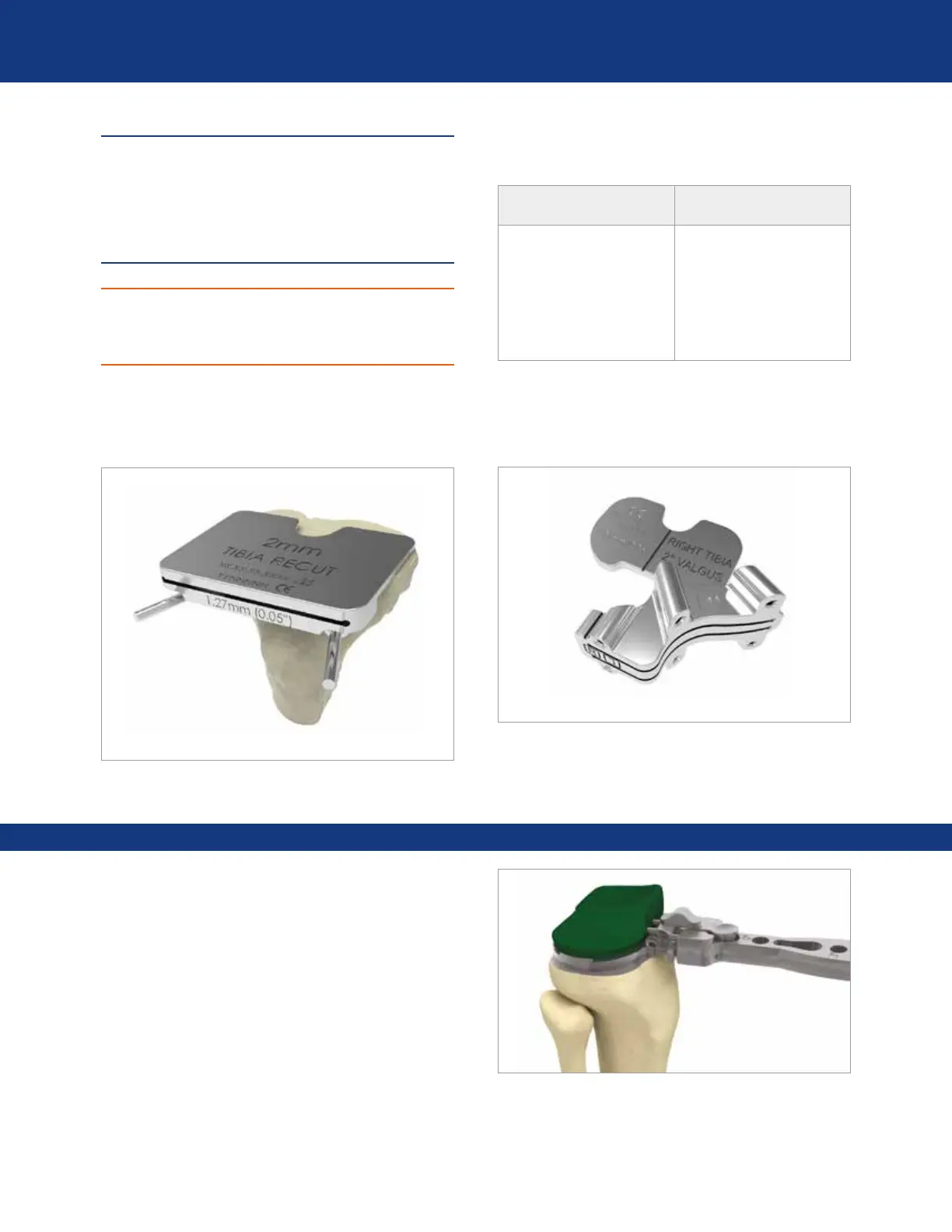
If necessary, a 2 mm recut can be performed through the
dedicated block. Position the block on the cut surface and
stabilize it inserting two pins in the fixation holes before
cutting.
37.
If a correction is needed to restore a tight rectangular gap,
follow the steps below.
TIGHT MEDIAL & LOOSE
LATERAL IN EXTENSION
TIGHT LATERAL & LOOSE
IN MEDIAL EXTENSION
Remove medial osteophytes.
Reassess.
Recut tibia in 1°- 2° more
varus.
Insert 1 mm thicker spacer.
Remove lateral osteophytes.
Reassess.
Recut tibia in 1° - 2°more
valgus.
Insert 1mm thicker spacer.
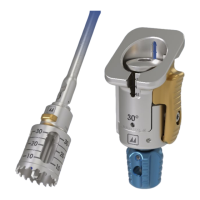
Varus and valgus adjustments of 2° can be performed
through the dedicated blocks. Position the appropriate
block on the cut surface and stabilize it inserting two pins
in the fixation holes before cutting.
38.
8. TRIAL REDUCTION
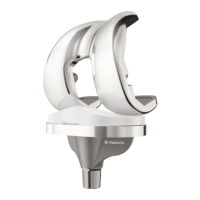
To position the tibial trial, attach the tibial trial insert of the
correct thickness on the appropriately sized tibial trial.
Connect the removable handle and place the tibial trial on
the tibial cut plane. The tibial baseplate is asymmetrical.
Rotate the baseplate until the best coverage of the tibial
cortical bone is achieved.
39.


 To Next Page