GMK Sphere Calipered Kinematic Alignment Surgical Technique
8
In cases of a 1 mm under-resection, refine the cut through
the slot of the distal cutting block.
Should a recut be necessary, use the repositioning holes to
move the distal cutting block proximally in 2 mm
increments. Before performing the recut, check the distal
cutting block position with an angel wing.
If one or both condyles have been over-resected by 1 or 2
mm, the correct joint line level is restored using dedicated
washers, as described in the next section.
TIP
Mark the number of millimeters of over-resection on each
distal femoral condyle with a pen as a reference for
selecting the correct washer.
4. ANTERIOR CUT, POSTERIOR CUT AND CHAMFER
Calipered kinematic alignment sets the femoral component
coincident to the posterior articular surface of the native
femur. Restoring the native posterior femoral line requires
compensation for cartilage wear when present.
Compensation for bone wear at 90° of flexion position is
rarely required on the osteoarthritic femoral condyle with
end-stage varus or valgus deformity.
Set the anterior-posterior translation and internal-external
rotation of the femoral component by placing the 0°
posterior referencing guide in contact with the posterior
femoral condyles.
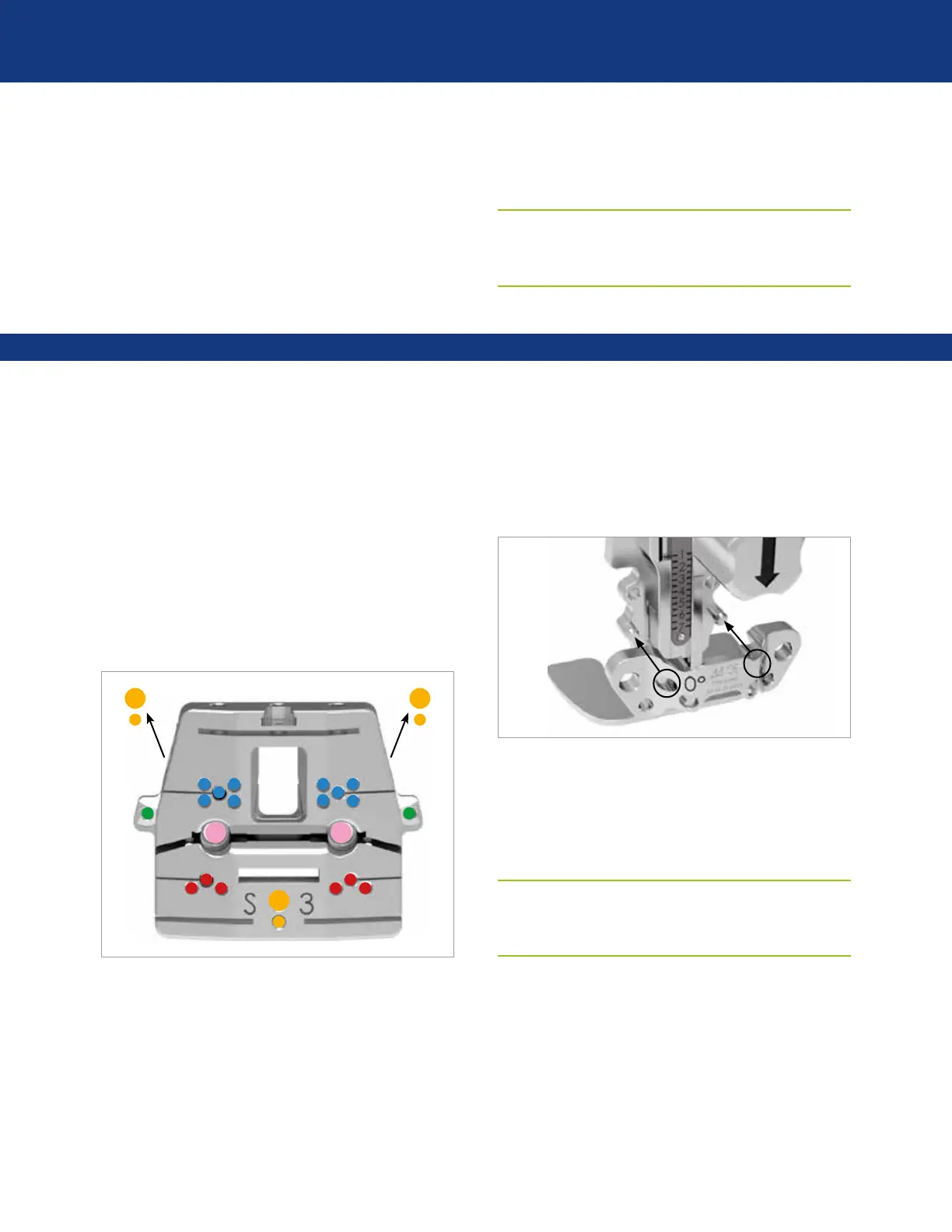
Use the 4in1 cutting block to perform the anterior, posterior,
and chamfer resections of the femur. All femoral resections
must be performed using a sawblade 13 mm wide with a
maximum thickness of 1.27 mm.
10.
4in1 cutting block holes
Parallel positioning holes (Posterior Referencing)
Parallel positioning holes (Anterior Referencing)
Handle holes
Oblique fixation holes
Cancellous bone screw holes
4.1 FEMORAL SIZING
A modular femoral sizer is available to position the 4in1
cutting block.
Select the 0° rotational guide. Slide the rotational guide
onto the driven pins to connect the rotational guide to the
posterior referencing femoral sizer. A ‘click’ will be heard
when it is fully engaged.
11.
The posterior referencing femoral sizer must be flush
against the cut edge of the distal femur. Both the posterior
condyles should be in contact to its base. The position of
the posterior referencing guide rarely requires correction
because it is uncommon for the posterior femoral condyles
to experience complete cartilage loss.
TIP
Insert an angel wing between the foot of the Posterior
Referencing Femoral Sizer posterior to the worn femoral
condyle when compensating for worn cartilage.


 To Next Page