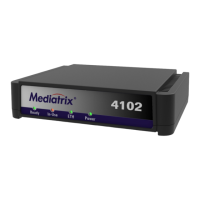
Need help?
Do you have a question about the Mediatrix 1104 and is the answer not in the manual?
Defines the target audience for the manual.
Outlines prerequisites and assumptions for device usage.
Explains the difference between Switched Circuit Network (SCN) and Public Switched Telephone Network (PSTN).
Lists other relevant documentation for the Mediatrix 1104.
Highlights new features or changes in the current version of the manual.
Describes a booklet for rapid setup and initial use of the Mediatrix 1104.
Details a manual containing all parameters within the MIB structure.
Explains symbols and conventions used throughout the document for clarity.
Warning about using the correct circuit breaker rating (120 VAC, 15A).
Warning that the device is designed for TN power systems.
Guidance on the proper disposal of the product according to national regulations.
Warning to use No. 26 AWG or larger telecommunication line cord to prevent fire risk.
Warning against connecting the LAN port to the PSTN or unauthorized equipment.
Warning to locate the socket outlet near the equipment for accessibility.
General guidelines for safe operation and handling of the equipment.
Details how end-users can obtain technical assistance for the product.
Illustrates various calling scenarios supported by the Mediatrix 1104.
Describes call routing between two Mediatrix 1104 devices.
Explains communication between a Mediatrix 1104 and a LAN endpoint.
Details call communication via an analog gateway to an SCN.
Explains how to dial other units directly using IP addresses.
Covers the procedures for initiating calls from the Mediatrix 1104.
Describes methods for indicating the completion of a dialed number sequence.
Guides on dialing standard and forced SCN calls using phone numbers.
Provides instructions for placing emergency calls.
Details the process of dialing other devices directly via their IP addresses.
Introduces fundamental telephony features available on the Mediatrix 1104.
Explains how to temporarily place an active call on hold.
Describes how to manage a second incoming or outgoing call.
Explains how call waiting alerts the user to incoming calls.
Details how to temporarily deactivate the call waiting tone.
Covers the procedures for transferring calls to other extensions or numbers.
Explains call transfer with consultation, requiring third-party answer.
Explains call transfer without consultation, where third-party answer is not needed.
Details the different types of call forwarding available.
Describes forwarding all incoming calls to another number.
Explains forwarding calls when the line is already in use.
Describes forwarding calls when there is no answer.
Explains how to set up and manage conference calls.
Lists the necessary conditions for successful conference calls.
Provides scenarios and steps for managing conference calls.
Explains how to use pre-programmed speed dial numbers.
Details how end-users can obtain technical assistance for the product.
Lists the various industry and regulatory standards the Mediatrix 1104 complies with.
Presents legal disclaimers related to the product's compliance and operation.
Details compliance with FCC Part 15 regulations for digital devices.
Details compliance with FCC Part 68 regulations for telephone network connection.
Describes compliance with Industry Canada telecommunications requirements.
Declares conformity with European Union essential requirements for the product.
Defines an area code and its role in telephone numbering plans.
Defines the code used for international direct telephone dialing.
Explains the multi-frequency signaling used in telephone systems.
Explains the action of briefly disconnecting and reconnecting a telephone line.
Defines the TCP/IP protocol for obtaining IP addresses.
Defines a network service connecting a local phone to a foreign exchange.
Defines a device connecting different network types using different protocols.
Defines the protocol for Internet addressing and message routing.
Defines a semiconductor diode that emits light.
Defines a data network confined to a limited geographic area.
Defines a group of interconnected computer systems.
Describes the line condition when a telephone handset is removed from its cradle.
Describes the line condition when a telephone handset is resting in its cradle.
Defines a group of bits transmitted as a package on a packet-switched network.
Defines rules and signals for computer communication.
Defines the public telephone network carrying voice data.
Defines a computer or device that works with a client.
Defines the protocol for transporting call setup and feature messages in IP domain.
Defines protocol for network management and monitoring.
Defines a communication network connecting users.
Defines ITU-T Recommendation for real-time fax over IP.
Defines the science of translating sound for transmission.
Defines protocols for connecting hosts and transmitting data.
Defines protocol for transferring files from a remote device.
Defines the technology for transmitting voice conversations over data networks.
Defines a computer network not geographically close.
Session Initiation Protocol.
Voice over Internet Protocol.
Dynamic Host Configuration Protocol.
Federal Communications Commission (USA).
 General
| Voice Ports | 4 |
|---|---|
| Ethernet Ports | 1 |
| Relative Humidity | 10% to 90% non-condensing |
| Ports | 4 FXS |
| Network Interface | Ethernet |
| Protocols | SIP, MGCP |
| Voice Codecs | G.711, G.729, G.723.1, G.726 |
| Operating Temperature | 0 to 40°C |
| Type | Gateway |


 To Next Page