2.7 Parameters, key <PARAM>
794 Basic Titrino
43
Relation between the stop criteria "time" and "drift"
The stop criterion "time", t(delay), means that the end point must be exceeded for a
certain period of time. In other words, after the last dosed increment, time t is allowed to
elapse before the titration is stopped. The size of this last increment depends on the
volume of the Exchange Unit used. With a 20 mL Exchange Unit, the smallest possible
increment is 2 µL. With a t(delay) = 5 s, the last 2 µL reagent must thus suffice for 5 s or
longer. This results in a drift of ≤ 2 µL/5 s = 24 µL/min (the drift can be less than 24
µL/min as it is not known whether the last increment would also suffice for 10 s). If you
have been working up to this point with a 20 mL Exchange Unit and a t(delay) = 5 s, you
can set a value of ≤ 24 µL/min as stop drift. The following table shows several values for
the maximum stop drift.
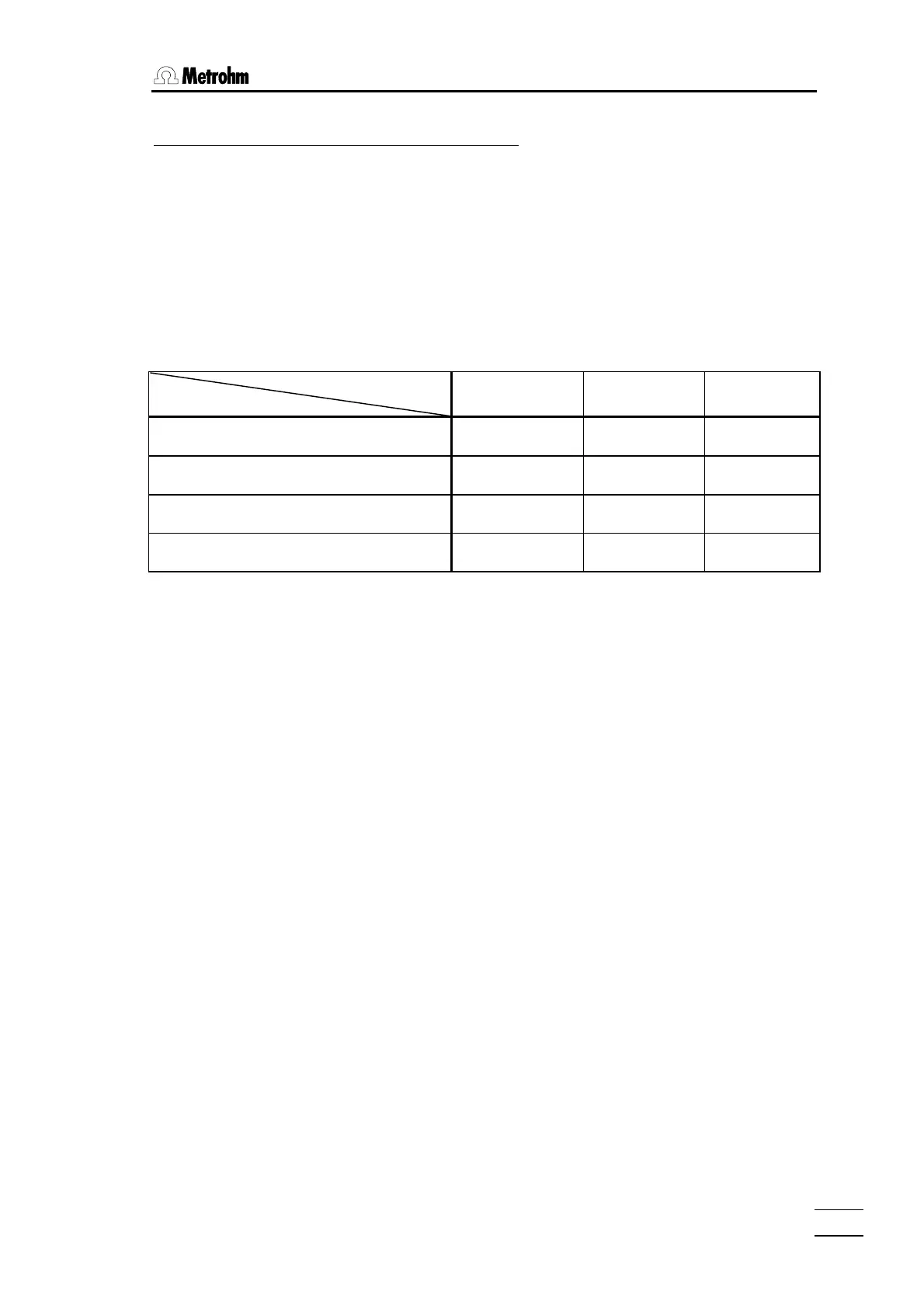
t(delay)
min.incr. (Exchange Unit)
5 s 10 s 20 s
0.5 µL (5 mL) 6 µL/min 3 µL/min 1.5 µL/min
1 µL (10 mL) 12 µL/min 6 µL/min 3 µL/min
2 µL (20 mL) 24 µL/min 12 µL/min 6 µL/min
5 µL (50 mL) 60 µL/min 30 µL/min 15 µL/min
Same t(delay) with a range of extremely small volume increments means different switch-
off points. In case the stop criterion "drift" is used, the stopping point remains the same.





 To Next Page