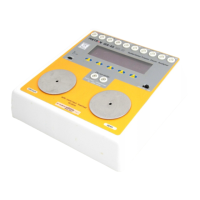
The METRON QA-1290 Non-Invasive Blood Pressure (NIBP) Analyzer is a precision instrument designed for trained service technicians to verify the performance of all types of adult and neonate oscillometric NIBP monitors. It operates in two stages: auto-calibration of the cuff and tubing to verify the NIBP monitor, followed by calibrated simulations under various conditions.
Function Description:
The QA-1290 provides dynamic performance testing using both real and simulated blood pressure waveforms. These waveforms include individual settings for systolic BP, diastolic BP, heart rate, and pulse volume/amplitude. It also simulates calibrated artifact and arrhythmias under a wide range of real-life conditions. The device offers high/low pressure release verification and automated leak testing. Additionally, it generates user-selectable pressure levels for calibrating various pressure monitors. The QA-1290 can be operated independently or connected to a PC via RS-232 for remote control and enhanced testing programs. It allows for the creation, storage, and retrieval of test templates and sequences, making it suitable for different equipment types at a facility. Test protocols with results can be printed or stored on disk, and the results can be sent to an equipment database to close a work order and update service history.
Important Technical Specifications:
- Simulations:
- Simulation technique: Oscillometric
- Calibration Tables used: DINAMAP, HP-Merlin
- Simulation repeatability: ±0.5 mmHg
- Heart Rate: 10-200 bpm, 1 bpm steps
- Heart Rate Accuracy: ±1 bpm @pps_2 mmHg
- Pulse Pressure: 0.05-5.00 mmHg
- Systolic/Diastolic Pressure: As shown in the preset pressures table (e.g., Adult: 60/30, 80/48, 100/65, 120/80, 150/95, 200/140, 255/195 mmHg; Neonate: 60/30, 80/48, 100/65, 120/80, 150/95, 200/140, 255/190 mmHg).
- Independent Systolic/Diastolic Settings: Systolic 20 to 255, Diastolic 5 to 220, Pulse Pressure 0.05 to 5.00.
- Preset Artifacts and Arrhythmias: Includes Bradycardia, Tachycardia, Geriatric, Obese, Strenuous Exercise, Mild Exercise, Weak Pulse, Premature Atrial Contraction, Premature Ventricular Contraction, 2nd Degree Heart Block, Atrial Fibrillation.
- Custom Patient Pattern Mode: An arbitrary patient pattern can be downloaded via RS-232 and Ansur software.
- Motion/Tremor Artifact: Available at all BP Start screens.
- Pressure / Leakage Measurements:
- Pressure Range/Accuracy: 0 to 500 mmHg automatic or manual inflation, Accuracy +/- 1mmHg.
- Units of pressure: mmHg, cmH2O, inH2O, PSI, kPa, mBar.
- Digital Readouts: Manometer, Start Pressure, Peak Pressure, Pressure Drop, Inflation Time and Leak Rate.
- Leak Rate Range: 1 to 500 mmHg/minute.
- Total Leak Measurement Time: 60 seconds (and each subsequent 60 seconds).
- General Information:
- Display/Control: Alphanumeric format: 4 lines, 40 characters. Display control: 7 F-keys and keypad.
- Data Input/Outputs (2): Parallel printer-port (1), Bi-directional 25-pin, Type Centronics. RS-232C (1), for Remote Control.
- Power: From 110 VAC to 240 VAC, 47/63 Hz.
- Housing: Aluminum.
- Weight (w/o batt.): 5.5 kg / 12.1 lb.
- Dimensions: Height: 9.5 cm / 4 in. Width: 30.0 cm / 11.7 in. Length: 27.0 cm / 11 in.
- Temperature Requirements: +18 °C - 35 °C / +64 °F - +95 °F while operating. 0 °C - +50 °C / +32 °F - 122 °F for storage.
- Part No: QA-1290 NIBP Analyzer (P.N. 17500).
- Standard Accessories: QA-1290 User & Service Manual (P.N. 17525), BP Cuff Mandrels - Adult (95 mm OD, 178 mm width) and Neonate (27 mm OD, 43 mm width), QA-1290 Tubing Kit (P.N. 17515) with various adapters (e.g., DINAMAP Luer, Luer Lock, HP-Merlin, Criticon/Marquette, VAC, 1/4" hose/barb, Baum (5/32" hose/barb), 1/8" hose/barb).
- Optional Accessories: QA-1290 Carrying Case (P.N. 17510), Ansur plug in for QA-1290 (P.N. 17520).
Usage Features:
- Simple Operation: High performance, compact design, and user-friendly interface.
- Comprehensive Testing: Performs a complete test including cuff and tubing.
- Preset Conditions: Large selection of adult and infant preset BP conditions.
- Customization: Programmable customized patient conditions.
- Artifact/Arrhythmia Simulation: Simulates real-life artifact and arrhythmia conditions such as Bradycardia, Tachycardia, Geriatric Patient, Obese Patient, Strenuous and Mild Exercise, Weak Pulse, Premature Atrial Contraction, Premature Ventricular Contraction, 2nd Degree Heart Block, Atrial Fibrillation.
- Manometer Functionality: Digital manometer with automatic or manual inflation of cuff pressure for Leak Test and Over Pressure Cut-off Test.
- Firmware Updates: Updates and enhancements of internal firmware via the RS-232 port.
- Connecting Devices: The QA-1290 connects to a printer via a 25-pin D-sub outlet port and to a PC via a 9-pin D-sub outlet port for remote control. Tubing from the NIBP Analyzer connects to the luer lock on the Inlet Port, while the cuff's tubing connects to the luer lock on the Cuff Port. The device has an internal fixed volume to simulate the cuff, allowing testing without an external cuff by connecting the inlet and cuff ports together and then to the monitor under test.
- Menu Navigation: The device uses a keypad with alphanumeric keys for data entry and function keys (F1-F7) for menu navigation and selecting functions. The display shows messages, test results, and function menus.
- Startup Sequence: Upon power-on, the QA-1290 displays boot software and firmware versions, performs a self-check, and prompts to zero the pressure before advancing to the Main Menu.
- Main Menu Options: From the Main Menu, users can access Equipment Code, Leak Test, BP Test, More (for additional options like Over-Pressure Cut-Off Test, Manometer, Print header/footer), and Setup.
- Configuring QA-1290: Setup screens allow users to configure operator, establishment, language, date, time, serial number, report page length, and firmware version. Pressure units for Manometer, Leak, and Overpressure testing can also be selected (mmHg, cmH2O, inH2O, PSI, kPa, mBar).
- Printing Results: After testing, a printed report can be generated, including a Print Test Header (facility, operator, device under test, QA-1290 setup), Print Test Footer (operator comments, signature), and Form Feed.
Maintenance Features:
- Required Equipment for Testing and Maintenance: Digital voltmeter (e.g., Fluke 87) and pressure calibration instrument (e.g., Druck DPI-601).
- Power Supply Checks: Connect +5.0 V and +24.0 V on P300. Measure the following voltages referenced to ground on T307: T300-T307 (+24.0 V ± 5%), T306-T307 (+5.0 V ± 5%), T301-T307 (+15.0 V ± 5%), T302-T307 (+12.0 V ± 5%), T303-T307 (-12.0 V ± 5%), T304-T307 (-5.0 V ± 5%), T305-T307 (+5.0 V ± 5%).
- Analog Ground Check: Verify that the analog and digital grounds on T307-T150 are tied together. The nominal value is 0 Ω ± 0.1 Ω.
- Reference Voltages Check: Inspect the following voltages referenced to ground on T150: T153-T150 (+5.0V ± 2%), T154-T150 (+12.1V ± 5%), T155-T150 (-1.2V ± 5%).
- A/D Converter Check: Measure the frequency of the oscillator on the A/D converter at T156. The nominal value is 4 MHz ± 20 kHz. Check the amplitude on the oscillator on T156. The nominal value is 5.0 V ± 0.5 V.
- Functional QA-1290 System Test: Connect signal- and power cables to the front board, step motor, compressor and valve. Turn on the power. Verify that the system runs and that the SW starts. Verify that the buzzer beeps when the system starts. Verify that the step motor first moves against the cylinder, then away from the cylinder on startup. Measure voltage over each valve control output: Valve 1 (24 V ± 5%), Valve 2 (23 V ± 5%), Valve 3 (23 V ± 5%). Enter the Leak Test menu and press INFLATE (F2), then DEFLATE (F2). Verify that the compressor starts on INFLATE and stops on DEFLATE.
- Cleaning and Sterilization: The QA-1290 does not require sterilization. It should be cleaned with warm soapy water, isopropyl alcohol, or a weak bleach solution. DO NOT ALLOW FLUIDS TO ENTER THE ENCLOSURE OF THE UNIT! The cuff mandrels and tubing adapters may be sterilized using liquid, gas, or light techniques if items are inadvertently contaminated.
- Calibration: The QA-1290 must be powered on for at least 30 minutes prior to conducting any testing.
- Offset Adjustment: Connect a lead of voltmeter to T150 on the QA-1290 board and the + lead to T151. Power up the unit and stop at the zero adjustment menu. With a screwdriver, adjust R101 (offset adjustment) until the voltmeter displays 0.000V (5mV). The display on the QA-1290 shall read 0.
- Gain Adjustment: Enter the "LEAK TEST" menu. Connect the pressure pump to the cuff connection. Reset the pressure pump display to zero. Pump up the pressure to 495 mmHg (660 mBar). Adjust R100 (gain) until the display shows 495 mmHg. Release pressure and verify that the display reads 0. Check the calibration and linearity by applying pressure of 330 mmHg (440 mBar) and 165 mmHg (220 mBar), and verify that the QA-1290 displays this value ± 1mmHg.

 Need help?
 General

 To Next Page