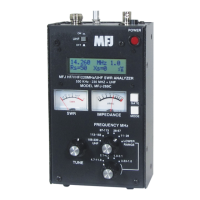
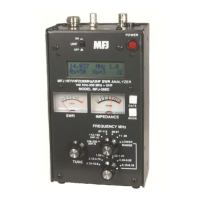
MFJ-223 Vector Impedance Antenna Analyzer
MFJ Enterprises, Inc
15 Version 1
To check numerical data at any scan-stop on any plot,
rotate Encoder
To return to Scan-Set mode to enter a new setup,
press ScanSet*
*After reviewing your plots, you may wish to expand or
compress them by using a wider or narrower scan width
(SCAN), or you may wish to move them left or right on the
screen by shifting and entering a new center frequency (CF).
5.6 Retrieving Data From Memory:
The analyzer's
previous scan data remains in memory, even when the
analyzer is turned off. If you wish to recall it, do the following:
From the Boot Screen, press Scan. The analyzer
switches to Scan-Set mode.
From Scan-Set, press Present. The analyzer switches
to Present mode.
The marker function will be activated and your numerical data
will be recalled. To scroll through the screens, press Graph.
Note that the trace for your first plot (SWR) will not actually
appear on the screen until you cycle through Z, R, and X. If you
wish to set up a new test, press ScanSet and re-enter the
Scan-Set Mode. If you turn the analyzer off without initiating a
new scan, your old data will continue to be retained in memory.
6.0 Measurement and Accuracy Limitations
6.1 General: The MFJ-223 will serve as your eyes and ears
when working with RF systems. However, all handheld
analyzers share certain limitations, and being aware of them
will help you to achieve more meaningful results.
6.2 Local Interference:
Like most hand-held units, this
analyzer uses a broadband directional coupler that is open to
receiving signals across the entire radio spectrum. Most of the
time, the unit's built in +5 dBm RF generator is powerful
enough to overcome the lack of front-end selectivity and
override stray pickup. However, a powerful transmitter located
nearby could inject enough RF energy through the antenna
under test to overload the directional coupler and disrupt
readings. If this condition occurs, performance may become
erratic and SWR readings may appear higher than they really
are.


 To Next Page