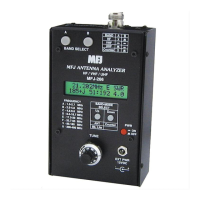
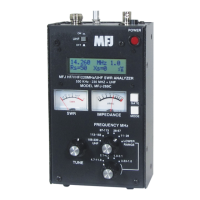
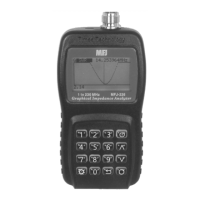
MFJ-226 Graphical Antenna Impedance Analyzer
17 Version 1A 1R02
without returning to the main menu. Alternatively, you could perform
each step independently bringing up each of the three individual
prompts, but keep in mind that the cal must always be completed to
the same calibration plane under the same conditions or it will
introduce serious measurement error. When applying the loads:
Connect the OPEN load when requested and hit Enter to start
the cal run.
When complete, remove OPEN and connect the SHORT.
Tap Enter.
When complete, remove SHORT and connect LOAD. Tap
Enter.
Upon completion, the new Global Cal will lock in place automatically
and the analyzer will be ready to use. The MFJ-226 can be re-
calibrated at any time. If you suspect your measurement results may
be inaccurate for any reason, a Global recalibration will eliminate the
analyzer as the source of the problem.
CALIBRATE
CALIBRATION DONE
CALIBRATION LOAD SET
The Calibration Load Set is more than a resistor to stick in the
connector, no connector and a piece of wire. You may get fair results
with these but the accuracy will suffer. A known Good dummy load
can be used in a pinch to check calibration if needed.
There are a number of web sites that show construction of loads but
basically they are an “N” connector that has a precision 49.9 ohm or
50.1 ohm 1% resistor connected between the center pin and the case
ground with as short leads as possible. Precision chip resistors would
be even better but are harder to work with. Do not use the precision
load for a dummy load. It will not handle any power.
Using a GOOD dummy load may work for the load BUT the
termination plane is unknown and will throw the calibration off.
The OPEN is more than leaving the connector off. It is an “N”
connector that the center pin and insulator are glued or clamped in
place with the connector assembly, giving a termination at the same


 To Next Page