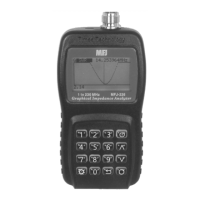
MFJ-226 Graphical Antenna Impedance Analyzer
4 Version 1A 1R02
As shown in the diagram above, the analyzer's DDS RF-Stimulus
Generator (or VFO) generates a test signal that routes through the
directional coupler to the load under test. If a mismatch (impedance
discontinuity) exists, a portion of that generated signal is reflected
back to the load.
The Directional Coupler measures amplitude and phase of both the
forward and reflected signals and feeds that information to the
microprocessor.
The Microprocessor compares data from the coupler and
mathematically converts it to useful engineering parameters such as
SWR, complex impedance, and S11 coordinates.
Using the Keypad and Menu System, the operator can call up the
specific type of data needed for display on the LCD Screen.
The MFJ-226 is compact and simple to use, but offers several
advanced features that set it apart from may lower-cost analyzers.
These features include OSL (Open/Short/Load) calibration, true
reactance signs, continuous frequency coverage, exceptionally high
DDS resolution, extensive on-board memory, a serial data port, and
simple power requirements.
MFJ-226 Technical Specifications
Frequency Range: Continuous, 1 MHz to 230 MHz
Frequency Resolution: 1 Hz
Test Port Termination Type-N Female
Output Power +10 dBm typical
Harmonics -15 dBc typical
LCD Display 128 x 64 resolution with backlight
Dimensions 6.5" (165 mm) x 3.12" (80 mm) x 1.25" (32
mm)
Weight 10 oz with batteries and UHF adapter
Power Two (2) AA cells, Alkaline or NiMH
Computer Interface USB serial
OSL Calibration Male-N or UHF, Open, Short, and 50-Ohm
Load


 To Next Page