53
Appendix H
Glossary of Terms
APPLICATION RATE: An amount, unit or ratio of material
being applied.
BALL VALVE: A valve controlling flow by means of a ball
pierced with an opening in one direction and fixed to rotate
on a spindle at right angles to the opening.
BOOM: The entire apparatus which holds the nozzles of a
sprayer.
BOOM SECTION: The portion of the boom which is supplied
by a shut-off valve.
BOOST VALVE: A device that provides additional by-pass to
compensate for partial boom shut-off.
BOOST ADJUST VALVE: A device that determines the amount
of by-pass the boost valve will provide; typically the amount
of material that was flowing through the boom sections that
were shut-off to cause boost activation.
BYPASS INSTALLATION: An installation in which the
servo valve is installed between the high and low pressure
sides of the system (pump outlet/pump inlet), therefore
allowing more bypass as the servo opens. [Open servo
= more bypass = lower pressure = less output; closed
servo = less bypass = higher pressure = more output.]
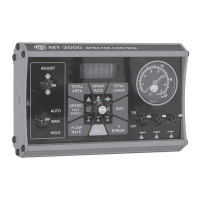
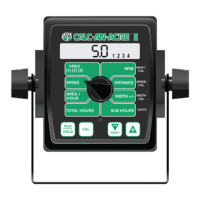
CONSOLE: The main instrument panel, containing
programmed software, used to operate the MT-9000
system.
CONTROL MODE: A mode which determines the information
used to adjust the systems output. Choices include flow,
pressure or hybrid (flow and pressure combined).
DRIVE SHAFT: A shaft that transfers power from one place
to another.
FLOWBASED CONTROL: Using information from a flowmeter
to determine the amount of adjustment required.
FLOWMETER: The device that measures flow through the
system.
FLOW SENSOR: An electronic device that sends a signal to
the console to calculate and display flow-related functions.
INLINE INSTALLATION: An installation in which the servo
valve is installed in the high pressure side of the system
(between pump and boom).
MODULE: A detachable unit which is a component of a larger
unit.
NONDRIVEN WHEEL: A wheel that is free-rolling on the
ground, as opposed to the wheel being driven by or driving
other devices.
OUTPUT: The amount of material applied.
PRESSUREBASED CONTROL: Using information from a
pressure sensor to determine the amount of adjustment
required.
PRESSURE SENSOR: An electronic device typically mounted
between the pump output and the boom shut-off valves
(near the flowmeter) that sends a signal to the console to
calculate and display pressure.
RANGE ADJUST VALVE: A valve installed between the high
and low pressure sides of the system (pump outlet/pump
inlet) to provide extra bypass when the pump is much larger
than required.
RELIEF VALVE: A valve installed between high and low
pressures sides of the system that opens to avoid excessive
pressure build-up and possible damage when all boom
sections are shut off.
SERVO VALVE: A device which adjusts the amount of product
being applied.
SHROUD: The female plastic portion of the connector
typically containing male electrical contact pins.
SOLENOID: A coil of wire that acts like a bar magnet when
carrying a current.
SOLENOID VALVE: A valve actuated by the magnetic field
produced in a solenoid to control the flow of liquid.
SPECIAL CALIBRATION: A calibration mode sequence
that provides access to an extended list of calibration
parameters.
SPEED SENSOR: An electronic device that sends a signal to
the console to calculate and display speed-related functions
including distance and area.
STANDARD CALIBRATION: A calibration mode of the
MT-3405MSeries which lets the operator enter values specific
to their operating needs.
TARGET RATE: The desired amount of material which is to
be applied.
TOWER: The male plastic portion of the connector typically
containing female electrical contact pins.
TRAKSTAR: A device that calculates true ground speed
independent of any wheels, which may induce error due to
slippage.
UNITS: A standard quantity with which others of the
same kind are compared for purposes of measurement. For
example, Units of Area = Acres (English), Hectares (Metric)
and/or Thousand Square Feet (Turf).



 To Next Page