7 Dry Flo
l Discard used Dry Flo since small amounts of lubricant are lost during analysis. It is possible to
reuse Dry Flo, but high-precision results may not be achieved.
The analyzer comes equipped with a rubber mat to catch Dry Flo that may spill onto the platform
beneath the analysis chamber.
AMOUNT OF DRY FLO TO USE
These guidelines provide a general idea of how to estimate the amount of Dry Flo to use. There is no
exact or specific amount of Dry Flo that is correct for any sample.
Use enough Dry Flo to surround the sample or calibration object on all sides. There must be
sufficient Dry Flo to surround the object to become consolidated during the analysis process.
Accuracy is impossible when using an insufficient amount of Dry Flo (the sample bed cannot be
consolidated) and reduced when there is too much (relative change is not maximized).
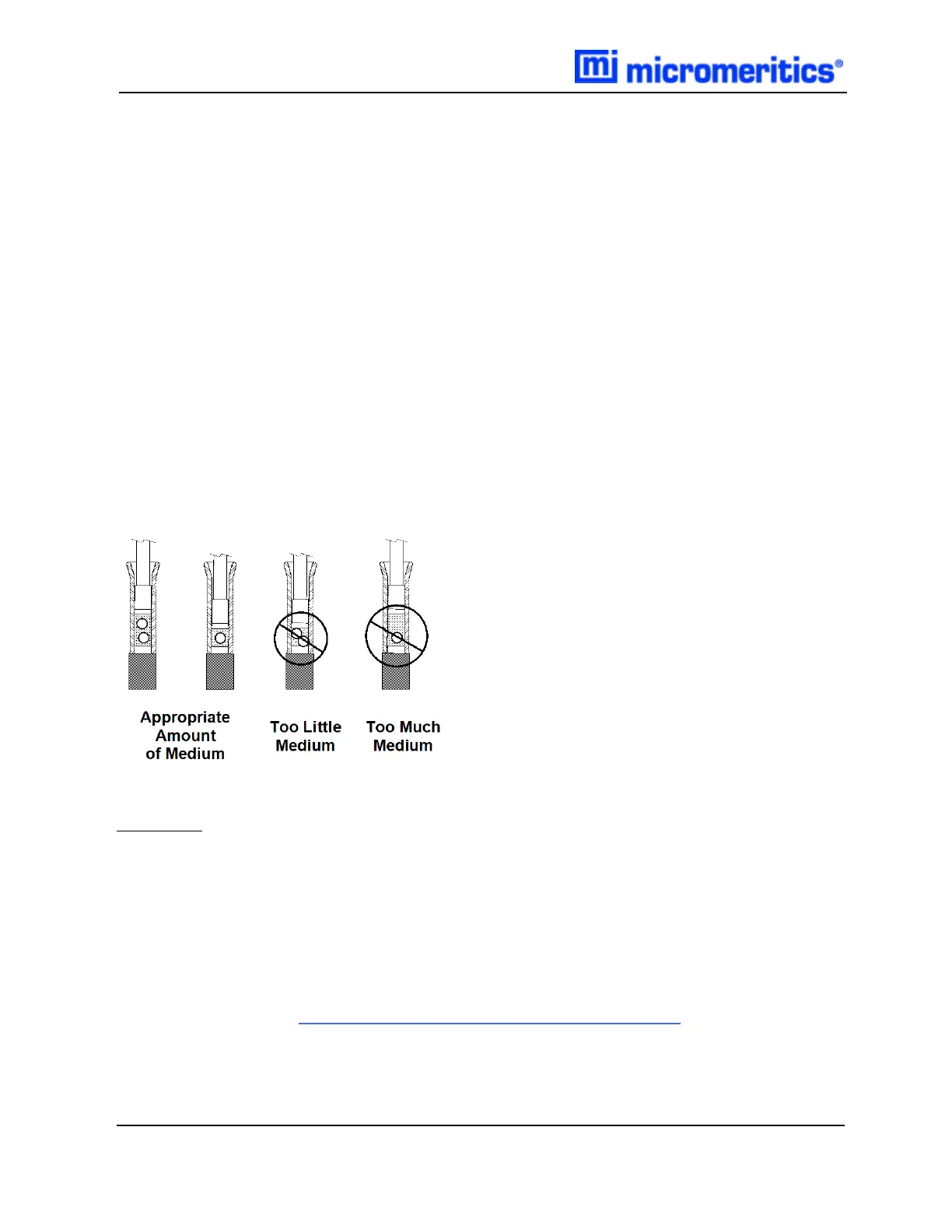
Ideally, the final bed of sample plus Dry Flo should consist of approximately 1/3sample and 2/3Dry
Flo. However, at minimum, the sample must constitute at least 1/4 of the final bed. This illustration
shows how to determine the appropriate amount of Dry Flo.
Method A
Place the sample in the chamber and push the plunger into the chamber until it touches the sample.
Mark the level of the plunger seal with a grease pencil or tape. Remove the plunger, then the sample,
and:
l For single objects, fill the chamber with Dry Flo to the marked line.
l For multiple small objects, fill the chamber with Dry Flo to the marked line, then double this
amount. If adding sufficient Dry Flo causes the sample plus medium bed to exceed the maximum
length specified in the Chamber Parameters Table on the facing page use a smaller amount
of sample .
7 - 2
GeoPyc 1365 Operator Manual
136-42800-01 (Rev -) — Dec 2016


 To Next Page