SECTION V
FUNCTIONAL
Transceiver
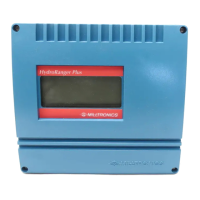
The HydroRanger I transceiver will transmit a set of long and/or short pulses per
measurement. The number and duration of the pulses is dependent upon P-88.
A short pulse has a maximum measurement range of 2 m (6.6 ft) from the transducer
face and the CABLE LOE message does not work.
A long pulse has a measurement range of 2 m (6.6 ft) from the transducer face out to its
maximum setting (P-3, empty distance to transducer plus P-87, range extension).
Submergence detection (P-23) does not work with a long pulse.
Transducer
The HydroRanger I is designed to work in conjunction with the ST-H series of
transducers with integral temperature sensor.
The transducer converts the electrical energy of the transmit pulse from the transceiver
into acoustical energy and converts the acoustical energy of the echo back into
electrical energy for the transceiver receive period.
The effective acoustical energy is generated from the face of the transducer and is
radiated outward, decreasing in amplitude at a rate inversely proportional to the square
of the distance. Maximum power is radiated axially (perpendicular) from the transducer
face in a line referred to as the axis of transmission. Where power is reduced by half
(-3 dB), a conical boundary defining the sound beam, centered about the axis of
transmission is established. The diametric measurement of the cone in degrees
defines the beam angle and varies according to the transducer type.
Impedance matching is used to optimize the transfer of power from the transducer into
air and from the air back into the transducer.
Damping and Process Rate
The HydroRanger I provides damping to control the maximum rate of change of the
displayed material level, volume or flowrate and of the mA output signal. As most relay
functions respond to the dampened level reading, they indirectly fall under the control of
the damping function. Damping may be set within the range of 0.001 to 9999 in units
selected per minute (e.g. if P-1 = 3 and P-68 = 15, then the fill damping rate is 15
ft/min). P-68 is set to provide damping specifically for filling conditions while P-69 is set
to provide damping specifically for emptying conditions.
The required damping may be estimated by filling and emptying the vessel at its normal
rate. The rate of material level change can be viewed via process rate display
PL-399 5 – 1



 To Next Page