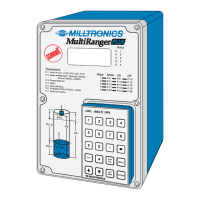
» select P - 61
» perform an empty calibration
The following temperature functions (in °C) can be viewed:
P-65 air temperature: » present temperature at sensor
or
» preset temperature, if sensor not used
P-66 max. air temperature: » highest temperature encountered
during operation
P-67 min. air temperature: » lowest temperature encountered
during operation
Sound Velocity
The HydroRanger I can be calibrated to compensate for transducer operation in
homogenous vapours with sound velocities other than that of air.
The basis is to physically measure the level (measuring tape or sight glass) and enter
this value via P-61. The HydroRanger I then calculates the sound velocity by
comparing the entered physical measurement to its own ultrasonic measurement
(empty calibration, P-61).
P-63, velocity at 20°C, can be used to enter the known velocity at 20°C of sound in a
particular gas or vapour or to view the resultant velocity of a sound velocity
compensation, normalized to 20°C.
P-64, velocity at P-65, can be used to enter the known velocity at the temperature of
P-65 of sound in a particular gas or vapour or to view the resultant velocity of a sound
velocity compensation, at the temperature of P-65.
Refer to Appendix I, for typical sound velocities in various gases and vapours.
Blanking
Near blanking (P-5) is used to ignore the zone in front of the transducer where ringing
or other false echo is at a level that interferes with the processing of the true echo.
Ringing is the inherent nature of the transducer mass to continue vibrating after the
transmit pulse has ceased. The amount of ringing varies with the type of transducer
used and decays to acceptable levels in the order of milliseconds. Excessive cold and
overtightening of the transducer mounting (refer to Figure 6) will increase the ring time
such that it may appear as an echo during the receive cycle. This is usually indicated
by an incorrect high level reading. This condition may be verified with the use of
an oscilloscope (refer to Section VIII) and may be overcome by increasing the
near blanking.
PL-399 5 – 3



 To Next Page