than
"START"
invalid.
If
this mode
is
used, any
RAM
data
is
not
destroyed by
erroneous operations, which contributes considerably
to
mass production.
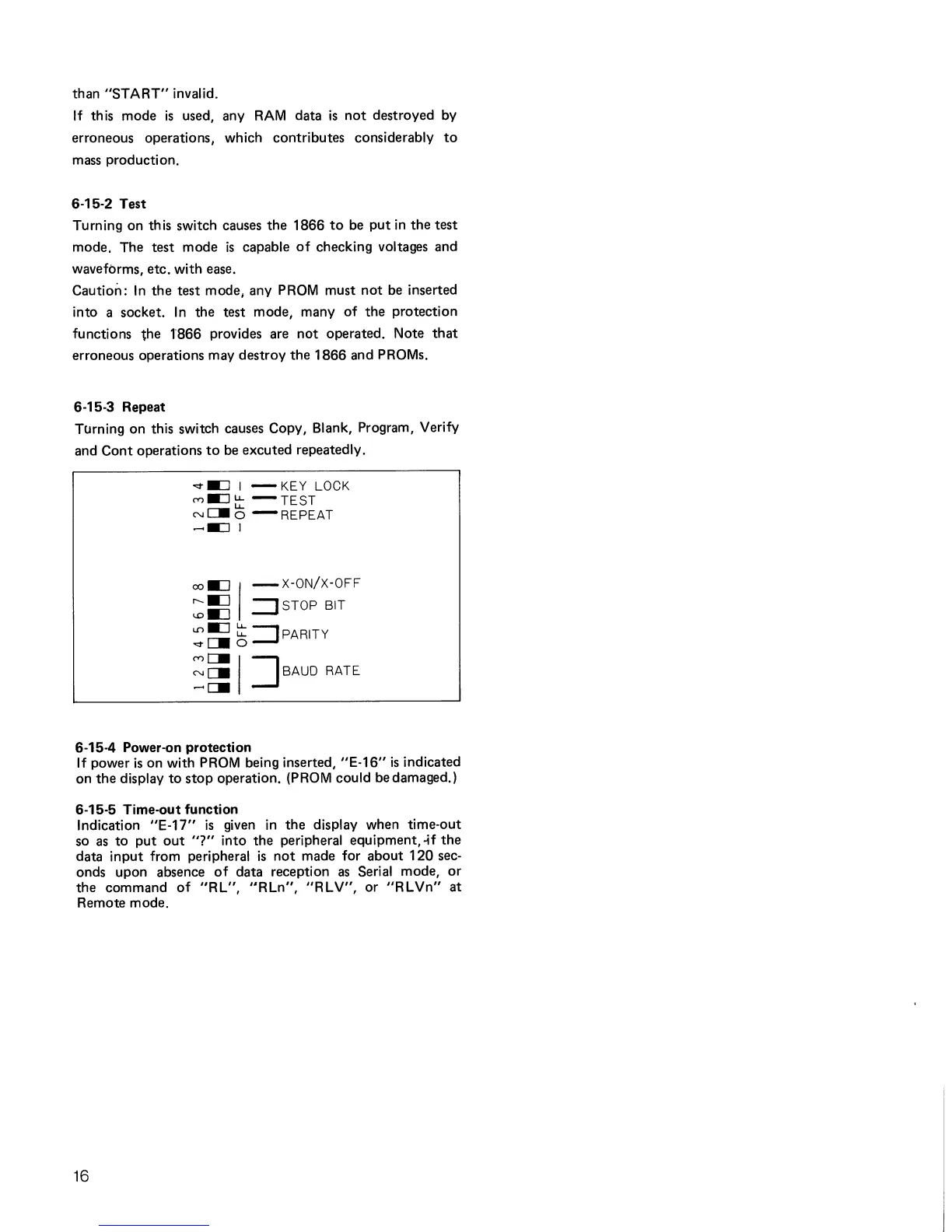
6-15-2 Test
Turning on this switch causes
the
1866
to
be
put
in
the
test
mode. The test mode
is
capable
of
checking voltages and
waveforms, etc. with ease.
Caution:
In
the
test
mode. any
PROM
must
not
be inserted
into a socket.
In
the test mode, many
of
the
protection
functions
the
l866
provides are
not
operated. Note
that
erroneous operations may destroy
the
1866 and PROMs.
6-15-3 Repeat
TUrning on this switch causes Copy, Blank, Program, Verify
and
Cont
operations
to
be
excuted repeatedly.
<:t".::J I - KEY LOCK
M.::J::
-
TEST
Nc::::.O
- REPEAT
.....
.::J
I
oo~
I
-X-ON/X-OFF
:;:s
~
STOP BIT
L.{).:J
tz
::J PARITY
<:t"~O
:§!
I
~BAUO
RATE
6-15-4 Power-on protection
If
power
is
on with
PROM
being inserted, "E-16"
is
indicated
on
the
display
to
stop
operation. (PROM could be damaged. I
6-15-5 Time-out function
Indication
"E-17"
is
given
in
the
display when time-out
so
as
to
put
out
"?"
into the peripheral equipment, -if
the
data
input
from peripheral
is
not
made for
about
120 sec-
onds upon absence
of
data reception
as
Serial mode,
or
the
command
of
"RL",
"RLn",
"RLV",
or
"RLVn"
at
Remote mode.
16



 To Next Page