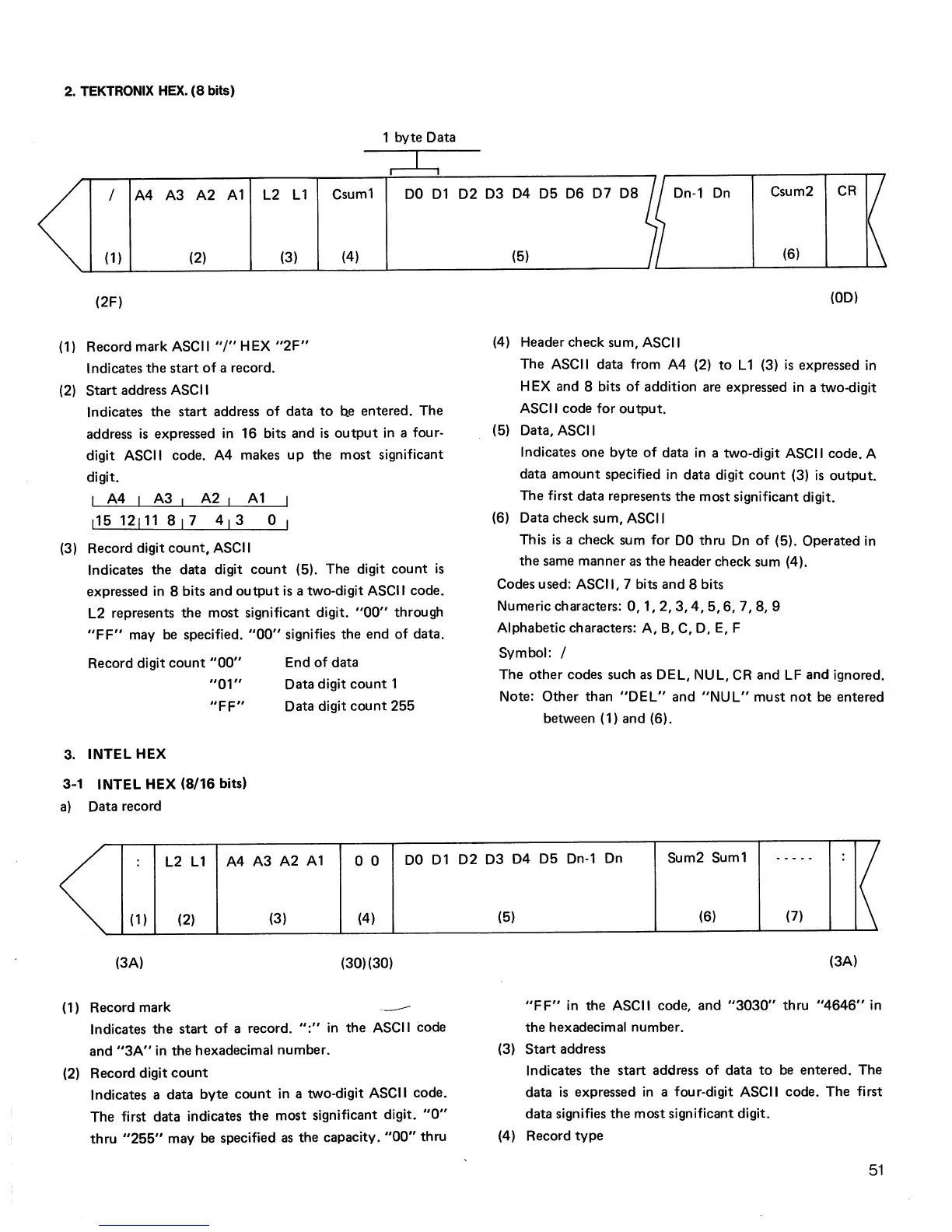
2. TEKTRONIX
HEX.
(8
bits)
1 byte Data
/ A4 A3 A2
Al
L2 Ll Csuml
DO
Dl D2 D3
D4
D5 D6 D7 D8
Dn·l
Dn
Csum2
CR
(1
)
(2)
(3)
(4)
(2F)
(1)
Record mark ASCII
"/"
HEX
"2F"
Indicates
the
start
of
a record.
(2)
Start
address ASCII
Indicates
the
start
address
of
data
to
be entered. The
address
is
expressed
in
16 bits and
is
output
in
a four-
digit ASCII code. A4 makes
up
the most significant
digit.
I A4 I A3
I A2 I A 1
,1512111817
413
0
(3) Record digit
count,
ASCII
Indicates
the
data digit
count
(5). The digit
count
is
expressed
in
8 bits and
output
is
a two-digit ASCII code.
L2 represents
the
most significant digit.
"00"
through
"FF"
may be specified.
"00"
signifies
the
end of data.
Record digit
count
"00"
"01"
"FF"
3.
INTEL
HEX
3-1
INTEL
HEX (8/16 bits)
a)
Data record
End of data
Data digit
count
1
Data digit
count
255
(5)
(6)
(OD)
(4)
Header check sum, ASCII
The ASCII data from A4 (2)
to
L 1 (3)
is
expressed
in
H
EX
and 8 bits of addition are expressed
in
a tWO-digit
ASCII code for
output.
(5) Data, ASCII
Indicates one byte
of
data
in
a two-digit ASCII code. A
data
amount
specified
in
data digit
count
(3)
is
output.
The first data represents
the
most significant digit.
(6) Data check sum, ASCII
This
is
a check sum for
DO
thru
Dn
of (5). Operated
in
the
same manner
as
the
header check sum (4).
Codes used: ASCII, 7 bits
and
8 bits
Numeric characters:
0,
1,2,3,4,5,6,
7,8,9
Alphabetic characters: A, B, C,
D,
E,
F
Symbol: /
The
other
codes such as DEL, NUL,
CR
and
LF
and ignored.
Note:
Other
than
"DEL"
and
"NUL"
must
not
be entered
between (1) and (6).
:
L2
L1
A4 A3 A2
Al
o 0
DO
Dl
D2 D3 D4 D5 Dn-l
Dn
Sum2
Suml
-- - --
:
I(
(1
)
(2)
(3)
(4)
(3A)
(30)(30)
(1) Record mark
Indicates
the
start of a record.
":"
in
the
ASCII code
and
"3A"
in
the
hexadecimal number.
(2)
Record digit
count
Indicates a data
byte
count
in
a two·digit ASCII code.
The first data indicates
the
most significant digit.
"0"
thru
"255"
may be specified
as
the
capacity.
"00"
thru
(5)
(6)
(7)
(3A)
"F
F"
in
the ASCII code,
and
"3030"
thru
"4646"
in
the
hexadecimal number.
(3)
Start
address
Indicates
the
start
address
of
data
to
be
entered. The
data
is
expressed
in
a fou r-digit ASCII code. The first
data signifies
the
most significant digit.
(4) Record
type



 To Next Page