
 Need help?
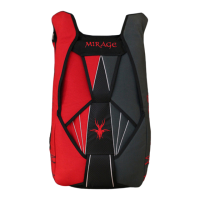
Do you have a question about the MIRAGE SYSTEMS G4 and is the answer not in the manual?
Details limitations for use from airplane under 150 mph.
Acknowledges sport parachuting risks and user responsibility for equipment use and potential malfunction.
Lists necessary tools for packing the reserve container, including data card, seals, and leverage bar.
Guides on installing the Cypres processing unit into the reserve container's bolster pocket.
Details on routing the EOS and control unit through the reserve pack tray and securing it.
Instructions for attaching steering toggles and setting deployment brake length per manufacturer.
Guides on stowing excess reserve canopy steering line using velcro keepers on the riser.
Instructions for attaching temporary pile velcro tabs to the freebag's line stow pocket hook side.
Guides on threading the bridle through pilot chute loops and forming a lark's head knot.
Details on folding the canopy according to manufacturer instructions, recommending PRO pack style.
Instructions on cocooning the canopy to the width of the reserve freebag mouth lock.
Explains placing the first fold to position the slider grommet on the canopy edge, typically 3-6 inches.
Describes placing the second S fold to create the desired wedge shape of the reserve container.
Guides on pulling the remaining center cell back to create the MOLAR shape.
Explains the G4's requirement for thick MOLAR "ears" to fill the top of the container.
Instructions for placing the canopy onto the freebag and ensuring the top is filled as full as possible.
Details on closing the freebag mouth lock using the safety stow, specifying line lock lengths.
Guides on inserting remaining lines into the line stow pocket in an S fold, leaving 4 inches out.
Provides a chart of suggested reserve closing loop lengths for different canopy sizes.
Instructions for threading the pull up cord through the closing loop and tying it off with a bowline.
Guides on placing the reserve freebag into the pack tray and aligning risers.
Instructions for pushing the freebag into the reserve container, filling corners and working Cypres.
Describes folding the bridle in a "V" shape and tucking it under the #1 closing flap.
Guides on threading the closing loop and pull up cord through the Cypres cutter and #1 closing flap.
Instructions for distributing the remaining 3-4 ft of bridle on top of the #1 closing flap.
Guides on threading the pull up cord through the spring pilot chute and centering it.
Explains how to compress the pilot chute while keeping fabric out of the spring.
Instructions on using a leverage bar to pull the closing loop through the #2 pilot chute cap.
Guides on forcing the pilot chute down into the freebag after it's pinned.
Describes accordion folding the pilot chute canopy and threading the pull up cord through flap #3.
Instructions on folding reserve canopy fabric around the back and under flap #3.
Guides on forcing the pilot chute down into the freebag after flap #3 is pinned.
Instructions for threading the pull up cord through flaps #4 and #5 and drawing grommets to center.
Details on drawing side flap grommets towards the center, unthreading flap #5, and repinning flap #4.
Guides on stowing the yoke assembly side tucktabs and checking the #6 flap.
Instructions for removing the temporary pin and pinning the closing loop with the reserve ripcord pin.
Describes counting tools, sealing the reserve pin with thread, and replacing the packing data card.
Instructions on closing the reserve pin cover using all three tuck tabs.
Explains the RSL's purpose, mechanism, and passive operation, emphasizing instructor training.
Step-by-step guide for attaching the RSL lanyard to the reserve riser using Velcro.
Guides on inserting excess RSL lanyard fold into the space behind the ring cover.
Instructions for attaching the snap shackle to the main riser RSL ring and inspecting routing.
Details on threading the reserve ripcord through the RSL rings before closing flap #6.
Guides on neatly tucking the excess RSL lanyard under the reserve riser after closing flap #6.
Instructions for threading the elastic through the RIGHT legstrap first, leaving no extra webbing.
Guides on passing the elastic through the buckle on the center bottom of the rig.
Instructions for threading elastic through the LEFT legstrap buckle and stowing excess.
Guides on threading the elastic lumbar support starting with the buckle on the right of the backpad channel.
Explains how to adjust the lumbar support by snugging or loosening the buckle.
Instructions for tucking the buckle and excess strap into the channel when adjusted.
Emphasizes ensuring risers are not twisted or reversed before assembly.
Guides on passing the large ring of the riser through the large harness ring from above.
Instructions for threading the smallest ring through the middle ring without passing through the large ring.
Guides on passing the white loop over the small ring and through the riser grommet.
Instructions for threading the white loop through the end fitting on the cable housing.
Guides on threading the yellow cable through the white loop and inserting the free end.
Lists critical checks for the 3-ring release system before jumping.
Guides on setting out the main canopy, bag, and pilot chute, and finding the bridle attachment point.
Instructions for feeding the bridle end through the main bag grommet and folding fabric loops.
Guides on guiding the open #4 Rapid link through the fabric loop backed with yellow Kevlar tape.
Instructions for passing the white collapse line and bridle through the Rapid link.
Guides on feeding the male end of the connector link through the second loop and closing it.
Describes pulling the loop material over the barrel and ensuring correct exit of collapse line.
Instructions for passing the large loop of the bridle through the canopy bridle attachment loop.
Guides on cinching the bridle tight and consulting a rigger if instructions are unclear.
Explains the importance of cocking the pilot chute before each jump to prevent malfunctions.
Guides on feeding the large loop of the bridle through the main bag grommet from the outside.
Instructions for passing the large loop of the bridle through the canopy bridle attachment loop.
Guides on cinching the bridle tight after assembly.
Instructions for stowing suspension lines after placing the canopy into the deployment bag, with stow limits.
Guides on leaving 12-15 inches of suspension line unstowed for straighter openings.
Instructions for lifting the bag over the container, stowing risers and toggles.
Guides on laying secondary riser covers over the risers and tucking them into the riser channel.
Instructions for folding back flaps and placing the main bag into the main pack tray.
Guides on pushing the top of the bag down and laying the main bridle to the right side.
Instructions for closing flap #2, routing the main bridle, and mating velcro.
Guides on closing flap #3, with a hint for maintaining container symmetry.
Instructions for closing flap #4, inserting the closing pin, and checking the pilot chute's cocked state.
Illustrates the correct routing of the main bridle for standard right-handed deployment.
Warns against crossing the main bridle from left to right side of the pin cover flap, which can cause deployment issues.
Demonstrates one method for folding a main pilot chute as provided by Mirage Systems.
Guides on storing excess bridle line and folding the pilot chute in half.
Instructions for inserting the folded main pilot chute into the spandex pouch, ensuring no exposure.
Step-by-step guide on putting on the Mirage harness/container, starting with lift web and legstraps.
Guides on tightening the chest strap until the harness yoke is parallel over shoulders.
Instructions on tightening the legstraps until they are comfortable, with a fitting tip for alignment.
Guides on stowing excess webbing under keepers and into legpad pockets.
Instructions for stowing all excess webbing to prevent entanglement and removing the harness/container.
Information required when ordering replacement risers, including length, color, and type.
Details needed when ordering a main pilot chute, including type and handle options.
Information on breakaway handles (color, embroidery) and reserve ripcords (length, handle type).
Notes that container size and serial number are critical when replacing freebags or pilot chutes.
Explains that proper maintenance ensures longevity, appearance, and correct function of the Mirage.
Recommends monthly inspection of all rig details and immediate repair of wear or damage.
Lists specific areas requiring attention during inspection, like breakaway system, reserve system, and harness.
Details potential damage sources like sunlight, acids, oils, water, soil, sand, and abrasion.
Suggests washing the container every 500 jumps to remove sand particles.
Guides on operating the 3-ring release system on the ground and disconnecting risers.
Details on inspecting white locking loops, touch-fastener fabric, and cable ends for wear.
Instructions for cleaning and lubricating release cables with silicone spray.
Guides on checking stitching, cable housing stretch, and end fittings for integrity.
Details on inspecting risers for deformation and cable housings for dents or obstructions.
 General
| Brand | MIRAGE SYSTEMS |
|---|---|
| Model | G4 |
| Category | Sports & Outdoors |
| Language | English |

 To Next Page