44 • Section 2 — Driving & Safety Cayman 2006
Unequal tire pressures on same axle can cause:
• Uneven braking, swerve upon acceleration.
• Steering lead, torque steer.
• Reduced handling quality.
WARNING:
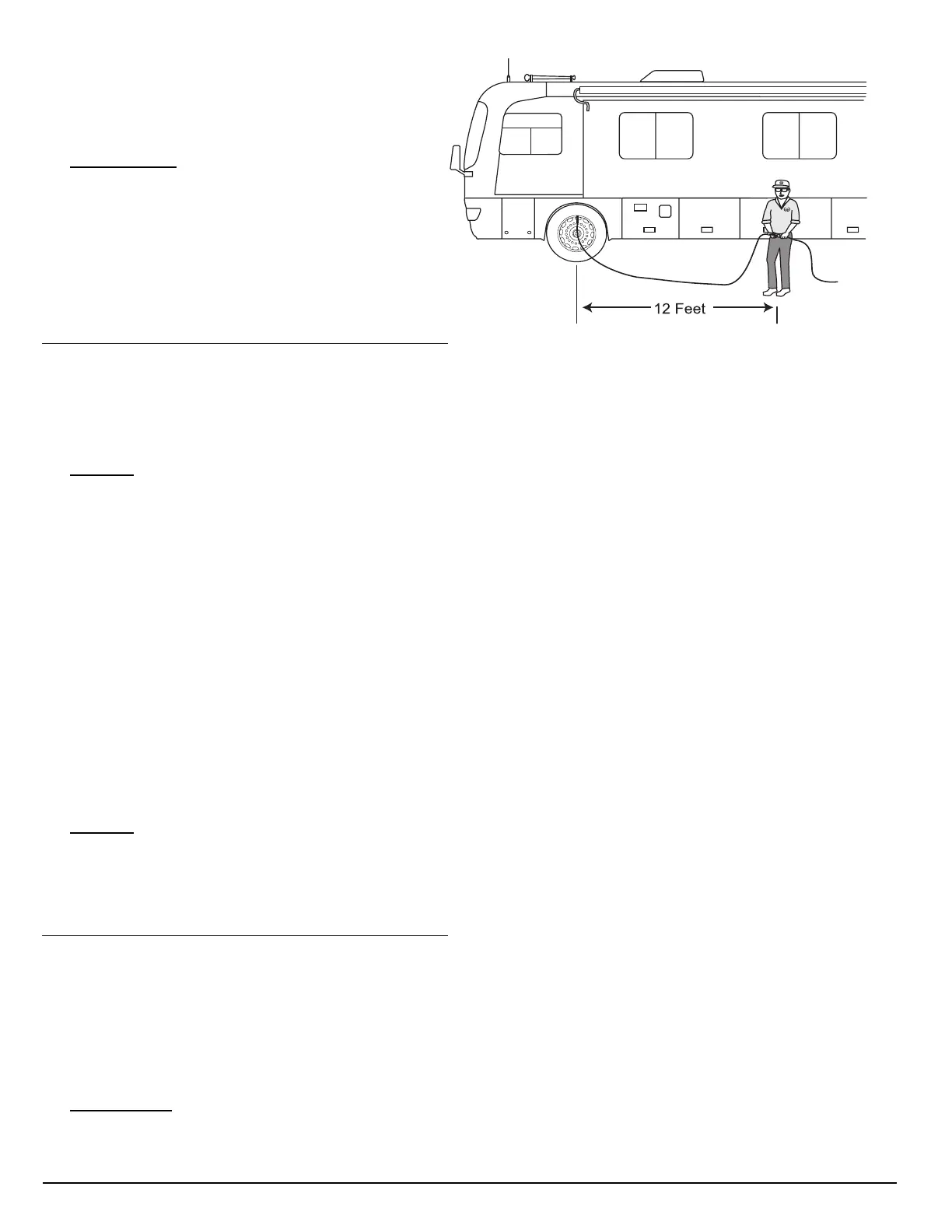
For safety purposes clear the area of
people and pets during tire inflation.
Inflate tires using a remote inflation
device.
Air Pressure Checklist
1. When inspecting the tires, confi rm the tires are cool before increasing or reducing air pressure. Even
driving a short distance can heat up tires.
NOTE:
If the motorhome must be driven a distance to get air, check and record the tire pressure
first and add the recorded calculation when reaching the pump. It is normal for tires to heat
up and the air pressure inside to go up as driven. Never reduce air pressure when tires are hot.
2. Remove the cap from the valve on one tire.
3. Firmly press a tire gauge onto the valve and record reading.
4. Add air to achieve recommended air pressure.
5. If the tire is over fi lled, release air by pushing on the metal stem in the center of the valve. Then recheck
the pressure with the tire gauge.
6. Replace the valve cap.
7. Repeat with each tire.
8. Visually inspect the tires to make sure there are no nails, or other objects embedded that could poke a
hole in the tire and cause an air leak.
9. Check the sidewalls to make sure there are no gouges, cuts, bulges, or other irregularities.
NOTE:
Air pressure in a tire goes up (in warm weather) or down (in cold weather) one to two
pounds for every 10° of temperature change.
Supporting When Leveling
Extreme caution must be taken to ensure that the tires are fully supported when placing blocks under the tires.
The load on the tire should be evenly distributed on the support block. In the case of dual tires, distribute the
load evenly on blocks for both tires. If not properly supported, the steel cables in the sidewall of the tires may be
damaged and could lead to premature fatigue of the sidewall.
CAUTION:
Supporting tires prevents damage to the sidewall of the tires and does not prevent tire roll.
020161



 To Next Page