This document describes the MORRA Rotary Mower, specifically models MF 2240, MF 2250, MF 2260, and MF 2270. It serves as an operating and maintenance manual, providing essential information for safe and correct use, as well as routine servicing. The manufacturer, MORRA MACCHINE AGRICOLE, emphasizes strict compliance with the instructions to ensure optimal performance, longevity, and safety.
Function Description
The MORRA Rotary Mower is an agricultural machine designed and built for mowing grass in stable lawns and meadows, as well as alfalfa and other forage crops. It attaches to a tractor via a three-point hitch and operates through turning discs equipped with fast-spinning knives, powered by the tractor's power take-off (PTO). The cutting action results from the kinetic energy of the knives against the base of the plant stems. The machine is not suitable for use outside of agriculture. It is designed for use by a single, authorized, and trained operator.
Important Technical Specifications
The rotary mower is available in four versions (MF 2240, MF 2250, MF 2260, MF 2270), each with varying power, weight, and dimensional specifications.
General Specifications (for PTO=540 rpm):
- 3-point hitch class: I - II
- Number of disks: 4 to 7 (depending on model)
- Number of tines per disk: 2
- Disk rotation speed: 3080 rpm
- Minimum power rating: 26-35 kW-HP (MF 2240) up to 38-52 kW-HP (MF 2270)
- Working width (A): 1650 mm (64.96 inches) for MF 2240 up to 2800 mm (110.23 inches) for MF 2270
- Transporting width (D): 1350 mm (53.14 inches) for all models
- Machine width (B): 3490 mm (137.40 inches) for MF 2240 up to 4690 mm (184.64 inches) for MF 2270
- Machine length (C): 1250 mm (49.21 inches) for all models
- Machine height (E): 1390 mm (54.72 inches) for all models
- Total weight (excluding cardan shaft): 465 kg (MF 2240) up to 585 kg (MF 2270)
Tractor Requirements:
- PTO speed: 540 rpm
- Minimum power rating: 26-35 kW-HP to 38-52 kW-HP (according to model)
- Maximum hydraulic system pressure: 160 bar
- Single-acting spool valve: 1
Packaging for Shipment (weights and dimensions for one mower):
- 4 disks: 515/525 kg, 2500 mm (98.42 inches) length, 740 mm (29.13 inches) width, 740 mm (29.13 inches) height
- 5 disks: 550/560 kg, 2500 mm (98.42 inches) length, 740 mm (29.13 inches) width, 740 mm (29.13 inches) height
- 6 disks: 595/605 kg, 2650 mm (104.3 inches) length, 740 mm (29.13 inches) width, 740 mm (29.13 inches) height
- 7 disks: 650/660 kg, 3050 mm (120.0 inches) length, 740 mm (29.13 inches) width, 740 mm (29.13 inches) height
Noise Level: 87 dB(A) (operator must use individual protective equipment).
Usage Features
The mower is equipped with a safety release mechanism to prevent damage from impacts with large obstacles. Ball joints allow the machine to turn up to 30° and automatically re-engage by reversing a short distance. Standard supply includes a driveline with a free wheel, an automatic release device, two sets of knives (long and short), and sprung suspension to reduce ground load.
Pre-operation precautions:
- Ensure no large stones (diameter > 10-15 cm / 3.93-5.9 inches), tree stubs (> 10 cm / 3.93 inches high, diameter > 10-15 cm / 3.93-5.9 inches), or metal objects are present in the work area.
- Adjust cutting height carefully.
- Ensure no bystanders are within 50 meters (1968 inches) of the machine.
- Avoid working on wet soil or when the crop could be damaged, as this impairs efficiency and increases knife wear and power draw.
Hitching to the tractor:
- Connect to a universal three-point hitch, ensuring the pins are mobile and adjustable for class 1 and 2.
- Maintain a distance (L) of approximately 100-150 mm (3.93-5.9 inches) between the machine and tractor.
- Ensure the tractor's front axle load is at least 20% of its empty weight.
- The driveline must operate at the least possible angle (never more than 10-15 degrees) and overlap by at least 1/3rd of its length when fully extended. When fully inserted, there must be at least 40 mm (1.57 inches) of play.
- The PTO speed must be set to 540 rpm.
Transport Position:
- Raise the machine from the ground using the tractor's hydraulic power lift (30 cm / 12 inches).
- Stop the engine, remove the ignition key, and disengage the PTO.
- Fold the front protective cover upward.
- Fit pin K into the crossbar return.
- Close the mowing bar using the tractor's valve system until the safety clip A fastens.
- Connect chain S to point B using pin N and plug R for transport safety.
- For models with the DMD hydraulic cylinder, a harpoon system is used to lift the cutting bar for headland maneuvers, allowing it to clear mowed beds.
Work Position:
- Detach pin N of safety chain S.
- Release safety clip A and lower the disc bar to the horizontal position.
- Remove pin K.
- Lower the machine using the tractor's power lift to an adequate work position (450 mm / 17.7 inches).
- Fix the adjuster chain alongside the tractor's third point using clip G.
- Fold the front protective cover downwards.
- Ensure the driveline is engaged and the shield fixed with chains.
During Work:
- Operate at a speed between 5 and 15 kph, adjusting to soil and crop conditions.
- Always lift the machine when changing direction and turning after disengaging the PTO.
- The safety release retracts the mowing bar upon impact with obstacles; reverse a few meters to re-engage.
Maintenance Features
Regular and periodic maintenance is crucial for the machine's performance and longevity.
Initial Service (after first 4 hours):
- Check bolt tightness.
- Verify belt tension.
- Inspect for leaks in the hydraulic circuit.
- Ensure transmission components are lubricated.
Regular Inspections (periodically and at the beginning of each season):
- Oil: Check/change oil in the overdrive and mowing bar units.
- Overdrive unit (fig. 26): Check level with dipstick on fill plug (T) with bar horizontal. Use GEAR POWER ISO 150 oil (0.8 liters). Fill with bar horizontal, drain with bar vertical.
- Mowing bar unit (fig. 27): Check level with bar vertical for 5 minutes. Oil must reach fill plug C. Use GEAR POWER ISO 150 oil. Capacities: 4 discs (1.7 liters), 5 discs (2.2 liters), 6 discs (2.7 liters), 7 discs (3.2 liters). Fill with bar vertical, drain with bar vertical.
- Lubrication: Grease all articulations, supports, hinges, grease nipples, and the safety release before use and after every 8 hours of service. Clean and grease the driveline before long idle periods.
- Knives and Discs:
- Check after every 15-20 hours of service, more frequently on stony ground or after impacts.
- Replace knives when worn (width is ¼ of original width, fig. 19) or when the hole is ovalized (> 2 mm / 0.078 inches, fig. 20).
- Replace fastening components when curved or excessively worn (fig. 21).
- Ensure the self-braking layer of the fixing screw is not missing or worn (replace after 5 tightenings, fig. 22).
- Replace fixing screw if worn (diameter is 3 mm / 0.11 inches less than original, fig. 23).
- Replace tightening nut if worn (height is 1/2 original height, fig. 24) or if the washer is flattened (fig. 25).
- Tighten M10 screws for oval discs to 7.5 kgm (75 Nm) torque (fig. 18).
- Belts: Check tension regularly, especially after the first few hours. Tighten until belts give no more than 2 cm (0.78 inches) in the central part (fig. 16). Replace all belts at the same time if worn.
- Protective Covers: Regularly check and replace if damaged.
Storage:
- Clean the mower thoroughly.
- Store in a sheltered place, protected from weather, and covered to prevent dust.
- Rest on wooden planks for stability.
- Lubricate all mechanical components to prevent rust.
- Slacken transmission belts.
- Dispose of used oil at authorized centers.
Troubleshooting:
The manual provides a troubleshooting guide for common issues such as excessive vibrations, failure to adapt to irregular ground, inability to lift parallel, soil buildup, frequent safety device release, and incorrect stubble height. Each issue is linked to probable causes and recommended actions, often involving adjustments to springs, bar tilt, PTO speed, or replacement of worn parts.
Warranty:
The manufacturer provides a one-year warranty against material and manufacturing defects from the delivery date. The warranty is void if the machine is improperly used, maintained, modified without authorization, or if non-genuine spare parts are used. The warranty document must be returned within one month of a mechanical fault, with detailed information about the machine, damage, and usage.

 Need help?
 General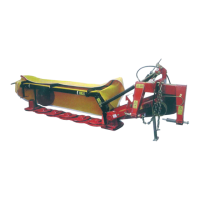

 To Next Page