ENGLISH
5.5 STORAGE
- Clean the mower.
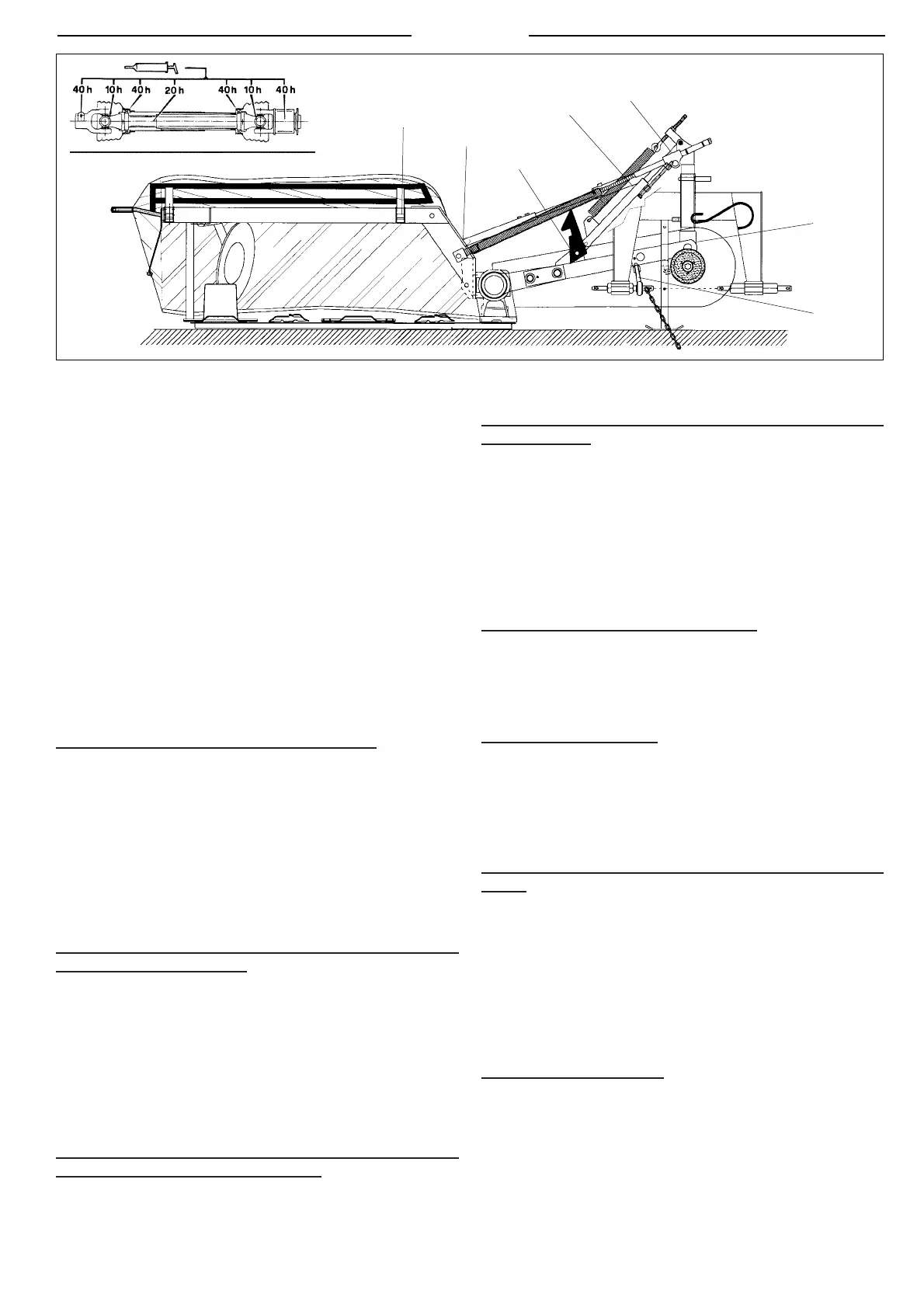
- Store the mower in a horizontal position (always lower the
guards and cover).
- Change the oil in the overdrive and mowing bar as indicated
in the instructions (quantity and type of oil).
- It is advisable to slacken off the transmission belts.
5.6 CHECK-CONTROL
TROUBLESHOOTING
* PROBABLE CAUSES
>RECOMMENDED ACTION
The mower vibrates too much during work:
* The nylon bushes of the pivot are excessively worn or
actually missing > replace the bushes;
* The crossbar pivot pin and/or the relative bushings are
excessively worn > replace the worn parts and lubricate
regularly;
* Excessive play on the discs > make sure that the discs
are fixed correctly and that self-locking nut D under the disc
covers is tight, fig.17 (driving torque 18 Kgm = 180 Nm).
The mowing bar (disc carrier) fails to adapt to irregular
ground in the correct way:
* The height of the hitching framework that couples to the
tractor is not regulated correctly > check the setting as
specified in chapters 3.2, 3.5 and 4.1 (in particular: the two
lower pins of the three-point hitch must be equidistant from
the ground);
* The mower pivots are not free to turn > thoroughly clean
and grease all articulations.
The mowing bar fails to lift parallel to the ground (even
when the frame has been adjusted):
* The perforated rod of the bar retracting cylinder is not
regulated correctly > adjust it correctly, by lengthening or
shortening the rod with the relative screws.
Soil builds up between two adjacent skids in the front
part of the bar:
* The soil is too wet > raise the tiller by means of the
tractors power lift in order to lighten the weight of the bar
on the ground.
* The bar weighs down too much on the soil > the springs
are not adjusted correctly;
* The disc bar tilts too much > adjust the bar tilt by means
of the tractors 3rd point idler (see chapter 3.5).
The safety device releases frequently:
* Insufficient pressure exercised by the Belleville washers
> increase the compression of the springs by degrees
(chapter 4.4).
The stubble is too high:
* The disc bar is not slanting correctly > increase the bar
slant by means of the tractors 3rd point idler.
* The ground speed is too high > lower the speed of the
tractor.
The stubble height is uneven throughout the mowing
width:
* The mowing bar slants too much > reduce the degree to
which the bar slants;
* The knives are excessively worn > replace the knives;
* The PTO speed is too low > increase the PTO speed to
540 rpm and no more;
* The ground speed is not correct > increase or decrease
the tractor speed to suit the crop height.
The stubble is too short:
* The disc bar is not slanting correctly > decrease the bar
slant by means of the tractors 3rd point idler.
* The ground speed is too low > increase the speed of the
tractor.
Fig. 28


 To Next Page