5-12 | ni.com
Chapter 5 Counters
Large Range of Frequencies with Two Counters
By using two counters, you can accurately measure a signal that might be high or low frequency.
This technique is called reciprocal frequency measurement. When measuring a large range of
frequencies with two counters, you generate a long pulse using the signal to measure. You then
measure the long pulse with a known timebase. The cDAQ chassis can measure this long pulse
more accurately than the faster input signal.
Note Counter 0 is always paired with Counter 1. Counter 2 is always paired with
Counter 3.
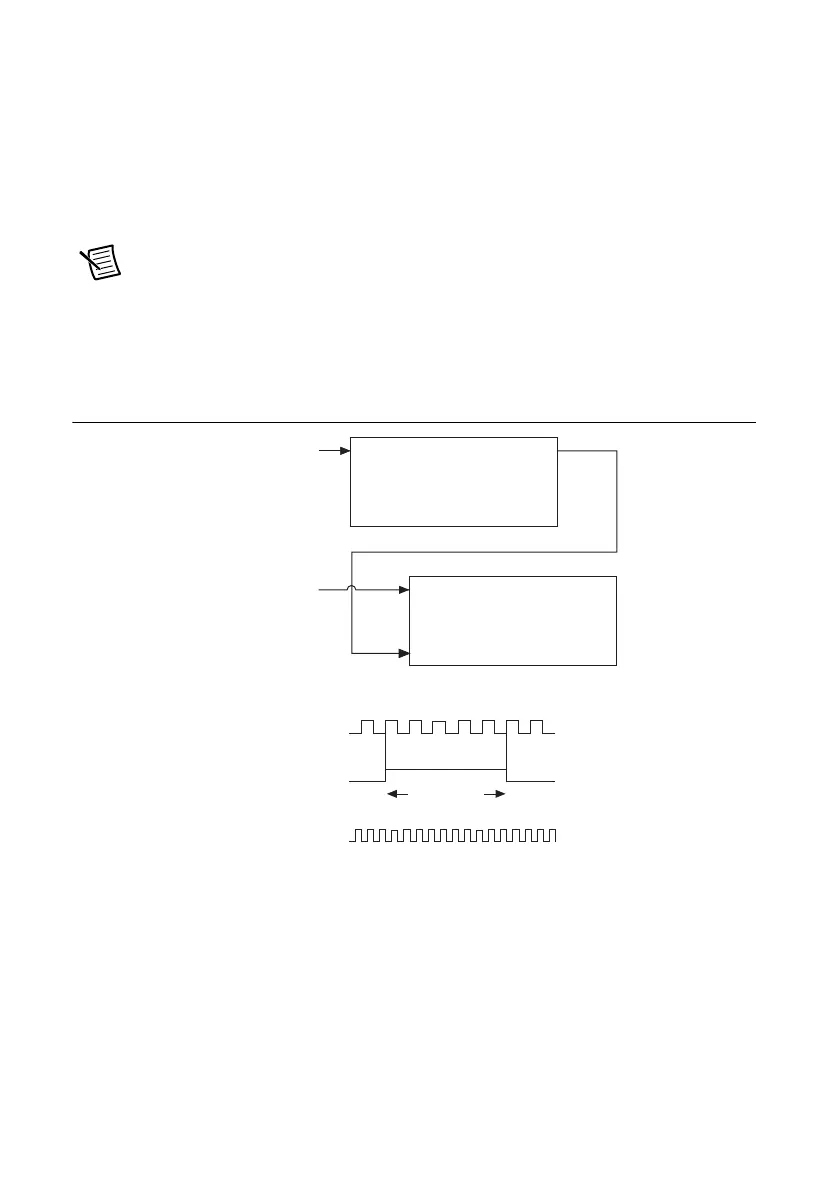
You can route the signal to measure to the Source input of Counter 0, as shown in Figure 5-14.
Assume this signal to measure has frequency fx. NI-DAQmx automatically configures Counter
0 to generate a single pulse that is the width of N periods of the source input signal.
Figure 5-14. Large Range of Frequencies with Two Counters
Next, route the Counter 0 Internal Output signal to the Gate input of Counter 1. You can route a
signal of known frequency (fk) to the Counter 1 Source input. Configure Counter 1 to perform a
single pulse-width measurement. Suppose the result is that the pulse width is J periods of the fk
clock.
From Counter 0, the length of the pulse is N/fx. From Counter 1, the length of the same pulse is
J/fk. Therefore, the frequency of fx is given by fx = fk *(N/J).
Source Out
Counter 0
Source
Gate
Out
Counter 1
Signal to
Measure (fx)
Signal of Known
Frequency (fk)
CTR_0_SOURCE
(Signal to Measure)
CTR_0_OUT
(CTR_1_GATE)
CTR_1_SOURCE
Interval
to Measure
0123 … N



 To Next Page