© 2005-2016 Nira Control AB 18
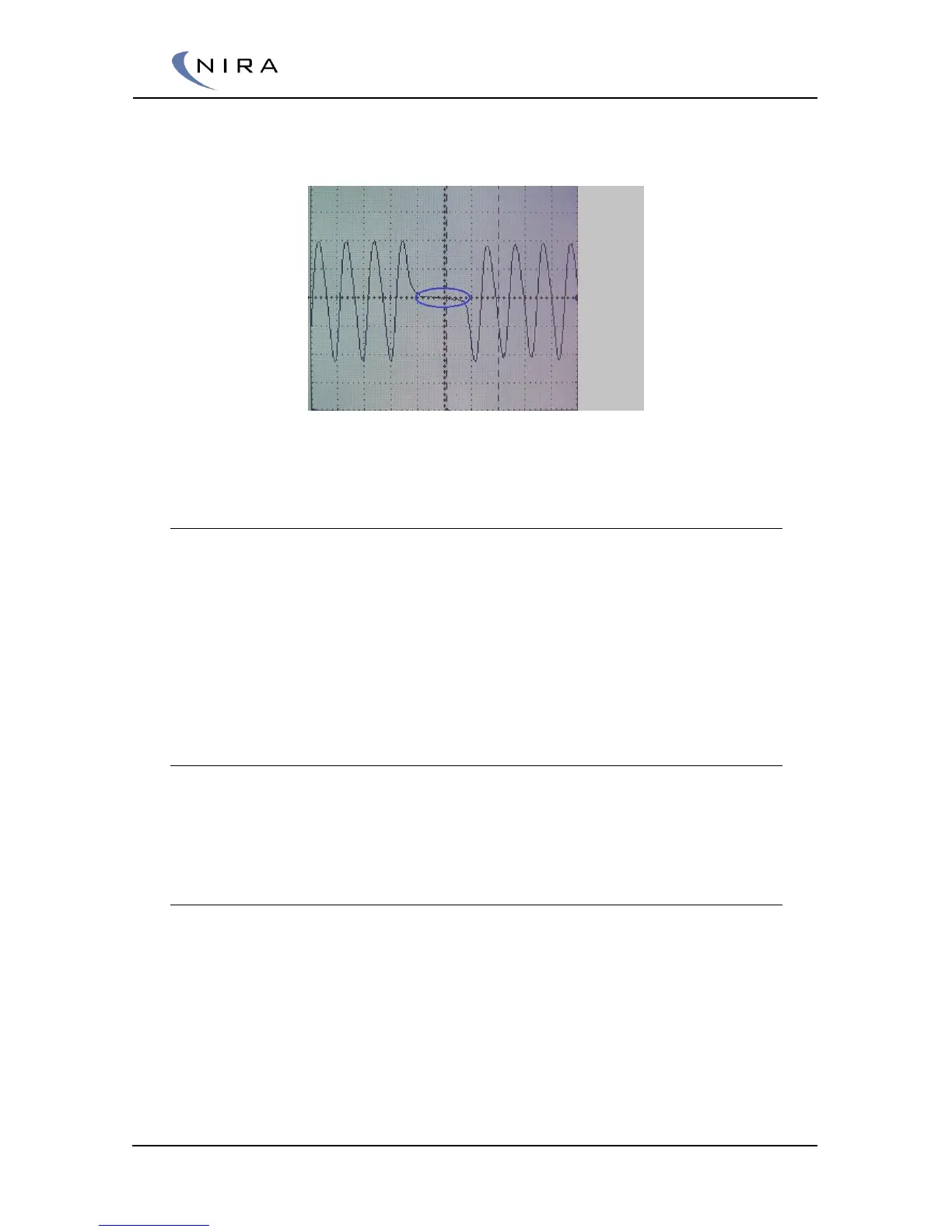
picture has to look like the pictures above. The level transition through the “2
lost”-gap cannot be falling in this case.
Example of wrong polarity at inductive sensor. The level transition through the gap is falling
and the zero crossing will be undefined in the blue circled area.
2.3.2 Volumetric Efficiency (VE)
For controlling the air mass flow through the engine, a volumetric efficiency
model can be used. The VE model uses Manifold Air Pressure or Throttle
Position sensor together with Engine Speed to choose a VE value. The VE
value is volumetric fill rate of the displacement and calculated for every
stroke. A VE value of 1 means that 100 % of the cylinder is filled with air
during intake stroke. For example, if the cylinder volume is 500 cc, the
engine breathes in exactly 500 cc of air while the intake valve is open.
VE to Fuel Mass
With the density of air, the volume can be converted to air mass filled into
the cylinder every stroke. Based on the air mass filled into the cylinder it is
possible to calculate fuel mass based on the desired A/F-ratio.
Volumetric Efficiency and Boost Pressure
The Volumetric Efficiency does not have to increase with increased boost
pressure. The intake air mass will increase and thus, the volume filled into the
cylinder contains compressed air. If high exhaust manifold pressure occurs,
the VE might even decrease.


 To Next Page