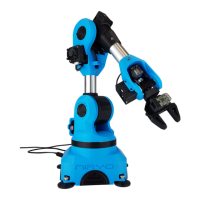
The Ned2 is a six-axis collaborative robot designed for education, research, and Industry 4.0 applications. It is built on open-source technologies, specifically Ubuntu 18.04 and ROS Melodic, and leverages the power of a Raspberry Pi 4 with a high-performance 64-bit ARM V8 processor and 4GB of RAM.
Function Description:
The Ned2 robot is primarily intended for:
- Learning robotics: Providing a platform for educational purposes.
- Research and development in robotics: Supporting advanced studies and experimentation.
- Simulation and prototyping of industrial scenarios: Enabling the creation of "Pick & Place" and "Pick & Pack" applications.
- Hardware application: Allowing connection and control with sensors and external actuators to simulate real-world applications.
The robot features new servo motors with Silent Stepper Technology, which significantly reduces its noise level, making it suitable for various environments. Its collaborative nature, combined with multiple ROS libraries, allows users to develop programs ranging from simple to complex, offering flexible solutions for diverse needs.
Important Technical Specifications:
- Robustness, Precision, and Repeatability: The Ned2 maintains the same aluminum structure as its predecessor, Ned, ensuring robustness, a precision of 0.5 mm, and a repeatability of 0.5 mm.
- Degrees of Freedom: It has 6 rotating joints.
- Weight: The robot itself weighs 7 kg.
- Payload: It can handle a payload of up to 300 g.
- Reach: The maximum reach is 440 mm.
- Joints Range (rad):
- Joint 1: -2.949 to 2.949
- Joint 2: -2.09 to 0.61
- Joint 3: -1.34 to 1.57
- Joint 4: -2.089 to 2.089
- Joint 5: -1.919 to 1.922
- Joint 6: -2.53 to -2.53
- Joints Speed Limit (rad/s):
- Joint 1: ≤ 0.785
- Joint 2: ≤ 0.5235
- Joint 3: ≤ 0.785
- Joint 4: ≤ 1.57
- Joint 5: ≤ 1.57
- Joint 6: ≤ 1.775
- TCP Max Speed: 468 mm/s.
- Footprint: 200x200 mm.
- Mounting: Designed for table mounting.
- Operating Temperature: 5-45°C.
- Materials: Constructed from Aluminum and ABS-PC (injection molding).
- Human-Machine Interface: Includes 3 control buttons ("FreeMotion," "Save Pose," and "Custom"), an LED Ring, speakers, and a microphone.
- Power Supply: Input: AC100-240V / 50-60Hz, 2.5A; Output: DC 12V-7A; 5V-7A.
- I/O Power Supply: 5V.
- Inputs/Outputs (Back Panel): 3 digital inputs, 3 digital outputs, 2 analog outputs, 2 analog inputs.
- Inputs/Outputs (Control Panel): 1 digital input, 1 digital output.
- Robot Interface: 2 x USB 2.0, 2 x USB 3.0, 1 x ETHERNET GIGABIT.
- Communication: Modbus TCP (master), TCP/IP.
- Collision Detection: Features an accelerometer and gyroscope in the control panel.
- Certification: CE Conformity.
The Ned2 is compatible with an ecosystem of tools, easily mounted using the EasyConnect system.
- Custom Gripper (included):
- Max operating width: 43 mm.
- Picking distance from end effector base: 85 mm.
- Motor: XL330 Servo Motor.
- Weight: 87 g.
- Power Supply: 5 V.
- Operating temperature: 5-45°C.
- Standard jaws can manipulate small objects, and custom 3D-printed jaws are supported.
- Large Gripper:
- Max operating width: 79.2 mm.
- Picking distance from end effector base: 109.35 mm.
- Motor: XL330 Servo Motor.
- Weight: 72.5 g.
- Power Supply: 5 V.
- Operating temperature: 5-45°C.
- Designed for grabbing larger objects while maintaining full closure.
- Adaptive Gripper:
- Max operating width: 97.49 mm.
- Picking distance from end effector base: 113.79 mm.
- Motor: XL330 Servo Motor.
- Weight: 83 g.
- Power Supply: 5 V.
- Operating temperature: 5-45°C.
- Allows grabbing non-standard objects with complex shapes (e.g., an egg).
- Vacuum Pump:
- Max operating width: 20 mm.
- Picking surface: 20 mm.
- Picking distance from end effector base: 27 mm.
- Control interface: Digital output.
- Weight: 44.5 g (Vacuum Pump control: 18 g, Total weight: 183 g).
- Payload: 300 g.
- Power Supply: 5 V.
- Operating temperature: 5-45°C.
- Vacuum Tube dimension: 20 mm.
- Integrated XL330 servo motor.
- Used for grabbing objects with plane and non-porous surfaces.
- Electromagnet:
- Max operating width: 20 mm.
- Picking surface: 20 mm.
- Picking distance from end effector base: 27 mm.
- Control interface: Digital output.
- Weight: 44.5 g.
- Power Supply: 5 V.
- Operating temperature: 5-45°C.
- Useful for manipulating metallic objects.
Ecosystem Add-ons:
- Vision Set:
- Enables object detection and interaction.
- Includes a camera, a workspace with repositionable material, 6 objects (3 rounds, 3 squares of different colors), and a calibration tip.
- Supports image processing, machine learning, and AI applications.
- Conveyor Belt (v2):
- A key add-on for prototyping Industry 4.0 production lines.
- Composed of a mountable workspace for vision functions, a slope for complex processes, an end-stop, and 6 Vision Set objects to extend production line capabilities.
Usage Features:
- Operating Modes:
- Manual mode - Robot calibration: Automatically defines the Zero positions of each axis.
- Collaborative mode - Programming: For programming, editing, loading, and executing programs. The robot automatically switches to this mode after calibration.
- Manual mode - FreeMotion: Allows manual movement of robot joints by pressing and holding the FreeMotion button on the control panel or in Niryo Studio.
- LED Ring Indications: The LED ring on the robot's base visually indicates the current operating mode and status (e.g., booting, calibration required, program running, motor error, collision detected, saving position). Different colors and animations (Solid, Flashing, Alternate, Chase, Rainbow, Breath, Snake) convey specific information.
- Wi-Fi Mode: An indicator displays Wi-Fi status (hotspot mode, connected to network, mode change in progress, not activated). A Wi-Fi button allows activation/deactivation of hotspot and Wi-Fi modes.
- Top Button Functions: The top button on the Ned2 has multiple functions depending on press duration:
- Program running: 1 short press (0.1-2 seconds) pauses the program; 1 long press (>2 seconds) stops the program.
- Program paused: 1 short press (0.1-2 seconds) resumes the program; 1 long press (>2 seconds) stops the program.
- Program with automatic start: 1 short press (0.1-2 seconds) starts a saved program.
- Control Panel Buttons:
- FreeMotion button: Deactivates motor torques for manual arm movement.
- Save button: Saves the robot's current position in Niryo Studio.
- Custom button: Programmable by the user for custom actions.
- Tool Mounting: Tools connect via a mechanical connector interface with a magnetic part for quick changes and stability.
- Programming Environment: Supports Niryo Studio, C++, PyNiryoRos, PyNiryo, and ROS.
- Safety Box: Contains an emergency stop button to immediately halt all robot motion. It must always be wired to the robot.
Maintenance Features:
- Software and Firmware Updates: The robot's software and circuit board firmware can be updated via Niryo Studio. The robot will restart automatically after an update.
- Support: Niryo provides a dedicated support team for technical problems, responding within 48 hours.
- Warranty: All products come with a one-year warranty from the invoice date. Warranty claims require the invoice, serial number, and visual evidence (photos/videos) of the problem for remote diagnosis.
- Disposal: The robot complies with European Directive 2012/19/CE (WEEE) and must be disposed of according to local laws. Users are advised to find collection points for electronic devices.
- Prohibited Modifications: While software modifications are generally permitted due to the open-source philosophy, modifications to low-level programming files (stack hardware), Raspberry Pi configuration, and robot configuration files (speed, acceleration, and torque limits) are prohibited. Niryo disclaims liability for damages resulting from such modifications.

 Need help?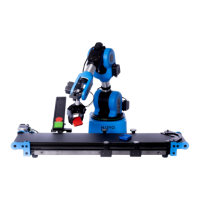

 To Next Page
 General