EasyManua.ls Logo

Ocean Optics Flame-S - Gratings and Detector Specifications

Ocean Optics Flame-S
130 pages
Print Icon
To Next Page IconTo Next Page
To Previous Page IconTo Previous Page
Loading...
5: How the Flame Spectrometer Works
40 225-00000-000-11-201604
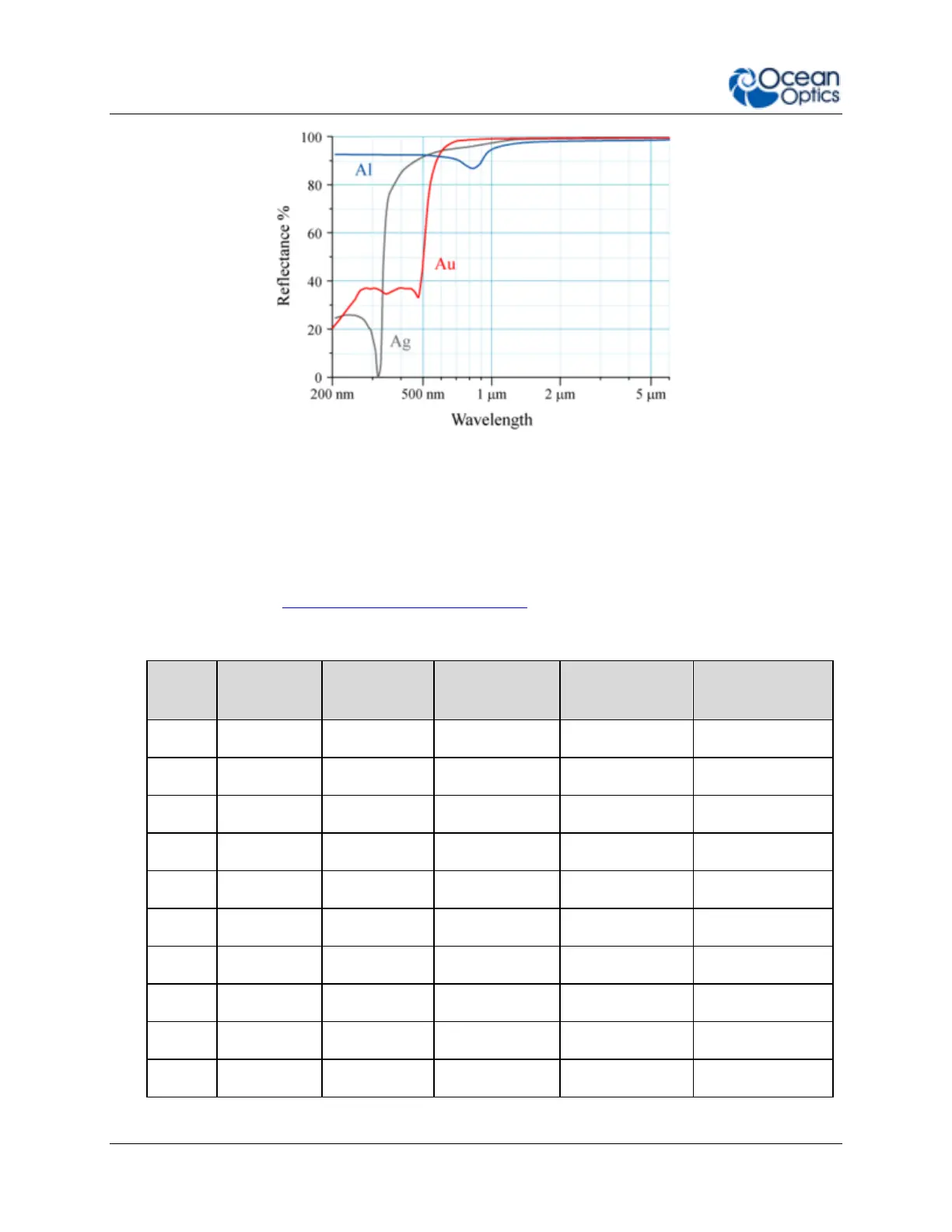
Reflectance vs. Wavelength for Aluminum, Gold, and Silver Mirrors
By Bob Mellish in Wikipedia
5. Grating and Wavelength Range (specify grating and starting wavelength): We
install the grating on a platform that we then rotate to select the starting wavelength
you have specified. Then we permanently fix the grating in place to eliminate
mechanical shifts or drift.
Use our online Range and Resolution Calculator to find out how your grating choice
affects spectral range and optical resolution by viewing the grating efficiency curves.
The available gratings are summarized below:

Grating
Number
Intended Use
Groove Density
Spectral Range
Blaze Wavelength
Best Efficiency
(>30%)
1
UV
600
650 nm
300 nm
200-575 nm
2
UV-VIS
600
650 nm
400 nm
250-800 nm
3
VIS-Color
600
650 nm
500 nm
350-850 nm
4
NIR
600
625 nm
750 nm
530-1100 nm
5
UV-VIS
1200
300 nm
Holographic UV
200-400 nm
6
NIR
1200
200-270 nm
750 nm
500-1100 nm
7
UV-VIS
2400
100-140 nm
Holographic UV
200-500 nm
9
VIS-NIR
1200
200-270 nm
Holographic VIS
400-800 nm
10
UV-VIS
1800
100-190 nm
Holographic UV
200-635 nm
11
UV-VIS
1800
120-160 nm
Holographic VIS
320-720 nm

Table of Contents

Related product manuals