5: How the Flame Spectrometer Works
225-00000-000-11-201604 41
Grating efficiency curves are available to view by using our online range and resolution
calculator at www.oceanoptics.com/product-category/modular-
spectrometers/.
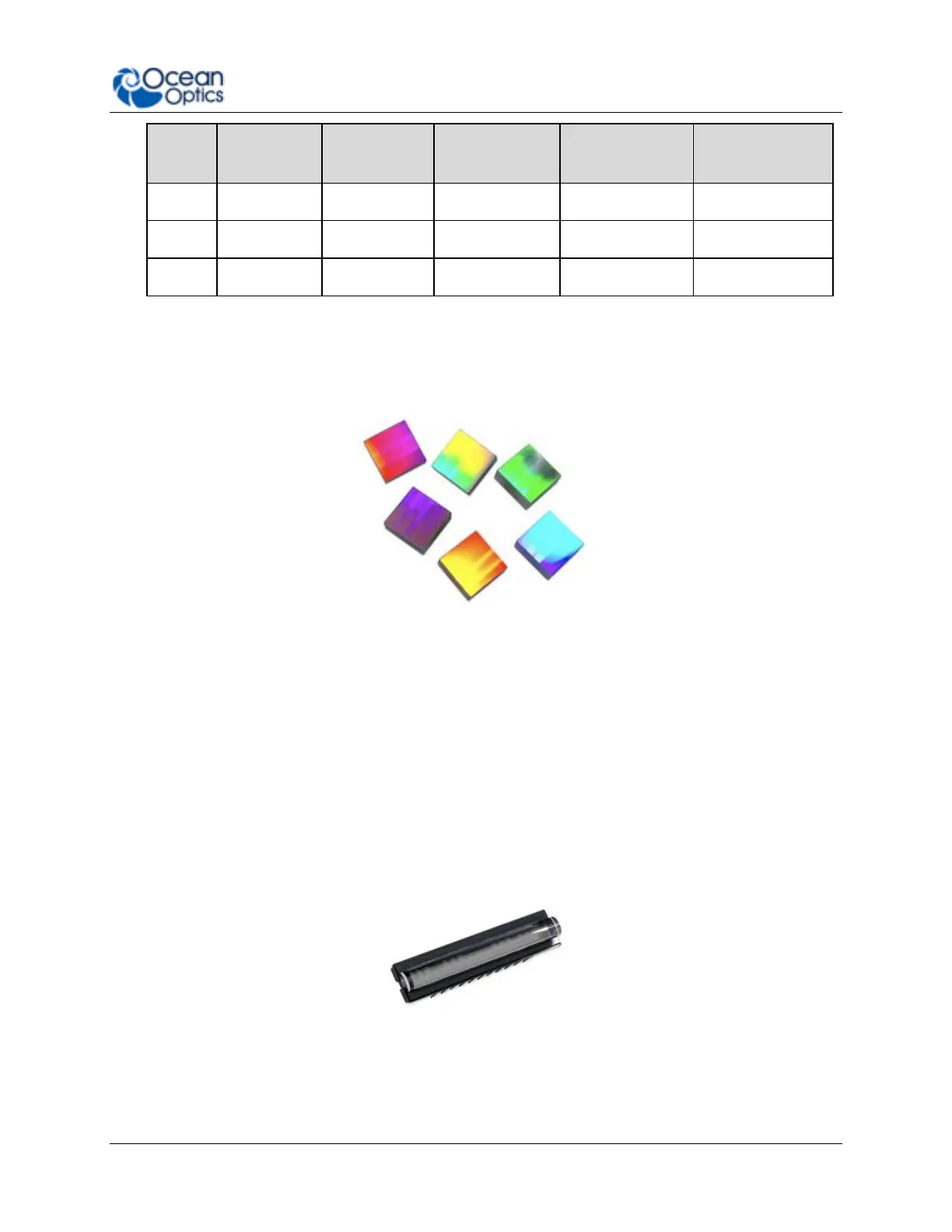
Gratings Showing Light Diffracted into its Constituent Wavelengths
6. Focusing Mirror (specify standard or SAG+): This mirror focuses first-order spectra
on the detector plane. Both the collimating and focusing mirrors are made in-house to
guarantee the highest reflectance and the lowest stray light possible. You can opt to
install a standard or SAG+ mirror. As with the collimating mirror, the mirror type needs
to be specified when ordering.
7. Detector Collection Lens (optional): This cylindrical lens is fixed to the detector to
focus the light from the tall slit onto the shorter detector elements. It increases light-
collection efficiency and reduces stray light. It also is useful in a configuration with a
large-diameter fiber and slit for low light-level applications such as fluorescence.
Preconfigured Flame spectrometers with a collector lens are available – look for –ES at
the end of the name.
8. Detector: There are two choices of detector available for the flame. We offer a 2048-
element FLAME-S (Sony ILX511B) or a 3648 element FLAME-T (Toshiba
TCD1304AP) linear CCD array. These both have an effective range of 190-1100 nm. The
optics split the light into its component wavelengths which fall across the different


 To Next Page