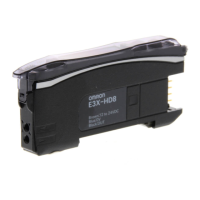
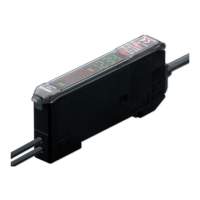
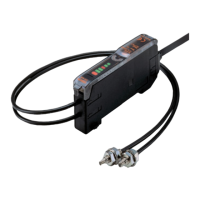
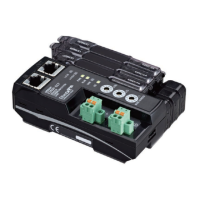
E3X-MDA Super Dual Fiber Sensors 5
Ordering Information: Fiber Units
■ Through-beam Fiber Units
Note 1. Indicates models that allow free cutting. Models without this mark do not allow free cutting.
2. The size of standard sensing object is the same as the fiber core diameter (lens diameter for models with lens).
3. The values for the minimum sensing object are representative values that indicate values obtained in standard mode with the sensing dis-
tance and sensitivity set to optimum values.
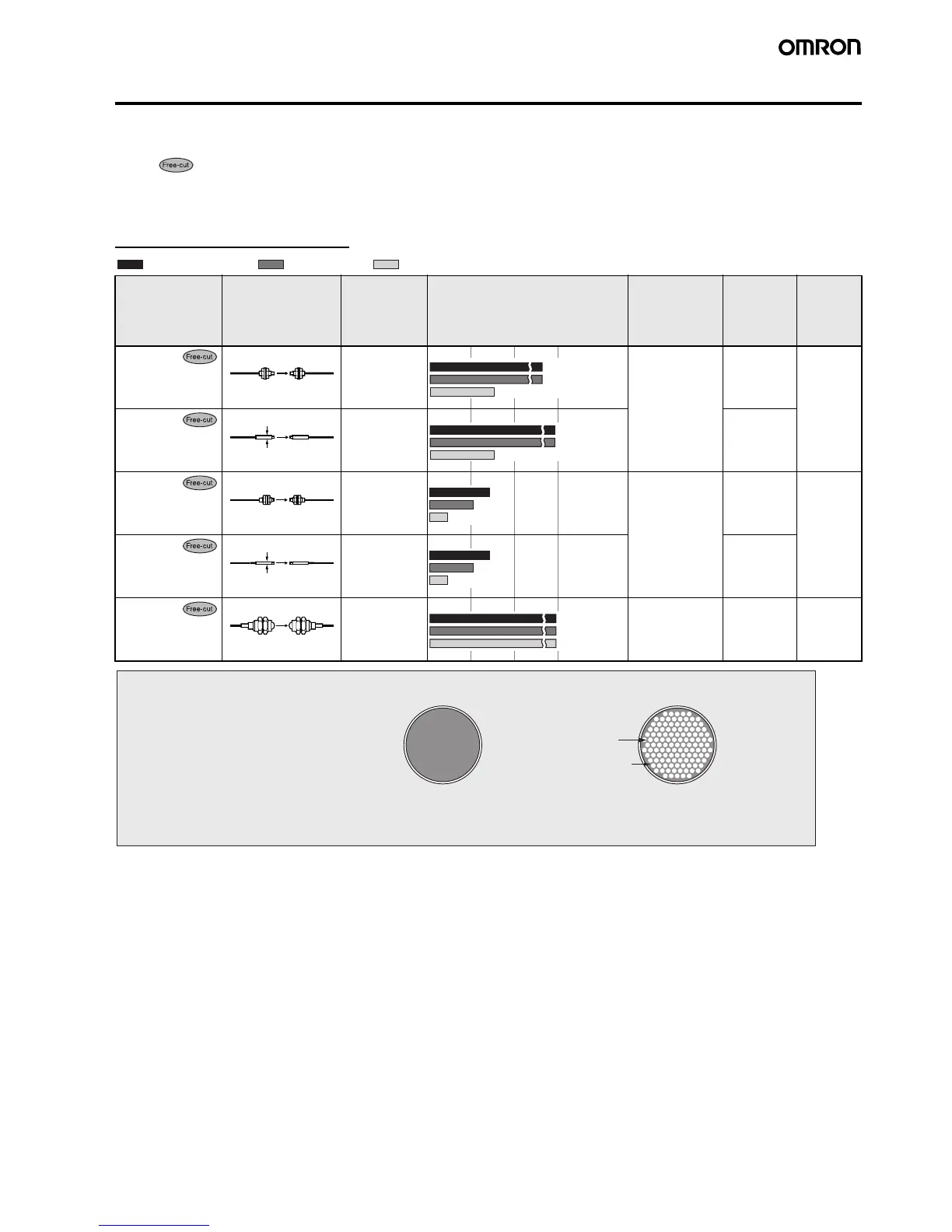
Long-distance Fiber Units
Features Appearance Applicable
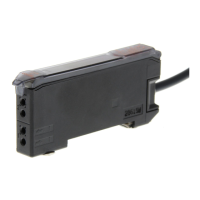
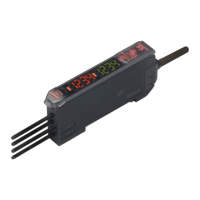
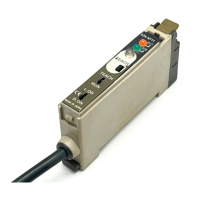
Amplifier Unit
Sensing distance (mm)
(Parentheses: With E39-F1 Lens
Unit)
Standard object
(min. sensing
object)
(Parentheses:
Opaque object)
Model Permissi-
ble bend-
ing radius
M4 E3X-MDA 1.4-mm dia.
(0.01-mm dia.)
E32-T11L 25 mm
3-mm dia. E3X-MDA E32-T12L
M3 E3X-MDA 0.9-mm dia.
(0.005-mm dia.)
E32-T21L 10 mm
2-mm dia.; small di-
ameter
E3X-MDA E32-T22L
M14; with lens; ide-
al for explosion-
proof applications
E3X-MDA 10-mm dia. E32-T17L 25 mm
: High-resolution mode : Super-high-speed mode: Standard mode
M4 screw
350 (840)
1,100 (2,600)
*1
870 (2,000)
3-mm dia.
350
1,100
870
M3 screw
340
260
100
2-mm dia.
340
260
100
M14 screw
13,000
10,000
4,000
Conventional Fiber
Flexible Fiber
Conventional fiber uses just one core and
one cladding section. Bending the fiber
may break it or reduce the light intensity.
Flexible fiber contains multiple independent cores
all surrounded by cladding. The fiber can be bent
without breaking or reducing the light intensity.
Core
Cladding
Flexible fiber models are indicated by an
"R" at the end of the model number.
Flexible fiber contains multiple cores.
These cores are all surrounded by cladding,
giving a minimum bending radius of 1 mm.
The fiber can be bent at right angles without
affecting the light intensity. Handle it just like
any other cable.
A Wide Range of Flexible Fibers for Easy Installation without Loss of Light Intensity


 To Next Page