45
OrionWelders.com
ch.7
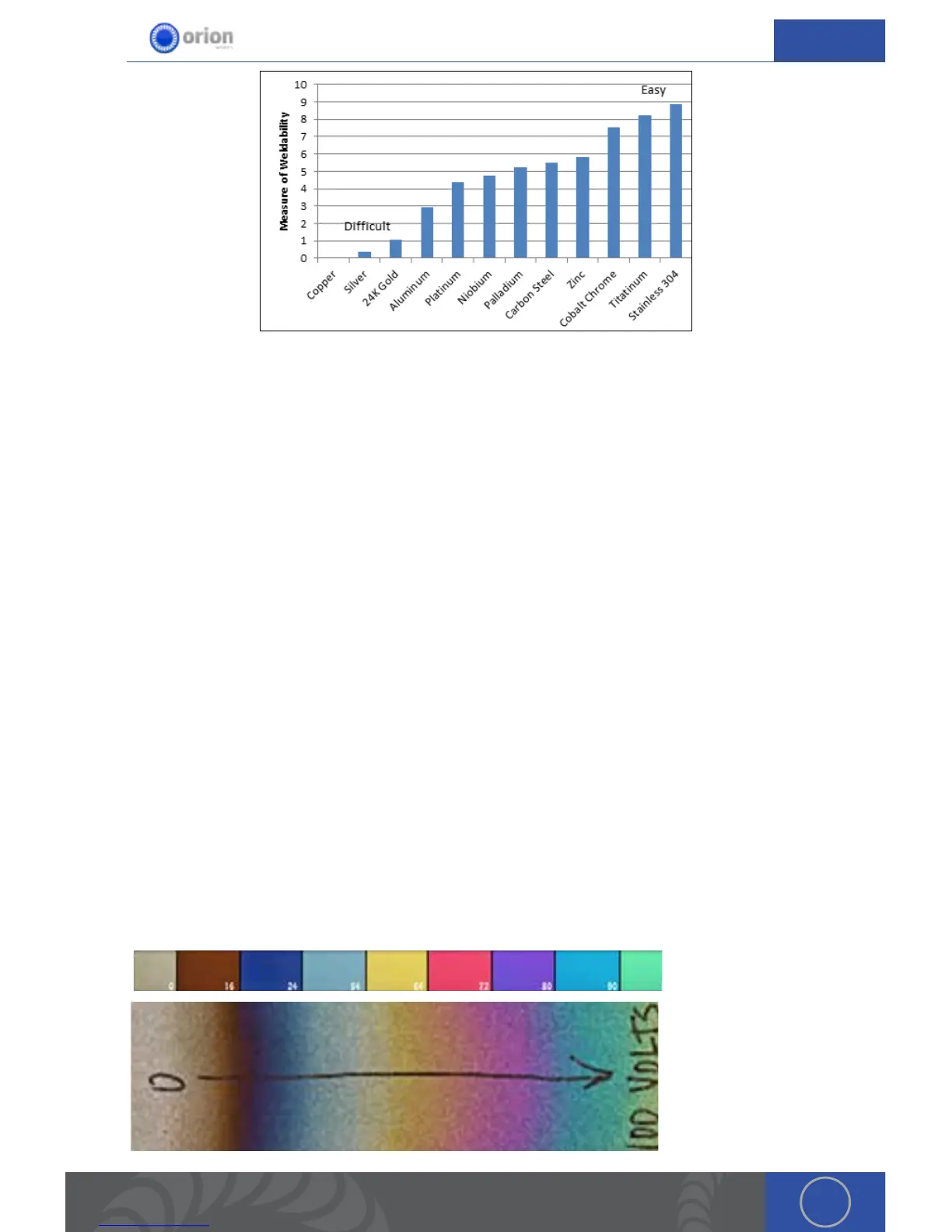
is measure of weldability comes from properties of the metal like melting point, thermal
conductivity, density etc., and is intended as a relative reference between the different metals. It
can be thought of as how much spot size and penetration a given amount of weld energy will have
on the metal. Please note that some metals may have properties not accounted for in this chart
that may make welding more difficult than indicated (e.g. palladium).
Titanium and Niobium
Some metals may react easily with oxygen and even other gases like nitrogen. Titanium (Ti)
reacts with both oxygen and nitrogen at elevated temperatures. (Ti) burns to form (TiO2) in air at
1200deg C. (Ti) will also burn in pure (N2) gas at 800deg C to form (TiN). Titanium nitride (TiN) is
inherently brittle, which will result in a weak weld joint. Very light reaction (mostly shielded) may
just include slight discoloration. However, a heavy reaction will cause absorption of gas and will
cause a dark gray and porous result. If the reaction is too heavy the weld location will become
very weak and porous.
Niobium (Nb) reacts with both oxygen (O2) and nitrogen (N2) gas. Niobium will oxidize (react with
oxygen) at 200deg C. e reaction with (N2) starts at 400deg C. As you can see, niobium is even
more reactive than titanium. is means that greater care must be taken when welding (Nb) to
ensure proper gas shielding and clean welds. For thin parts this is particularly difficult as heat is
easily conducted to the opposite weld side (the underside of the sheet for example). is heat on
the underside causes the (Nb) to absorb (O2) and (N2) gases resulting in brittle welds.
For both (Ti) and (Nb) the level of oxidation can be observed visually. Heavy oxidation will cause
a gray porous surface, however, oxidation (or nitrogen absorption) in smaller degrees will cause
the surface of the metal to color. is principle can be used to actually “paint” on oxide in different
colors on (Ti) and (Nb) parts.


 To Next Page