25
A. GENERAL
1. All fuel piping to the PUREFIRE
®
boiler is to be in
accordance with local codes. In the absence of local
regulations refer to the National Fuel Gas Code, ANSI
Z223.1/NFPA 54.
2. Size and install fuel piping to provide a supply of gas
sufficient to meet the maximum demand of all
appliances supplied by the piping.
B. FUEL LINE SIZING
1. The required flow rate of fuel gas to the boiler can be
determined by the following:
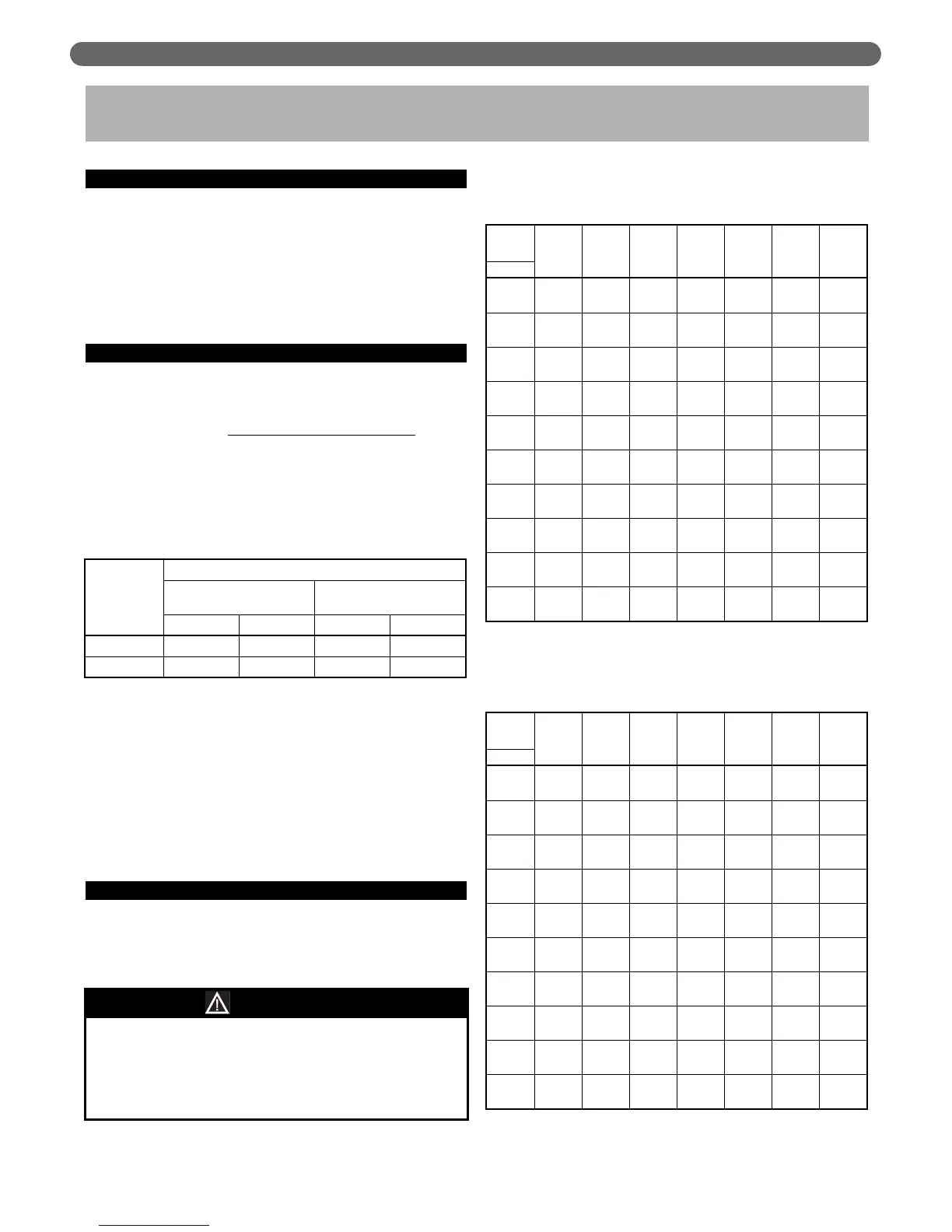
2. As an alternative, use Table 5.1 to determine the
required gas flow rate. This table uses typical heating
values for natural gas and liquefied petroleum (LP) gas.
3. Table 5.2 shows the maximum flow capacity of
several pipe sizes based on 0.3" w.c. pressure drop.
The values shown are based on a natural gas specific
gravity of 0.60.
4. Table 5.3 shows the maximum capacity of pipe sizes
for LP gas with a specific gravity of 1.50.
5. Size the fuel gas supply piping for no more than 0.5
in. w.c. pressure drop between the gas pressure
regulator and the boiler.
C. GAS SUPPLY PIPING - INSTALLATION
1. Do not install any piping directly in front of the boiler
or along either side. Always provide clearance for
removal of the front cover or side panels for
inspection and maintenance.
Boiler Input Rate
Gas Heating Value
Input Rate
(
ft
³
/
hr
)
=
(
Btu
/
hr
)
(
Btu
/
ft
³
)
FUEL PIPING
5. FUEL PIPING
PUREFIRE
®
Model
Required Input Rate
Natural Gas
(@1000 Btu/cu.ft)
LP Gas
(@ 2,500 Btu/cu.ft)
ft
3
/hr m
3
/hr ft
3
/hr m
3
/hr
PF-850 850 24.1 340 9.6
PF-1000 1000 28.3 400 11.3
Table 5.1: Required Fuel Input
Pipe
Length
1-1/4"
Pipe
1-1/2"
Pipe
2" Pipe
2-1/2"
Pipe
3" Pipe 4" Pipe 6" Pipe
ft (m)
10
(3.0)
1,050
(30)
1,600
(45)
3,050
(86)
4,800
(136)
8,500
(241)
17,500
(496)
44,000
(1246)
20
(6.1)
730
(21)
1,100
(31)
2,100
(59)
3,300
(93)
5,900
(167)
12,000
(340)
31,000
(878)
30
(9.1)
590
(17)
890
(25)
1,650
(47)
2,700
(76)
4,700
(133)
9,700
(275)
25,000
(708)
40
(12.2)
500
(14)
760
(22)
1,450
(41)
2,300
(65)
4,100
(116)
8,300
(235)
22,000
(623)
50
(15.2)
440
(12)
670
(19)
1,270
(36)
2,000
(57)
3,600
(102)
7,400
(210)
20,000
(566)
60
(18.3)
400
(11)
610
(17)
1,150
(33)
1,850
(52)
3,250
(92)
6,800
(193)
18,000
(510)
70
(21.3)
370
(10)
560
(16)
1,050
(30)
1,700
(48)
3,000
(85)
6,200
(176)
17,000
(481)
80
(24.4)
350
(10)
530
(15)
930
(26)
1,500
(42)
2,600
(74)
5,400
(153)
15,000
(425)
90
(27.4)
320
(9)
490
(14)
870
(25)
1,400
(40)
2,500
(71)
5,100
(144)
14,000
(396)
100
(30.5)
305
(9)
460
(13)
710
(20)
1,130
(32)
2,000
(57)
4,100
(116)
11,500
(326)
Table 5.2: Pipe Capacity – Natural Gas
Maximum Capacity of pipe in cubic feet per hour (cubic meters
per hour) with a pressure drop of 0.3" of water (75 Pa).
Pipe
Length
1-1/4"
Pipe
1-1/2"
Pipe
2" Pipe
2-1/2"
Pipe
3" Pipe 4" Pipe 6" Pipe
ft (m)
10
(3.0)
662
(18.7)
1,008
(28.5)
1,922
(54.4)
3,024
(85.6)
5,355
(151.6)
11,025
(312.2)
27,720
(784.9)
20
(6.1)
460
(13.0)
693
(19.6)
1,323
(37.5)
2,079
(58.9)
3,717
(105.3)
7,560
(214.1)
19,530
(553.0)
30
(9.1)
372
(10.5)
561
(15.9)
1,040
(29.4)
1,701
(48.2)
2,961
(83.8)
6,111
(173.0)
15,750
(446.0)
40
(12.2)
315
(8.9)
479
(13.6)
914
(25.9)
1,449
(41.0)
2,583
(73.1)
5,229
(148.1)
13,860
(392.5)
50
(15.2)
277
(7.8)
422
(12.0)
800
(22.7)
1,260
(35.7)
2,268
(64.2)
4,662
(132.0)
12,600
(356.8)
60
(18.3)
252
(7.1)
384
(10.9)
725
(20.5)
1,166
(33.0)
2,048
(58.0)
4,284
(121.3)
11,340
(321.1)
70
(21.3)
233
(6.6)
353
(10.0)
662
(18.7)
1,071
(30.3)
1,890
(53.5)
3,906
(110.6)
10,710
(303.3)
80
(24.4)
221
(6.2)
334
(9.5)
586
(16.6)
945
(26.8)
1,638
(46.4)
3,402
(96.3)
9,450
(267.6)
90
(27.4)
202
(5.7)
309
(8.7)
548
(15.5)
882
(25.0)
1,575
(44.6)
3,213
(91.0)
8,820
(249.8)
100
(30.5)
192
(5.4)
290
(8.2)
447
(12.7)
712
(20.2)
1,260
(35.7)
2,583
(73.1)
7,245
(205.2)
Table 5.3: Pipe Capacity – LP Gas
(1.50 Specific Gravity)
Maximum Capacity of pipe in cubic feet per hour (cubic meters
per hour) with a pressure drop of 0.3" of water (75 Pa).
Use a pipe joint sealing compound that is resistant to
liquefied petroleum gas. A non-resistant compound
may lose sealing ability in the presence of this gas,
resulting in a gas leak. Gas leaks may potentially
cause an explosion or fire.
WARNING



 To Next Page