58
3. Managing burner combustion test at high fire (100%
Modulation):
a. ON THE MANAGING BURNER, enter the
“Installer Menu” by pressing and holding the
“Select” & “Menu” keys simultaneously for 3
seconds.
b. Use the “” key to scroll down until the cursor
(➞) is at “System Test”. Press “Select”.
c. Use the “” key to scroll down to “High Power”.
Pressing select will initiate the burner operation.
d. The burner will ignite and, after a short
stabilization period, run at 100% of modulation.
If the supply temperature exceeds the setpoint (or
the boiler design temperature if an outdoor reset
CH mode is chosen) the burners will shut down.
e. Using a suitable combustion analyzer (Testo 330-2
or equivalent) determine the exhaust emissions of
the boiler.
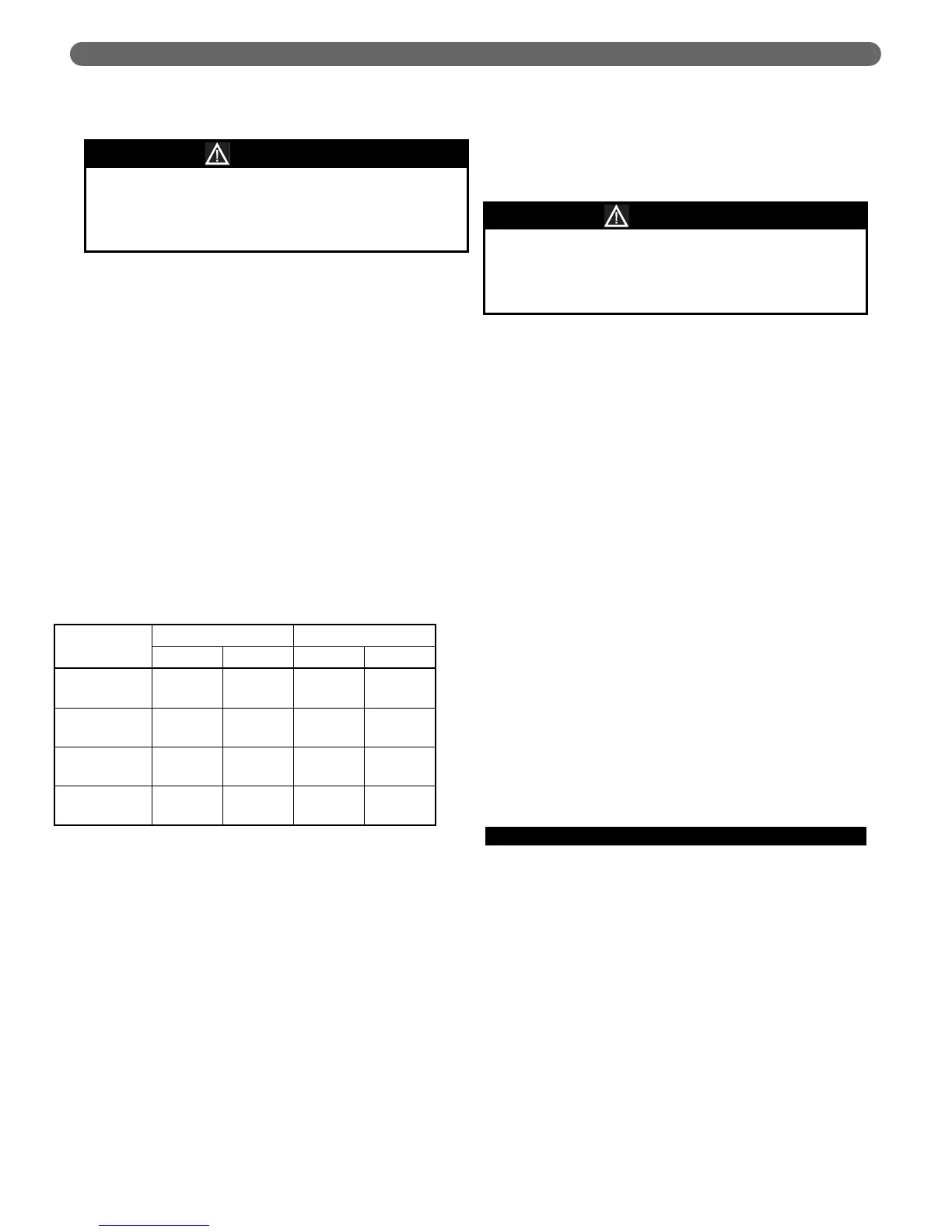
f. Using Table 9.1, determine the appropriate
emissions levels.
g.
If
the
emissions are incorrect, adjust the throttle screw to
correct the combustion. Note that increasing the
throttle adjustment (counterclockwise) will
decrease the O
2
and increase the CO
2
. Decreasing
the throttle will have the opposite effect.
4. Managing burner combustion test at low fire (1%
modulation):
a. Enter the “Installer Menu” and choose “System
Test”. Press “Select”.
b. Use the “” key to scroll down to “Low Power”.
Pressing select will initiate the burner operation.
c. The burner will ignite and, after a short
stabilization period, run at 1%.
d. Using a suitable combustion analyzer (Testo 330-2
or equivalent) determine the exhaust emissions of
the boiler and compare them with Table 9.1.
e. Do not make throttle adjustments in Low Power
system test. If the low fire values are out of
specification, contact your PB Heat representative.
5. Dependent burner combustion test at high fire (100%
modulation).
a. ON THE DEPENDENT BURNER enter the
“Installer Menu” and choose “System Test”.
b. Press select and use the “” key to scroll down to
“High Power”.
c. The burner will ignite and, after a short
stabilization period, run at 100%.
d. Using a suitable combustion analyzer determine
the exhaust emissions of the boiler and compare
them with Table 9.1.
e. Adjust the throttle screw if necessary to correct the
combustion.
6. Dependent burner combustion test at low fire (1%
modulation).
a. ON THE DEPENDENT BURNER, enter the
“Installer Menu” and choose, “System Test”.
b. Press select and use the “” key to scroll down to
“Low Power”.
c. The burner will ignite and, after a short
stabilization period, run at 1%.
d. Using a suitable combustion analyzer (Testo 330-2
or equivalent) determine the exhaust emissions of
the boiler and compare them with Table 9.1.
e. Do not make throttle adjustments in Low Power
system test. If the low fire values are out of
specification, contact your PB Heat representative.
7. Turn “System Test” to “Off” on both burner displays.
G. TEST OPERATING LIMIT
Check that each burner will shut down when the supply
water temperature reaches the control setpoint + 9°F (5°C).
1. On the LCD display for each burner, note the boiler
setpoint by accessing the User Menu, Status Display.
a. Press the “Menu” key on the keypad.
b. Choose “Status” by pressing the “Select Key”.
c. Use the “” and “” key to scroll through the CH
and DHW setpoints (Refer to Appendix B for an
overview of the User Menu).
2. Enter the “Installer Menu” by pressing and holding the
“Select” & “Menu” keys simultaneously for 3 seconds.
a. Use the “” key to scroll down until the cursor
(➞) is at “System Test”.
Be sure that the dependent burner is not running
when performing the combustion test on the
managing burner. If the other blower is running, the
test results will not be valid.
NOTICE
Table 9.1: Recommended Combustion Settings
Natural Gas Propane (LP)
Low Fire High Fire Low Fire High Fire
Carbon
Monoxide (CO)
< 50 ppm < 100 ppm < 50 ppm < 100 ppm
Carbon
Dioxide (CO
2
)
8.8% to
10.0%
8.5% to
9.5%
9.8% to
11.0%
9.5% to
10.5%
Excess
Oxygen (O
2
)
3.4% to
5.4%
4.2% to
6.0%
4.2% to
6.0%
4.9% to
6.5%
Excess Air
17.3% to
31.0%
22.4% to
35.8%
22.4% to
35.8%
27.3% to
40.1%
Be sure that the managing burner is not running
when performing the combustion test on the
dependent burner. If the other blower is running, the
test results will not be valid.
NOTICE
START-UP PROCEDURE



 To Next Page