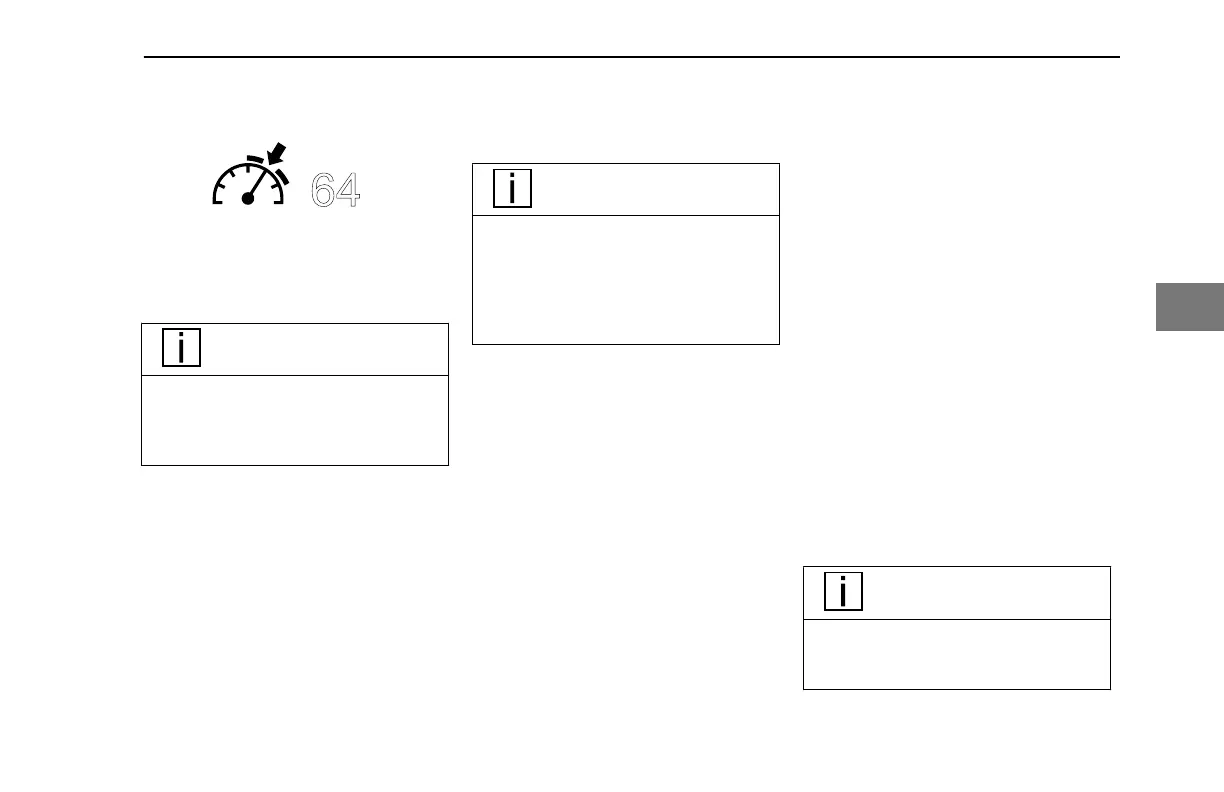
Predictive Cruise Control (Option)
Predictive Cruise Control (PCC) uses
satellite technology and GPS maps to look
at upcoming roads to dynamically calculate
optimal fuel-efficient speed over a given
terrain.
NOTE
There are many other factors that may
influence the overall fuel economy of
your vehicle (i.e., head wind and slope
terrain, etc.).
Predictive Cruise Control operates similarly
to standard cruise control. With PCC,
vehicle speed is maintained without
holding down the accelerator and can be
used at 19 mph (30 km/h) or more.
PCC will also actively recalculate and
change the target cruising speed for best
fuel economy rather than maintaing a
constant set speed. The range of the PCC
target cruise speed is defined by an
overshoot and undershoot speed values.
These values are adjustable by the
operator.
NOTE
Adaptive Cruise Control (ACC) has the
ability to override Eco cruise. This is
because ACC is designed to deceler-
ate the vehicle to match the speed of
traffic in front of the ACC equipped
truck.
PCC Behavior
As the vehicle approaches the top of a hill,
PCC will decrease the vehicle speed (up to
8%below the set speed) to prevent the
vehicle from exceeding the set speed while
traveling downhill. This will result in a
smoother, more fuel efficient ride as the
vehicle approaches the crest of the hill.
Once over the crest, momentum takes over
and the system allows a predetermined
amount of speed over the set speed.
PCC can also activate Neutral Coast (NC)
mode. NC mode disengages the vehicle's
driveline, reducing fuel consumption while
maintaining overall vehicle speed. Once
the vehicle can no longer maintain speed
while coasting, NC is deactivated and the
driveline re-engages.
If the driver has activated one of the
vehicle's retarder systems (Engine,
transmission, or driveline), the vehicle
speed may increase until it reaches the
cruise control set speed plus the retarder
offset. For more information about engine
retarders, see your vehicle Operator's
Manual.
If the vehicle drops outside the speed
range, PCC will accelerate the vehicle
back to the minimum PCC speed.
As the vehicle reaches flat ground after the
hill, PCC will maintain the set-speed until
the crest of the next hill.
If the vehicle is equipped with Adaptive
Cruise Control (ACC) and senses traffic
slowing, it will overrule PCC and slow the
vehicle. This event will cancel PCC only if
the service brakes are required to slow the
vehicle. If the service brakes are not used
by ACC to maintain a safe following
distance, PCC will remain engaged and
resume automatically after the ACC event.
NOTE
PCC was calibrated using a loaded ve-
hicle. Your results may vary, depend-
ing on your vehicle's configuration.
DRIVING - Engine Operations
Y53-6076-1D1 (09/20) 129
4


 To Next Page