PicoQuantGmbH MultiHarpSoftwareV.3.1.0.0
2. Primer on Time–Correlated Single Photon Counting
Inordertomakeuseofapowerfulanalysistoolsuchastime–resolvedfluorescencespectroscopy,onemust
recordthetimedependentintensityoftheemittedlight.Whileinprinciple,onecouldattempttorecordtheinten-
sitydecayofthesignalfromasingleexcitation/emissioncycle,therearepracticalproblemsthatpreventsuch
asimplesolutioninmostcases.Firstofall,thedecaytoberecordedisveryfast.Typicalfluorescencefromor-
ganicfluorophoreslastsonlyafewhundredpicosecondstosomehundrednanoseconds.Inordertorecoverflu-
orescencelifetimesasshortase.g.,500ps,onemustbeabletoresolvetherecordedsignalatleasttosuchan
extent,thattheexponentialdecayisrepresentedbyenoughsamplepointsintime.Thismeansthattherequired
transientrecorderwouldhavetosampleatveryhighrates.Thisishardtoachievewithordinaryelectronictran-
sientrecordersofreasonabledynamicrange.Secondly,thelightavailablemaysimplybetooweaktosample
ananalogintensitydecay.Indeedthesignalmayconsistofjustsinglephotonsperexcitation/emission.Thisis
typicallythecaseforsinglemoleculeexperimentsorworkwithminutesamplevolumes/concentrations.Then
thediscretenatureofthesignalitselfprohibitsanalogsampling.Evenifonehasmorethanjustasinglemole-
culeandsomereservetoincreasetheexcitationpowertoobtainmorefluorescencelight,therewillbelimits,
e.g.duetocollectionopticlosses,spectrallimitsofdetectorsensitivityorphoto–bleachingathigherexcitation
power.ThesolutionisTime–CorrelatedSinglePhotonCounting(TCSPC).Byusingperiodicexcitation(typically
fromalaser)itispossibletoextendthedatacollectionovermultipleexcitation/emissioncyclesandonecan
thenreconstructthesinglecycledecayprofilefromsinglephotoneventscollectedovermanycycles.
TheTCSPCmethodisbasedontherepetitive,preciselytimedregistrationofsinglephotonsofe.g.,afluores-
cencesignal.Thereferenceforthetimingisthecorrespondingexcitationpulse.Asinglephotondetectorsuch
asaPhotoMultiplierTube(PMT)oraSinglePhotonAvalanchePhotodiode(SPAD)isusedtocapturethefluo-
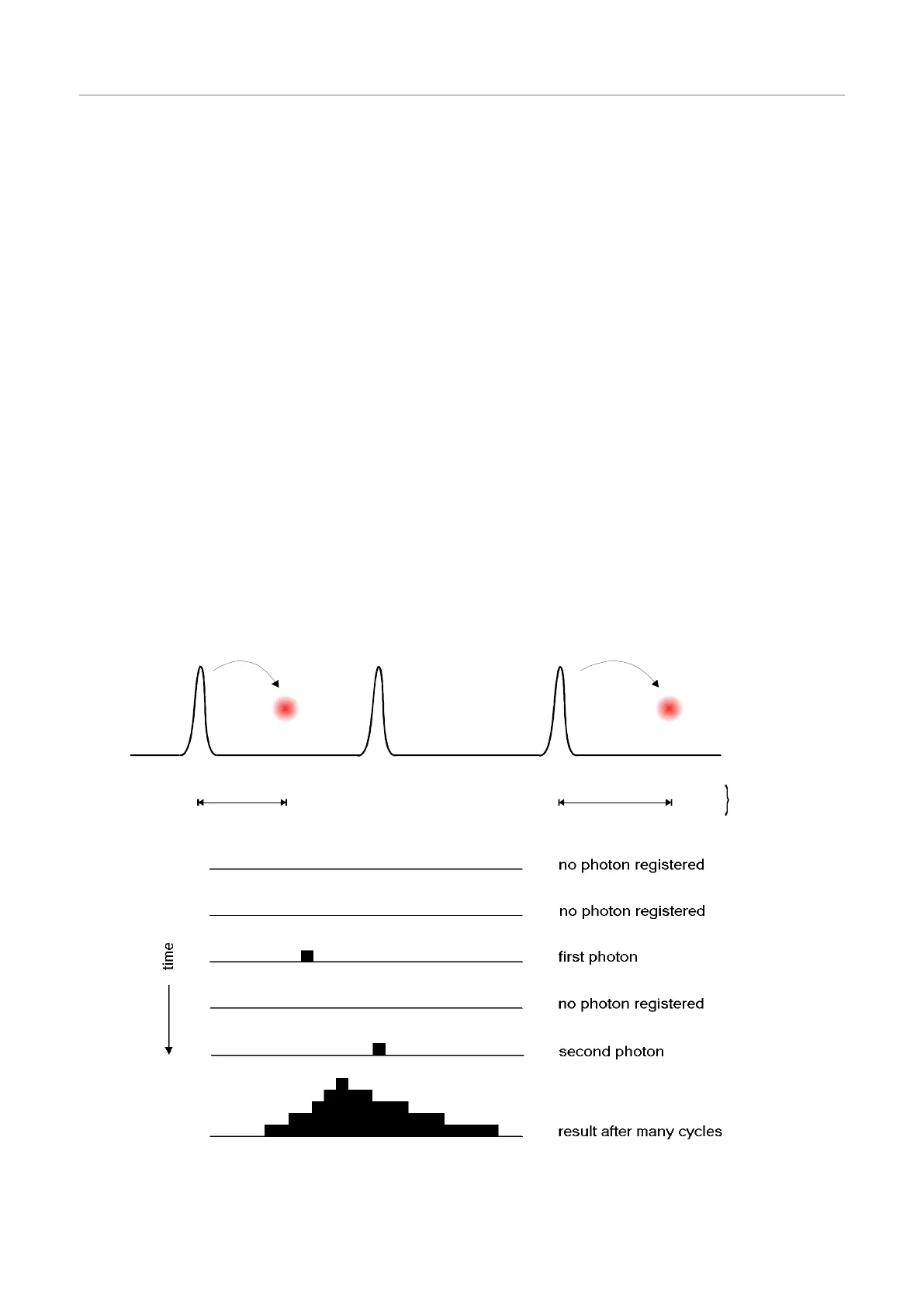
rescencephotons.Providedthattheprobabilityofregisteringmorethanonephotonpercycleislow,thehis-
togramofphotonarrivalspertimebinrepresentsthetimedecayonewouldhaveobtainedfromasingleshot
time–resolvedanalogrecording.Thepreconditionofsinglephotonprobabilitycan(andmust)bemetbyattenu-
atingthelightlevelreachingthesampleifnecessary.Ifthesinglephotonprobabilityconditionismet,therewill
actuallybenophotonsregisteredinmanyoftheexcitationcycles.Thediagramsbelowillustratehowthehis-
togramisformedovermultiplecycles.
Thehistogramiscollectedinablockofmemory,whereonememorycellholdsthephotoncountsforone
correspondingtimebin.Thesetimebinsareoften(historically)referredtoas“timechannels”.Inpractice,the
Page8


 To Next Page