10 EGW05-SWHPEG-20140724
TM
TM
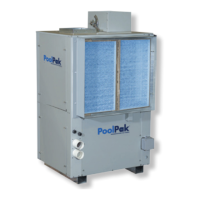
POOLPAK™ OPERATION
The PoolPak™ fan draws in warm, moist air from the pool enclosure. This air passes through the evaporator
(dehumidication) coil and gives up heat energy to the refrigerant which is in a cool, liquid state. This exchange of
energy causes the air temperature to fall below its dew point, resulting in moisture condensation on the evaporator coil.
The moisture formed falls into the unit’s condensate drain pan. After passing through the evaporator coil, the refrigerant
becomes a cool gas.
The refrigerant enters the unit’s compressor, where it is compressed into a hot gas. While in the compressor, the
refrigerant absorbs the energy used to operate the compressor. This hot gas refrigerant then travels either through an air
reheat coil, the pool water condenser or to an optional auxiliary air conditioning condenser, which may be either air or
water cooled. If air heating is called for, the air reheat coil is used. The hot refrigerant exchanges energy with the cooler,
dehumidied air coming from the evaporator coil. This causes the temperature of the air to rise for heating.
If pool water heating is required the hot gas ows into a pool water condenser, where it adds energy to the incoming pool
water. This heats the pool water while the refrigerant is condensed into a warm liquid. If space cooling is called for, the
refrigerant ows to the auxiliary air conditioning condenser bypassing the air reheat coil and pool water condenser and
allowing cool air from the evaporator coil to provide space cooling.
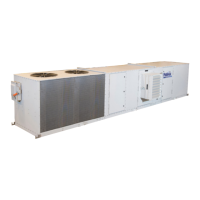
The SR series includes a return fan that allows for economizer operation and up to 100% outside air as shown in the SR
typical schematic, Figure 2-2.
The S series can include a factory mounted exhaust fan (SE), an exhaust and purge fan (SEP) or just an outside air
damper (S). A typical SEP series unit is shown in Figure 2-3. This series does not have a return fan so that the outside
air is limited to about 30% under normal operation.
Standard Items Factory Mounted
• Evaporator (dehumidication) coil
• Air reheat coil (hot gas reheat coil)
• Bottom, top (for indoor installations) or horizontal supply air conguration
• Filters and lter rack
• Air temperature and relative humidity sensor
• Compressor suction and discharge pressure transducers
• Compressor suction temperature
Standard Items Factory Supplied for Field Installation
• Remote Interface Unit (RIU)
• Cold surface temperature sensor
• Outside air temperature and humidity sensor
• Pool Water Temperature Sensor
System Options
• Remote air-cooled condenser for space air conditioning
• Flywheel air conditioning (SR and SEP)
• Water-cooled condenser
• Capability of introducing outside air
• Economizer control (SR and SEP)
• Network multiple units
• Remote monitoring via Internet
• Weatherproong for outdoor installation



 To Next Page
 Loading...