36
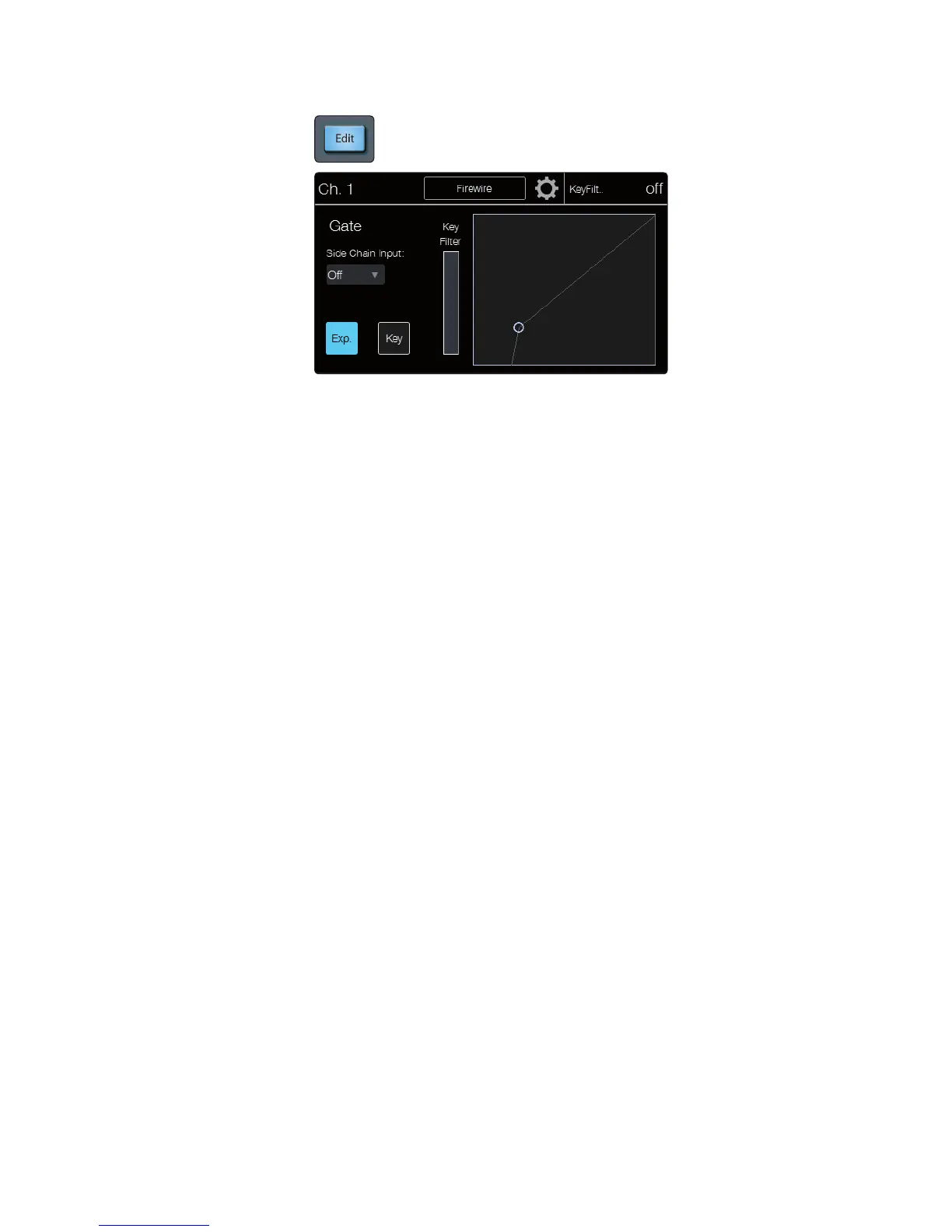
Gate Edit opens the Gate view on the touchscreen.
Exp turns the noise gate into an expander. The StudioLive RM allows
you to choose between an expander and a noise gate for each
channel or output. By default, the expander will be enabled.
Power User Tip: In practice, expanders and noise gates are used almost
identically. The main difference is that an expander is smoother and more
gradual, so that it is easier to set the attack and release times correctly.
Key Listen enables Key Listen in the Solo bus. The button will illuminate
to indicate that Key Listen is active. When Key Listen is enabled,
and the selected channel is soloed, you can use the Headphone or
Monitor outputs to monitor what the gate key filter is removing.
Key Filter sets the frequency at which the gate will open. Setting a specific
frequency, in addition to a specific decibel level, provides more sonic
shaping. The key filter can be triggered by the selected channel or bus’s
signal or by side chaining a channel and using its signal as the source.
Power User Tip: A properly set key filter on a gate can greatly improve the overall
sound quality of a mix. For example, if you are inserting a gate on a snare-drum
mic, you may get enough bleed from the kick drum to open the gate. This is
where a key filter can come in handy. By setting the key filter to remove some of
those low frequencies, the gate won’t be as apt to open for the kick drum.
Side Chain Input allows you to select a different channel as the trigger
source for the gate’s key filter. Side chaining has many uses. You can use a side
chained key filter to tighten up a rhythm section by side chaining the kick drum
channel to the bass channel and setting the gate to open at the frequency of
the kick drum. This, combined with a fast attack and release, will make your
rhythm section more cohesive. Increase the release time to loosen the feel.
Another great use for a side chain is as an effect in electronica production. Try side
chaining a drum loop to a sustained source, like pads or strings. By doing this,
every time a drum hit triggers the key filter, your sustained source will be heard.
Between hits, this source will be silenced. Playing with the attack and release will
transform this effect from a rhythmic pulse all the way to a chopped-up stutter.





 To Next Page