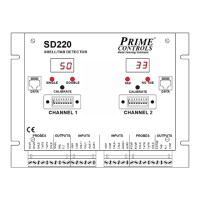
DS600 Non-Ferrous Double Sheet Detector
This document is confidential and proprietary. No part of this document may be disclosed in any manner
to a third party without the prior written consent of Prime Controls, Inc.
202177 25 Revision M
6 GAUGING SPECIFICATIONS
Aluminum:
Gauge Thickness Range: 0.001” to 0.150”
25.4µm to 3.81mm
Probe to Sample Gap: Direct contact to 0.500”
Direct contact to 12.7mm
300 Series Stainless Steel:
Gauge Thickness Range: 0.001” to 0.165”
25.4µm to 4.19mm
Probe to Sample Gap: Direct contact to 0.500”
Direct contact to 12.7mm
Graphs 1 and 2 show the expected difference in displayed gauge value between single and
double thicknesses of aluminum and 300 series stainless steel samples, respectively, following
two-point calibration. This information is valid for probe gaps (distance from probe face to gauge
sample) ranging from no gap up to 0.5 inches (12.7mm). In operation, the gap distance used
during gauging must be the same as the distance used during calibration.
A displayed difference of at least 15 counts between the single and double condition is ideal and
provides for reliable single/double detection over minor variations in material properties, probe
alignment, gap distance variations, and material temperature. Should this difference be less
than 15 counts, such as when gauging materials thicker than 0.125”, take extra care to insure
consistent probe gap distance, probe to material alignment, and minimize temperature
variations to less than 20°C/36°F in the gauged material between calibration and operation.
For thicker samples where the single/double difference drops to as low as 10 counts, reliable
double detection can still be realized if external variables such as temperature and probe gap
are more tightly controlled.
For reliable double detection, especially with thicker aluminum materials, the temperature of the
material during operation should not vary substantially from the temperature of the material
during calibration.



 To Next Page