24
advanced methods that traditionally require complex and often expensive lab testing
procedures.
Low range, direct reading chlorine dioxide, 0 to 35.0 ppm
The maximum absorption bank of aqueous chlorine dioxide is around 360nm. The
SP-910 has a 365nm UV LED and can be used to directly measure chlorine dioxide.
It offers a much lower detection limit (0.2 ppm) than direct methods available from
other portable colorimeters having only light sources in the visible range.
Select ClO2D in the method selection page and carry out the following steps to
measure chlorine dioxide:
1. Place a vial filled with deionized water into the vial compartment and press the
ZERO button to zero the SP-910.
2. Discard the deionized water and fill the same vial with the sample. Place the
vial into the vial compartment and press READ button to read. The measured
chlorine dioxide concentration will be displayed in the top of the method page.
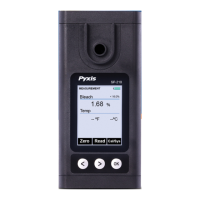
Direct Reading Bleach Percent Method, 0 to 15%
The SP-910 has a 365nm UV LED and other deep blue LEDs that can be used to
directly measure bleach concentration in the range of 0 to 15%. No reagent is
required for the method and the displayed result is the sodium hypochlorite
concentration in percentage.
Select BLCH in the method selection page and carry out the following steps to
measure chlorine dioxide:
1. Place a vial filled with deionized water into the vial compartment and press the
ZERO button to zero the SP-910.
2. Discard the deionized water and fill the same vial with the bleach sample.
Place the vial into the vial compartment and press READ button to read. The
measured bleach concentration will be displayed in the top of the method
page.
ChemTreat PolyTrak Method
1. Press Icon COLOR to launch the colorimetric method page. Select PTrk and
press the OK key to start the PolyTrk method.
2. Fill a sample vial to the 10 ml mark.
3. Add 0.5 ml Polymer Conditioning Reagent #1 to the sample and tightly cap the
sample vial. Swirl the sample vial to mix.
4. Place the sample vial to the sample compartment. Press the ZERO button.
5. Move the sample vial out. Add 0.5 ml Polymer Reactant Reagent #2 first, and
then add one level of scoop of Reagent #3 (Polymer Powder Precipitant).
6. Press TMR1 to start the 3 minute timer.


 To Next Page