RAL STAINER
17
RAL STAINER User guide
7.2 INSTALLATION ENVIRONMENT
r4UPSFUIFJOTUSVNFOUJOBMPDBUJPOXJUIJOUIFFOWJSPONFOUBMPQFSBUJOHMJNJUT
r5IFBQQMJBODFNVTUCFQMBDFEPOBTUBCMFGMBUBOEDMFBOUBCMF"WPJETIPDLTBOEWJCSBUJPOT
r$POTJEFSJOHUIFXFJHIUPGUIF3"-4UBJOFSLHVTFBTVGGJDJFOUMZTPMJEUBCMF
r1MBDFUIFBQQMJBODFDMPTFUPBNBJOTQPXFSPVUMFUBOEBSVOOJOHXBUFSUBQJGZPVIBWFTFMFDUFEUIFSVOOJOH
water connection option.
r$POTJEFSJOHUIFTJ[FPGUIF3"-4UBJOFSDN)DNQMBOUPVTFBTQBDFPGYDNGPS
the appliance installation, use and maintenance.
Avoid placing the appliance behind a window in order to limit the heating of the reagents under the
sun's rays.
If the appliance has been stored at temperatures outside the environmental usage limits, it must
remain at room temperature for 1 hour before powering up.
Avoid using the appliance in close proximity to a chemical reagent storage area or in an atmosphere
containing emanations of dangerous gases.
Make sure the on/off switch and the mains power
outlet remain accessible.
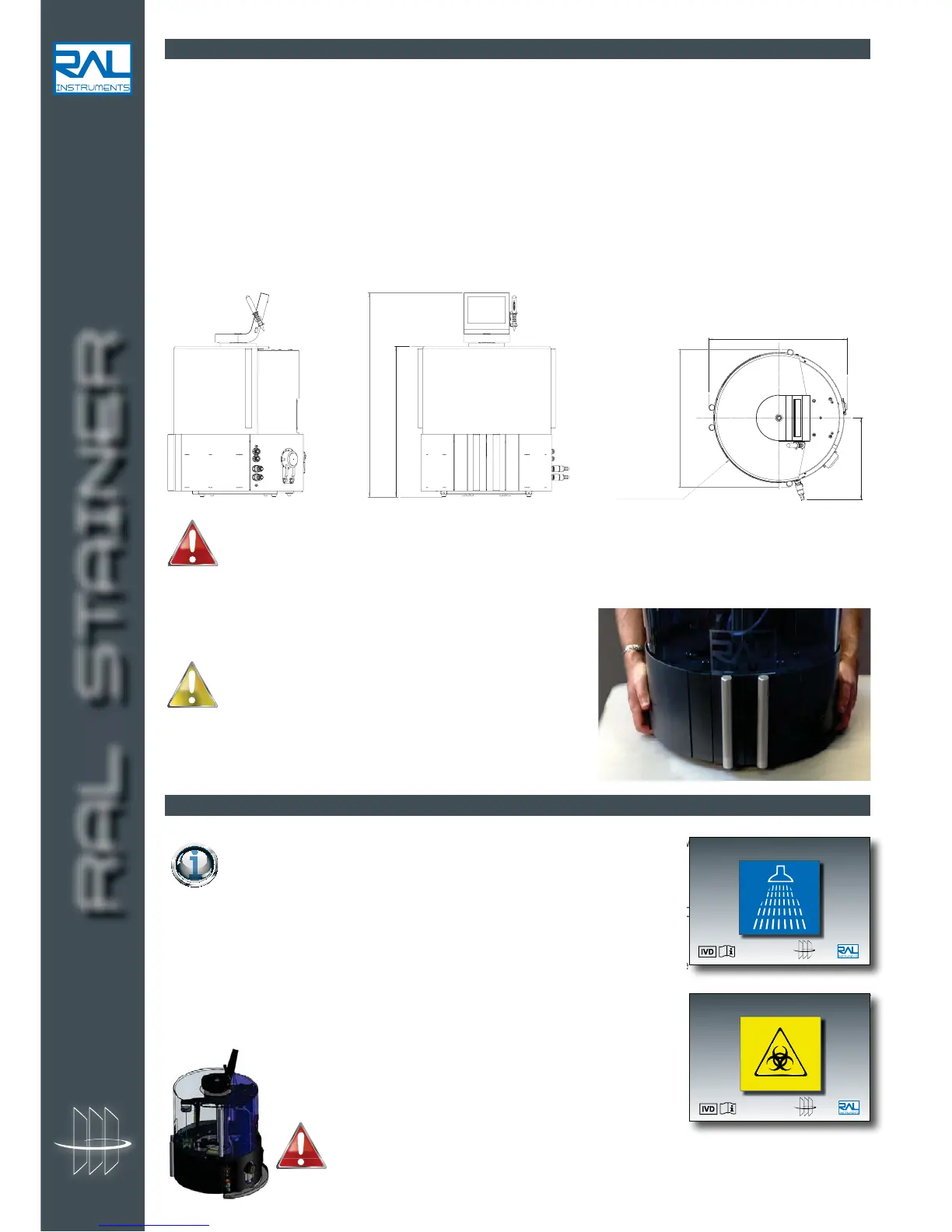
If you have to move the instrument, handle it carefully
by lifting it up by the bottom, like showing the opposite
picture
7.3 SETTING UP
Place the RAL Stainer on a flat and stable surface, in a sufficiently wide space, as described in
section 7.2.
Place the two supplied containers beneath the table.
To eliminate any risk of error in the use of the appliance, mark each supplied container with the
supplied labels in order to assign a function to each one: Effluent Container and Rinsing liquid
container.
The standard containers supplied with the RAL Stainer can be replaced by autoclave
compatible containers. Contact your RAL Instruments representative.
The supplied containers can also be replaced using your usual containers. However take care over the sealing of
the container as it is not certain that the supplied cover fits your container.
Rayon vrai
200 mm
424 mm
250 mm
421 mm
624 mm
460 mm
Réf.: 12094-V04 Rév.: 09/2013
RAL STAINER
Rinse label
Waste label
Slide the reservoir tank below the machine on the back until
it is blocked.
The reservoir tank must always be empty. If it is full,
because of the flammability hazard of some
products, remove it by sliding it gently, then empty it
and call your service engineer.


 To Next Page