6
5. HANDLING AND RIGGING
Good handling and rigging practices must be followed
to protect units from damage. Having proper handling
equipment at the job site is most important and it should be
planned.
In the US, follow OSHA 1926.251 standard for Rigging
Equipment and Material Handling.
In Canada, follow your province’s requirements for
hoisting and rigging.
Improper rigging of a load or a rigging failure
can expose riggers and other workers nearby to
a variety of potential hazards.
Always lift units secured to the fork lift to
prevent it from slipping off.
Your unit is shipped crated on a pallet. This prevents any
damage to the drain pan underneath. To fasten the unit to
the ceiling, it is recommended to leave it on the pallet in
order to securely lift it up with a motorized or hand-operated
forklift. Do not use a forklift against sheet metal panels or
coils. Make sure forks extend the entire length of the unit
and against a structural part or frame.
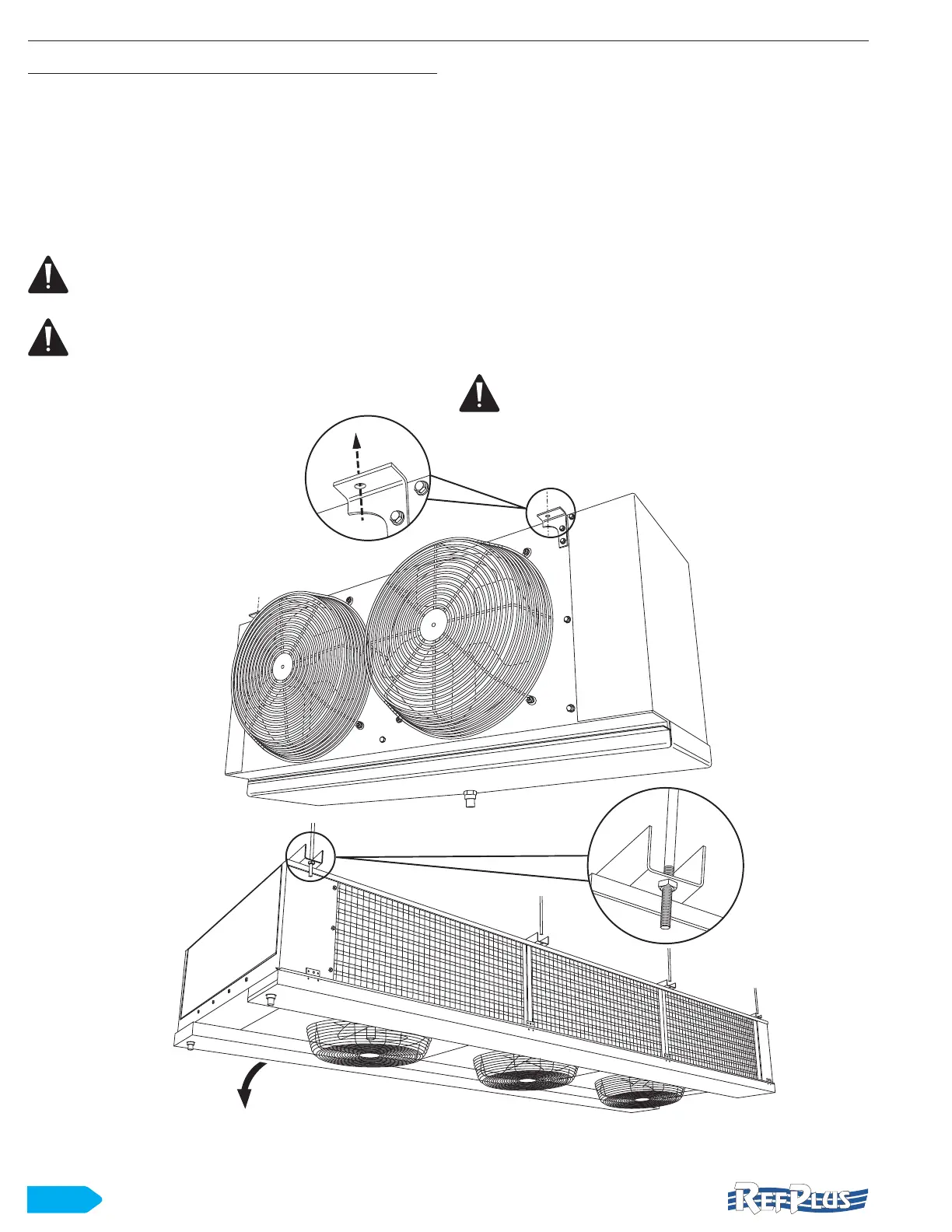
On EK models, use the provided support brackets to bolt the
unit to the ceiling, as shown. EM, EJ, LM, LJ and DJ models
must be mounted with steel rod hangers, as shown in Figure
1. Refer to section 6.3 MOUNTING for more information.
LM, LJ and DJ units should be titled so that drain ttings are
on the lower side, to allow proper draining.
This procedure is for reference only. Rigging and handling
procedures will vary from one machine to another and from
one site to another.
Equipment handling and rigging should be
carried out by a certied operator.
LJ-DJ
EK
LM, LJ & DJ UNITS MUST BE TILTED
TO ALLOW PROPER DRAINING
Figure 1 Securing unit to ceiling
HANDLING AND RIGGING


 To Next Page