7
RPB-IOM (06-22) 131782-B
Hazards of Chlorine
NOTE: Remember, chlorine is heavier than air. This fact should be kept in mind when determining
the installation location of heaters and building exhaust systems.
The presence of chlorine vapors in the combustion air of heating equipment presents a potential corrosion hazard.
Chlorine, found usually in the form of Freon or degreaser vapors, when exposed to flame will precipitate from the
compound and form a solution with any condensation present in the heat exchanger or associated parts. The result
is hydrochloric acid, which readily attacks all metals, including 300 grade stainless steel. Care should be taken to
separate these vapors from the combustion process. This may be done by wise location of the unit vent terminal
and combustion air inlet with regard to exhausters or prevailing wind directions.
Combustion Air Requirements
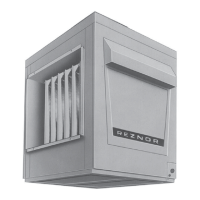
The combustion air and flue gas openings are carefully designed screened openings located on the side of the
unit just above the control access panel. Location of the flue opening directly above the air intakes discourages
recirculation of combustion products.
Curb Cap Base
Outdoor systems are equipped with a load bearing curb cap which forms an integral part of the unit. This curb cap
has welded joints and has a skirt that fits over a roof curb to provide a weatherproof installation. Four holes are
provided at the curb cap corners for lifting the unit. These holes do not interfere with unit weatherproofing. The curb
cap is not designed to be placed directly on the roof surface. The system may be mounted on an optional roof curb
purchased with the unit, a field-supplied roof curb, or field-supplied supports. If the system has a downturn plenum
and/or a bottom return air opening, a roof curb is recommended to provide a weatherproof installation as well as
more workable clearances for ductwork.
INSTALLATION
NOTE: Before installation, make preparations for necessary supplies, tools, and manpower.
Uncrating/Unpacking
• This furnace was test-operated and inspected at the factory prior to crating and was in operating condition. If
the furnace has incurred any damage in shipment, document the damage with the transporting agency and
immediately contact an authorized Reznor
®
distributor. If you are an authorized Distributor, follow the FOB freight
policy procedures.
• Check the rating plate for the gas specifications and electrical characteristics of the furnace to ensure that they
are compatible with the gas and electric supplies at the installation site.
Shipped-Separate Parts
• Check to see if there are any field-installed options that need to be connected to the furnace prior to installation.
• Shipped-separate options could include a roof curb, a screened outside air hood, a gas shutoff valve, a thermostat,
a different control switch, a remote console, a manual fan switch, a vertical vent terminal, a gas supply regulator,
and/or a disconnect switch.
• If the unit is equipped with an optional evaporative cooling module, a water hammer arrestor or fill and drain or
freeze kit could be shipped separately.
• Some gas control options will have parts either shipped loose with the heater or shipped separately. If the unit is
equipped with any of the gas control options listed in Table 5, ensure that these parts are available at the job site.



 To Next Page