Theory of operation
CGS-240 Manual 6/15/2021
Page 6 of 148
2.2 COMBINED TWO-PRESSURE AND TWO-TEMPERATURE PRINCIPLE
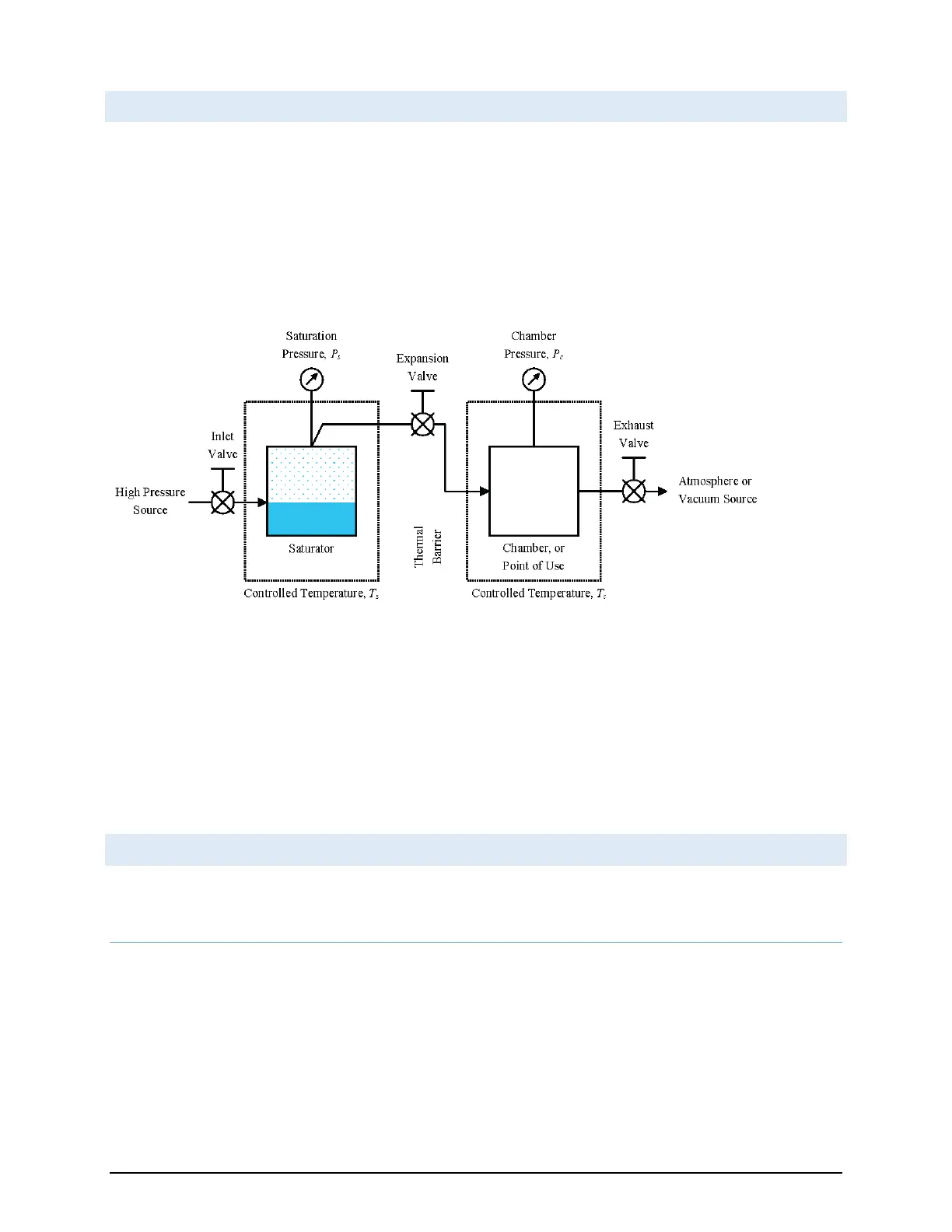
The two-pressure principle described above can be combined with a two-temperature principle to form a
combined Two-Pressure, Two-Temperature system which exploits the benefits of both architectures. In addition to
measurement of saturation and chamber pressures (as in the case of a two-pressure system), a combined two-
pressure two-temperature system also relies on measurement of saturation and chamber temperatures to fully
determine the resulting humidity. A combined two-pressure two-temperature system is shown in elemental
schematic form in Figure 2—Simplified schematic diagram of the two-pressure, two-temperature principle where Ts
≠Tc and Ps ≠Pc.
Figure 2—Simplified schematic diagram of the two-pressure, two-temperature principle where T
s
T
c
and P
s
P
c
.
Here, the temperature of saturation, Ts, and temperature of the chamber, Tc, may be controlled independently of
each other if desired. By allowing the saturator and chamber to operate at different temperatures from each
other, a wider variety of humidity values may be generated with reduced requirements on the height of saturation
pressure required. Regardless of whether the saturator and chamber are operated at the same temperature, or at
temperatures different from each other, all humidity calculations rely on the two pressures (Ps and Pc) and on the
two temperatures (Ts and Tc).
2.3 COMMON DEFINING EQUATIONS
The following equations of R. Hardy for saturation vapor pressure, enhancement factor, and temperature (from
saturation vapor pressure) are common and fundamental to most of the humidity calculations presented here.
2.3.1 SATURATION VAPOR PRESSURE OVER WATER
Saturation vapor pressure over water at a given ITS-90 temperature in the range –100 °C to +100 °C is defined by
the formula



 To Next Page