Troubleshoot/Maintenance
CGS-240 Manual 6/15/2021
Page 77 of 148
For instance, if it is low, add fluid (with a concentration of approximately 30-50% propylene glycol in water) to the
tank. If the level is above the maximum, drain out the excess amount to bring it within the minimum and maximum
marks. (Refer to Figure 9.13 for location of the drain port.)
7.1.3 MONTHLY
The humidity generator requires monthly maintenance actions, which are listed in the sections below.
CONDENSOR EXHAUST FAN
The refrigeration system requires adequate air flow to work properly. The condenser and fan assembly can get
clogged with dust and dirt. It should be cleaned with either compressed air or a vacuum cleaner. To perform
cleaning, remove the upper rear panel and with either compressed air or a vacuum, clean the condenser grill and
fan area to remove the debris.
LOWER CABINET FAN
The lower cabinet fan requires periodic cleaning to maintain performance. To clean the cabinet fan, remove the
exterior vent cover then, using either compressed air or a vacuum, blow out any collected dust and debris. The
vent cover should also be cleaned/washed prior to re-attachment.
7.1.4 QUARTERLY
The humidity generator requires quarterly maintenance actions, which are listed in the sections below.
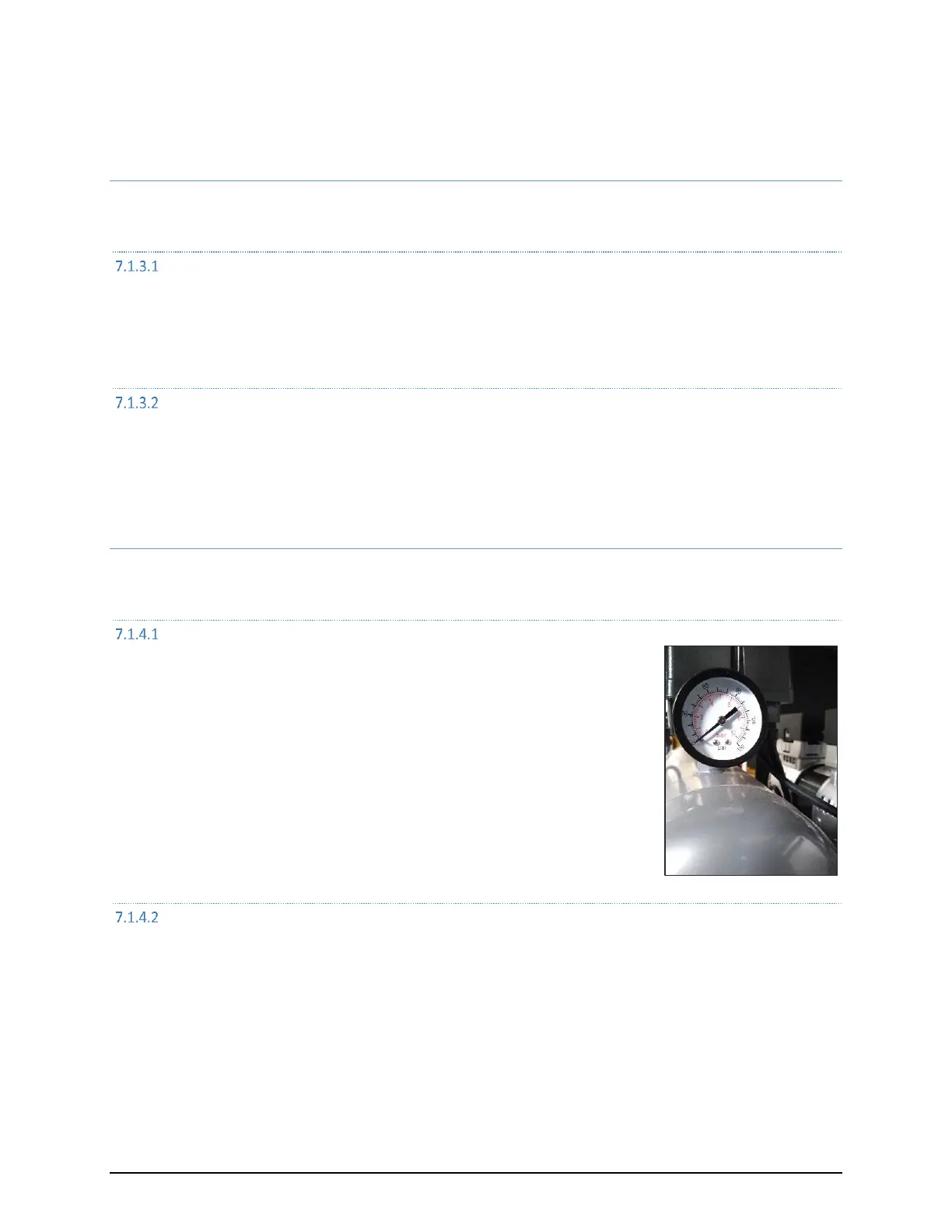
AIR COMPRESSOR TEST
As with all mechanical systems, the air compressor may wear out over time, limiting
its performance. To test its operation, it is important to run it at a known flow rate
and make sure it maintains its pressure requirement. To perform this test, set the
generator for operation at 20 l/min and 25% RH at 25°C. Press the run button to
ensure the generator is operating. Once the system is stabilized and it is flowing
approximately 20 l/min, check the output of the PSI pressure indicator on the front
panel, or the pressure gauge on the pressure regulator. It should be approximately
50 - 60 psi.
If it is not at least 50 psi, the air compressor may require service or replacement.
PRESSURE TRANSDUCER ALIGNMENT CHECK
The pressure transducer alignment test is to verify that the two pressure transducers have not drifted too far apart
from each other. This test is only to be performed at approximately ambient atmospheric pressure. To perform the
test, ensure the system is not generating, but is powered on. Looking at the front panel indications of low range
pressure and high range pressure, compare the two readings. If they differ by more than 1 psi, the pressure
transducer calibration should be performed. If they are within 1 psi, no further action is required, as the system
will automatically correct for this.


 To Next Page