INTERNAL PROTECTIVE DEVICES OF THE UPS
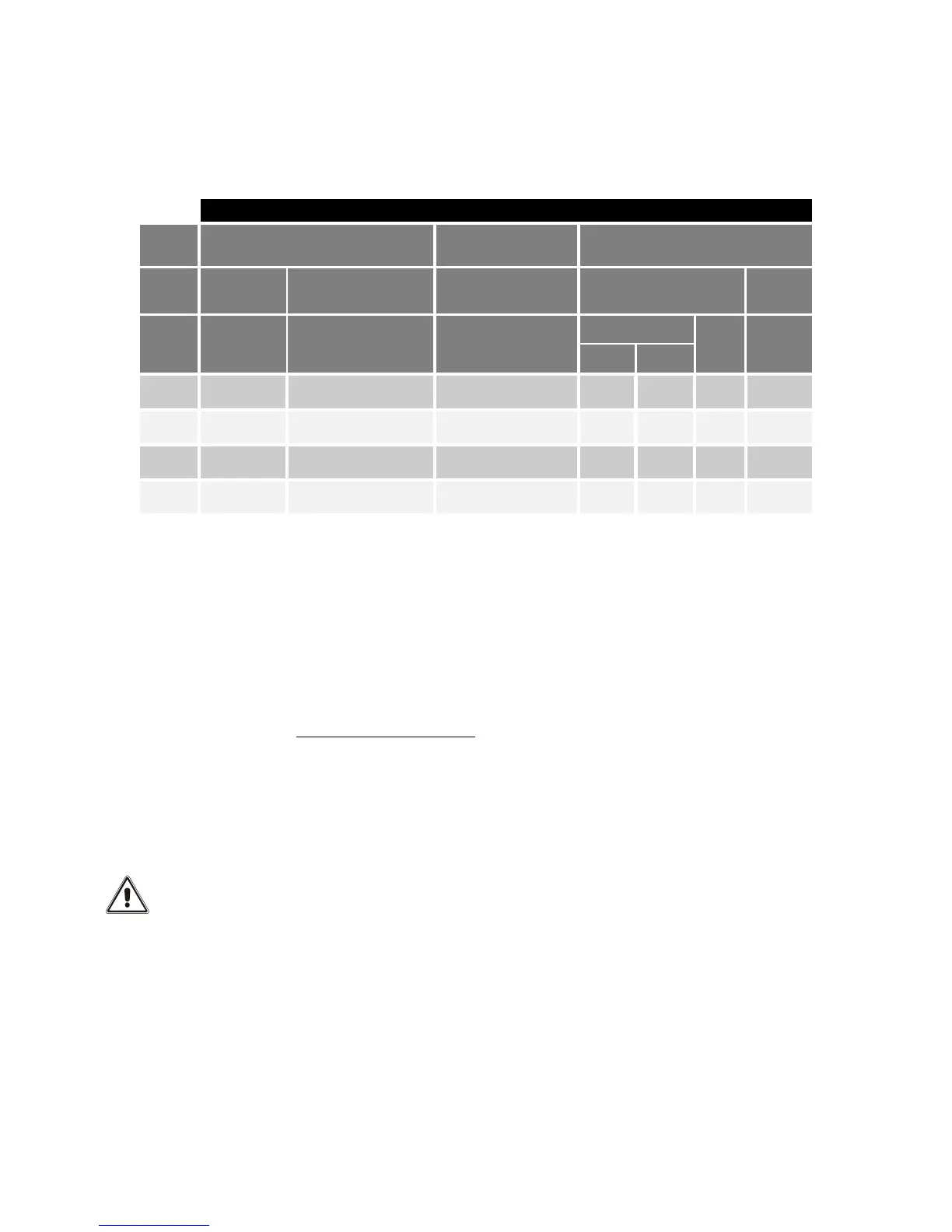
The table below shows the sizes of the isolators of the UPS and the sizes of the battery fuses (SWBATT): these devices are
accessible from the front of the UPS.
There are also indications about the internal fuses (not accessible) protecting the input and output lines and the maximum input
and rated output currents. To install the UPS, see the block diagram in the “USE” section of the “Description” paragraph.
Fuses are to be replaced with ones of the same size and the characteristics indicated in the table below.
Isolators and internal protective devices
UPS output /
Maintenance / Separate
bypass
SWOUT / SWMB /
SWBYP (optional)
* The max. input current refers to a rated load (PF = 0.8) and an input voltage of 346V (200V if P+N input) and a battery
charger charged with 4A.
** In versions with additional internal battery chargers (optional), the maximum input current on lines L2 and L3 must be
increased by 7A.
*** Valid in by pass mode and three phase input only. In normal mode L1=L2/L3.
SHORT CIRCUIT
If a failure occurs on the load, the UPS protects itself by limiting the value and duration of the current output (short-circuit
current). These values also depend on the operating status of the UPS at the time of the failure; there are two different cases:
UPS in NORMAL OPERATION: the load is switched instantaneously to the bypass line (I
2
t=25000A
2
s): the input line is
connected to the output without any internal protection (blocked after t>0.5s)
UPS in BATTERY OPERATION: the UPS protects itself by providing a current equivalent to about 1.5 times the rated
current for 0.5s and turns itself off after this time has elapsed
BACKFEED
The UPS has internal protection against backfeed through metal separating devices.
There is an output on the relay board (optional) for activating a releasing device to be installed upstream from the UPS.
The UPS has an internal device (redundant bypass power supply) which, when a failure occurs on the machine,
activates the bypass automatically, thus keeping the load powered without any internal protection and without any
limitation to the power supplied to the load.
Under these emergency conditions, any disturbance present on the input line will affect the load.
See also the “USE” section of the “Redundant Auxiliary Power Supply for Automatic Bypass” paragraph.



 To Next Page