August 2012
22
Quick Start Guide
7. If the enclosure is made of an alloy or plastic material, the following precautions
must be observed:
a. The metallic alloy used for the enclosure material may be at the accessible
surface of this equipment; in the event of rare accidents, ignition sources due to
impact and friction sparks could occur
.
b. Under certain extreme circumstances, the non-metallic parts incorporated in
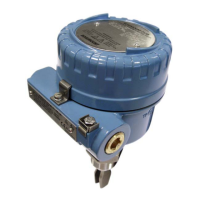
the enclosure of the Rosemount 2120 may generate an ignition-capable level of
electrostatic charge. Therefore, when they are used for applications that
specifically require group II equipment, the Rosemount 2120 shall not be
installed in a location where the external conditions are conducive to the
build-up of electrostatic charge on such surfaces. Additionally, the Rosemount
2120 shall only be cleaned with a damp cloth.
8. Technical Data:
a. I.S. Approval: Class 1 Division 1 Groups ABC and D, Class 1 Zone 0 AEx ia IIC
Non-Incendive Approval: Class 1 Division 2 Groups ABC and D
T5 (Ta = -40 °F to +176 °F [-40 °C to +80 °C])
T4 (Ta = -40 °F to +239 °F [-40 °C to +115 °C])
T3 (Ta = -40 °F to +302 °F [-40 °C to +150 °C])
Ta = the higher of the process or ambient temperature.
b. Input parameters:
2120 with NAMUR electronics:
Vmax=15 V, Imax=32 mA, Pi=0.1 W, Ci=211 nF, Li=0.06 mH
2120 with 8/16 mA electronics:
Vmax=30 V, Imax=93 mA, Pi=0.65 W, Ci=12 nF, Li=0.035 mH
c. Temperature:
Process (Tp) -40 °C to 150 °C
External (Ta) -40 °C to +80 °C
(up to Tp=80 °C, reducing linearly to 50 °C at Tp=150 °C)
d. Materials:
See the 2120 Product Data Sheet 00813-0100-4030 or
Reference Manual 00809-0100-4030.





 To Next Page